Why Experience Matters More Than Headcount in High-Risk Delivery

How execution judgement, authority, and delivery maturity outweigh team size in complex enterprise programmes

January 29, 2026 5 mins Read Insight

Why High-Risk Delivery Environments Expose the Limits of Headcount Growth

How complexity, interdependencies, and irreversible decisions reduce the value of simply adding more people

In high-risk delivery environments, pressure often manifests as urgency. Timelines tighten, dependencies multiply, and tolerance for failure narrows. In response, organisations frequently default to the most visible lever available: increasing headcount. More engineers, more analysts, more project managers are added in the belief that capacity will translate into momentum.

However, high-risk delivery does not scale linearly with team size. These environments are defined less by volume of work and more by the quality of decisions being made under uncertainty. Architectural choices, sequencing decisions, and trade-offs between speed, stability, and compliance tend to be irreversible or expensive to unwind. In such contexts, the marginal value of additional people diminishes quickly if they are not equipped to exercise judgement at the right moments.

As programmes grow, complexity increases faster than productivity. Coordination overhead rises, communication paths multiply, and dependencies become harder to manage. Without sufficient experience embedded close to execution, teams spend more time aligning, escalating, and reworking decisions than delivering outcomes. This is where headcount becomes a false signal of progress.

How Headcount Expansion Quietly Increases Delivery Risk

Why coordination overhead, diluted authority, and slower decision cycles emerge as teams scale under pressure

Adding people into an already complex delivery environment introduces new interfaces that must be managed. Each additional role requires clarity on ownership, authority, and decision rights. When these are not explicitly redesigned, ambiguity grows. Responsibility becomes shared in theory but fragmented in practice.

In many high-risk programmes, authority does not scale with team size. Decision-making remains centralised or distributed across multiple governance layers, creating latency at precisely the moments when speed and judgement matter most. Teams become adept at escalation rather than resolution. Work slows not because people are idle, but because decisions are deferred.

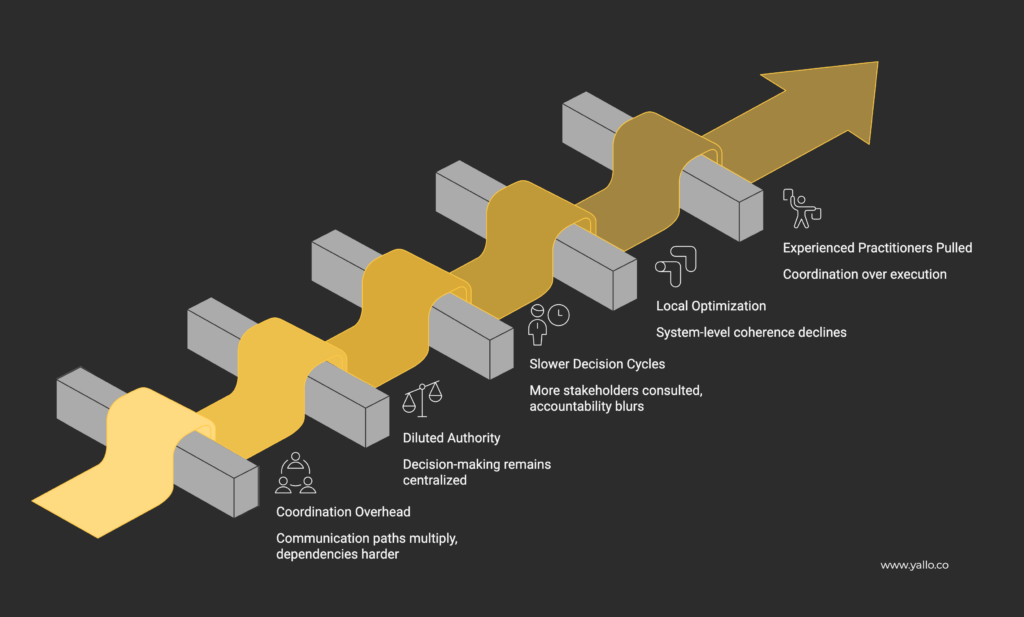
Diagram illustrating how increasing headcount in high-risk delivery environments leads to coordination overhead, diluted authority, slower decision cycles, local optimisation, and experienced practitioners shifting from execution to coordination.
As teams scale in high-risk delivery environments, coordination overhead and decision latency grow faster than execution capacity.
The visual highlights how delivery risk accumulates step by step as teams expand without a corresponding redesign of authority and ownership. Communication paths multiply, decision-making remains centralised, and accountability blurs across an increasing number of stakeholders. Over time, experienced practitioners are diverted from solving complex problems into managing interfaces and dependencies. This dynamic explains why programmes with large, well-staffed teams can still struggle to move decisively, and why experience embedded close to execution consistently delivers more value than additional headcount alone.

Several risk patterns tend to emerge as headcount increases:

  • Decision cycles lengthen as more stakeholders are consulted

  • Accountability blurs across overlapping roles and functions

  • Local optimisation increases, while system-level coherence declines

  • Experienced practitioners are pulled into coordination rather than execution

Ironically, the very act of adding people to reduce risk often amplifies it. Delivery becomes fragile, reliant on consensus rather than clarity, and increasingly sensitive to delays or misalignment.
What Experience Really Means in High-Risk Delivery Contexts

Why judgement, pattern recognition, and decision authority matter more than role coverage or functional depth

Experience in high-risk delivery is frequently misunderstood. It is not simply tenure, certifications, or familiarity with a particular technology or methodology. What matters is the ability to recognise patterns, anticipate second-order effects, and make informed trade-offs under pressure.

Experienced practitioners bring more than knowledge; they bring judgement. They understand which decisions are reversible and which are not. They know when to slow down to avoid downstream failure and when to move decisively to preserve momentum. Crucially, they are comfortable operating in ambiguity and taking accountability for outcomes rather than activities.

This form of experience only creates value when it is paired with authority. When experienced individuals are constrained by rigid role definitions or distant governance, their impact is muted. They become advisors rather than owners, observers rather than decision-makers. In such environments, experience exists, but it does not shape delivery.

Why Organisations Confuse Capacity with Capability

Many organisations measure delivery readiness through capacity metrics: team size, utilisation rates, or role coverage. These indicators are easy to quantify but poor predictors of success in high-risk environments. Capability, by contrast, is harder to observe. It resides in how teams make decisions, resolve conflict, and absorb uncertainty.

Traditional staffing models reinforce this confusion. Roles are defined narrowly, recruitment focuses on filling gaps quickly, and success is framed as having “enough people” in place. What is rarely examined is whether the team, as designed, can actually govern complexity and deliver outcomes coherently.As a result, programmes appear well-resourced while remaining executionally weak. Delivery risk accumulates quietly until it surfaces through delays, rework, or failures that seem sudden but are structurally inevitable.

Organisations that perform well in high-risk delivery environments take a different approach. Instead of scaling headcount reactively, they design teams deliberately around outcomes, decision rights, and execution maturity. Experience is positioned where it can shape delivery, not just advise it. This means embedding senior practitioners close to execution, clarifying authority boundaries, and aligning accountability end to end. Team size becomes a secondary consideration. What matters is whether the right judgement is available at the right time, and whether individuals are empowered to act on it.

This is the perspective reflected in Yallo’s work with complex enterprise programmes, where delivery risk is addressed through capability-led team design rather than volume-based staffing. Across Yallo’s case studies and insights, a consistent pattern emerges: high-risk delivery stabilises not when teams grow larger, but when experience, authority, and ownership are aligned to the realities of execution.

Recent Post

How We Serve

TS/EA as a Service

Empowering Business Transformation with Expert Technology Strategy

Talent in a Box

Scaling Innovation with World-Class Talent

Managed IT COE

Delivering Seamless IT Operations at Scale

Leave a Comment

Your email address will not be published. Required fields are marked *

Scroll to Top