How TA Teams Can Improve Fill Rates in Specialist Hiring

Practical lessons from embedded TA teams on improving fill rates and stabilising specialist hiring delivery

February 27, 2026 5 mins Read Insight

The Structural Problem Behind Specialist Hiring Bottlenecks

Why specialist hiring slows down even in well-funded programmes

Specialist hiring has become one of the most persistent bottlenecks within modern talent acquisition functions. Across enterprise environments, particularly in technology, data, platform engineering, cybersecurity, and architecture roles, demand consistently outpaces available capability. Market data from LinkedIn hiring trends and global workforce reports continue to show sustained shortages in advanced digital and technical skill sets. Even well-funded programmes with established vendor ecosystems often struggle to maintain consistent fill rates for specialist roles. The challenge is rarely budget alone. It is structural.

At its core, specialist hiring differs fundamentally from generalist recruitment. These roles often require deep domain experience, exposure to specific platforms or environments, and contextual understanding of complex delivery ecosystems. Traditional sourcing approaches that work for volume hiring do not translate effectively to niche capability segments. When job descriptions are broad, role calibration is inconsistent, or hiring managers shift expectations mid-process, pipelines stall quickly. Time to shortlist expands, interview loops lengthen, and qualified candidates disengage. The bottleneck is not simply about candidate scarcity, but about misalignment between market reality and internal expectations.

Another structural constraint lies in ownership and workflow design. In many organisations, specialist hiring is distributed across multiple recruiters, agencies, or sourcing partners without a unified market strategy. Each party may be working hard, yet operating without shared calibration, transparent feedback loops, or clear persona definitions. This fragmentation reduces signal quality and slows decision-making. Embedded TA teams that manage specialist hiring successfully tend to treat these roles as strategic capability builds rather than transactional vacancies. The difference lies in how rigorously the intake process is managed, how clearly the talent persona is defined, and how closely sourcing strategy is aligned with delivery outcomes.

What Embedded TA Teams Do Differently in Specialist Hiring

Operational discipline that improves fill rates without increasing headcount

Embedded talent acquisition teams that consistently improve outcomes in specialist hiring tend to operate with a higher degree of calibration and role clarity from the outset. Instead of treating specialist roles as standard requisitions, they invest time upfront to define the precise capability required, the business context in which the role will operate, and the non-negotiable versus flexible criteria. This reduces ambiguity in the market and prevents prolonged cycles of candidate rejection. Clear alignment between hiring managers and TA leads creates a stable target profile, which is critical in specialist hiring where the talent pool is already limited.

Another differentiator is structured market mapping before heavy outreach begins. High-performing TA teams conduct targeted mapping exercises to understand talent concentration, compensation benchmarks, competitor demand, and geographic feasibility. Rather than relying solely on reactive sourcing, they build focused pipelines aligned to known supply realities. This approach allows specialist hiring to move from opportunistic candidate discovery to intentional talent engagement. It also helps manage stakeholder expectations around timelines and feasibility, which is essential when dealing with scarce skill sets.

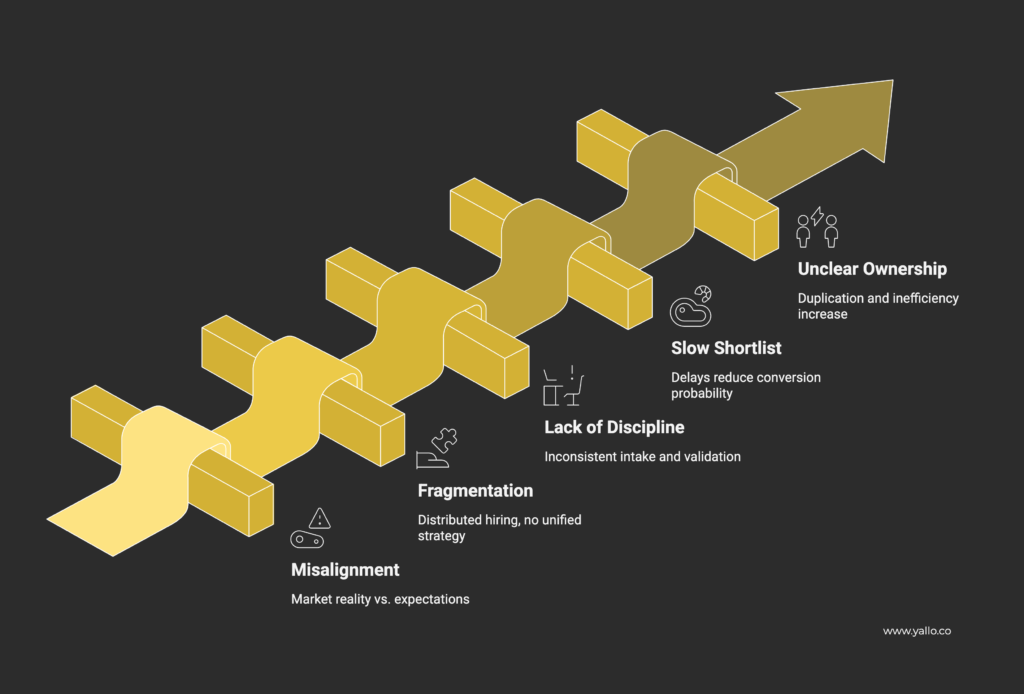
Diagram illustrating specialist hiring bottlenecks including misalignment between market reality and expectations, fragmented hiring strategies, lack of discipline in intake and validation, slow shortlist cycles, and unclear ownership leading to duplication and inefficiency.
Common structural breakdowns in specialist hiring that reduce fill rates and create execution bottlenecks across TA ecosystems.

Embedded TA teams that improve fill rates in specialist hiring typically demonstrate a few consistent operational behaviours:

  • Rigorous intake sessions that separate must-have capability from preferred experience
  • Early technical calibration with architects or domain leads before outreach begins
  • Market mapping to validate talent availability and compensation expectations
  • Defined feedback loops within 24 to 48 hours to avoid candidate drop-off
  • Clear ownership of stakeholder alignment to prevent shifting role definitions

These practices may appear procedural, but they directly affect conversion velocity. In specialist hiring, small delays or unclear expectations compound quickly. Teams that create structured discipline around intake, validation, and decision cadence reduce friction across the process. The improvement in fill rates often comes not from increasing sourcing volume, but from improving signal quality and maintaining alignment between market reality and internal demand.

Execution Levers That Improve Fill Rates in Specialist Hiring

Practical shifts in workflow, ownership, and market positioning

Once calibration and market mapping are established, the improvement of fill rates in specialist hiring depends heavily on execution discipline. Many hiring delays occur not because suitable candidates are unavailable, but because workflow design introduces friction. Interview scheduling gaps, unclear ownership between internal TA teams and external partners, and delayed stakeholder feedback all compound over time. Embedded TA teams that improve outcomes treat specialist hiring as a programme with defined operating rhythms rather than a series of disconnected requisitions.

Another key lever is structured ownership across internal and external ecosystems. In many enterprise environments, multiple sourcing partners may be supporting specialist hiring simultaneously. Without defined segmentation of focus areas or clarity on candidate ownership, duplication and inefficiency increase. Embedded TA teams mitigate this by defining clear talent pools, technical domains, or geographic segments across contributors. They maintain transparent communication on pipeline status and eliminate competition within the hiring ecosystem. When specialist hiring is treated as a coordinated capability build rather than parallel vendor activity, conversion improves and stakeholder confidence strengthens.

Execution LeverCommon Breakdown in Specialist HiringHigh-Maturity TA Approach
Speed to shortlistDelayed screening and interview setupPre-aligned panels and defined response SLAs
Stakeholder feedback cadenceInconsistent or delayed evaluationStructured 24–48 hour feedback windows
Multi-partner coordinationOverlapping sourcing and duplicationSegmented ownership by domain or geography
Candidate engagementLong silence between stagesContinuous communication and expectation setting
Decision authorityEscalation confusionClear hiring decision ownership upfront

These execution levers demonstrate that specialist hiring performance is rarely about volume alone. It is about workflow precision, disciplined ownership, and aligned execution across all contributors in the hiring ecosystem.

Designing Specialist Hiring for Execution Stability

Sustainable improvement in specialist hiring rarely comes from simply increasing the number of sourcing channels. Many organisations respond to specialist hiring pressure by adding more agencies or expanding internal recruiter capacity. While this may increase activity, it does not always improve outcomes. When role clarity, workflow discipline, and technical calibration are weak, additional suppliers often amplify noise rather than improve signal quality. A more mature approach is to design specialist hiring as a structured capability build with clear ownership and defined execution standards.

Execution stability in specialist hiring depends on how well talent acquisition is integrated with delivery objectives. When TA teams understand programme timelines, platform dependencies, and architectural milestones, they can align hiring priorities accordingly. This reduces reactive decision-making and ensures that specialist roles are sequenced based on business impact rather than urgency alone. In high-performing environments, specialist hiring is directly connected to roadmap execution, improving predictability and strengthening stakeholder confidence.

Ultimately, improving fill rates in specialist hiring requires structural clarity, disciplined workflows, and access to deep capability networks rather than fragmented sourcing efforts. Organisations that combine embedded TA models with architect-informed screening and targeted specialist pipelines tend to see greater stability in conversion and retention. Across complex enterprise delivery environments in the Middle East and India, Yallo works with organisations to bridge strategy and execution through architect-led screening and structured specialist talent design. When hiring ecosystems are built around capability depth and operational maturity, fill rates improve not through volume, but through alignment.


Recent Post

How We Serve

TS/EA as a Service

Empowering Business Transformation with Expert Technology Strategy

Talent in a Box

Scaling Innovation with World-Class Talent

Managed IT COE

Delivering Seamless IT Operations at Scale

Leave a Comment

Your email address will not be published. Required fields are marked *

Scroll to Top