The true cost of a wrong hire on a transformation programme in UAE

The hidden financial impact of the wrong specialist hire on enterprise transformation programmes

May 13, 2026 5 mins Read Insight

The standard objection to specialist recruitment fees is that they are expensive. The calculation that is rarely made is what a wrong hire on a critical programme path costs compared to the recruitment fee.

When the numbers are laid out, the fee looks very different.

A wrong specialist hire on a UAE transformation programme does not just create a hiring problem. It creates delivery delays, rework, leadership distraction, budget overruns, and downstream business planning issues that continue long after the replacement is made. In many cases, organisations spend weeks negotiating a recruitment fee while unknowingly exposing the programme to millions in operational risk.

Here is what the actual cost of a wrong hire looks like across a transformation programme and how organisations are reducing that risk.

The direct cost calculation

Consider a realistic UAE enterprise transformation scenario.

A SAP functional lead is placed on a retail transformation programme. After three weeks, it becomes clear the specialist lacks the UAE retail localisation knowledge the programme requires. The programme team spends another week validating the issue internally and deciding to replace the consultant.

Now the replacement cycle begins.

Through standard recruitment channels, sourcing and onboarding another qualified SAP specialist typically takes four to five weeks. That creates a total delivery gap of approximately 8–9 weeks. At a programme operating cost of roughly AED 180,000 per week based on a delivery team of eight specialists averaging AED 2,000 per day, the organisation absorbs AED 1.4–1.6 million in direct programme cost while delivery momentum slows or stalls.

The recruitment fee that was originally questioned was AED 25,000. This is where many transformation programmes miscalculate risk. The visible cost is the recruitment fee. The invisible cost is the operational exposure created by the wrong hire.

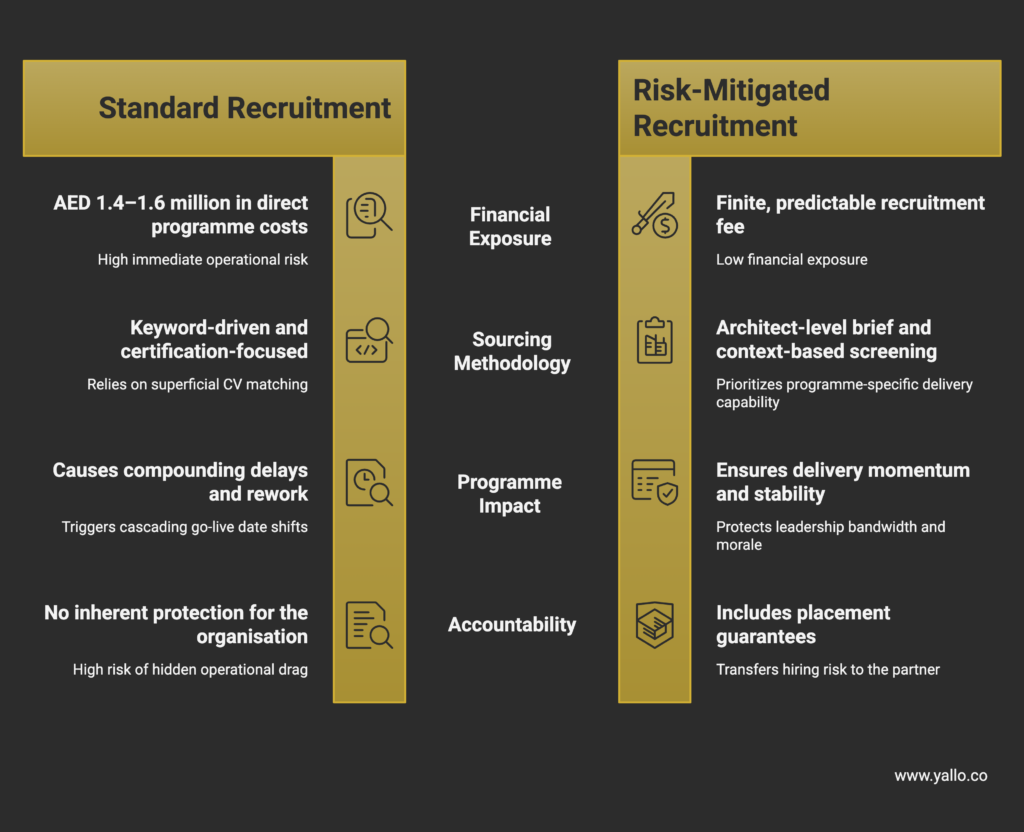
Comparison graphic showing “Standard Recruitment” versus “Risk-Mitigated Recruitment” for UAE enterprise transformation programmes. The chart compares financial exposure, sourcing methodology, programme impact, and accountability. Standard recruitment highlights high programme costs, keyword-driven sourcing, delays, rework, and lack of protection. Risk-mitigated recruitment highlights predictable recruitment fees, architect-level screening, delivery stability, and placement guarantees.
The difference between standard recruitment and risk-mitigated recruitment on enterprise transformation programmes, from financial exposure and sourcing quality to delivery stability and accountability.

The indirect cost: rework

The wrong specialist rarely delivers nothing.

More commonly, they deliver incomplete, misaligned, or poorly structured work that the replacement consultant later has to review, undo, or rebuild. On SAP programmes especially, this creates a major secondary cost driver: rework.

In enterprise implementations, rework often adds 20–30% additional effort to the affected workstream. For a six-month SAP implementation with a 12-specialist delivery team, that can translate into an additional three to four weeks of programme activity operating at full delivery cost.

And rework does not only impact budget. It affects team morale, stakeholder confidence, testing cycles, documentation quality, and decision-making speed. Programme leaders often underestimate how quickly technical debt compounds once incorrect implementation decisions begin spreading into adjacent workstreams. By the time the issue becomes visible at leadership level, recovery is already expensive.

Leadership distraction and operational slowdown

A wrong hire does not only affect delivery teams. It also pulls leadership attention away from strategic execution. When a critical programme resource underperforms, programme managers, architects, delivery leads, HR teams, procurement teams, and business stakeholders all become involved in damage control.

Instead of focusing on transformation outcomes, leadership bandwidth gets consumed by:

  • Escalation meetings
  • Internal reviews
  • Replacement approvals
  • Vendor discussions
  • Delivery recovery planning
  • Stakeholder reassurance

This hidden operational drag rarely appears in programme budgets, but it directly affects organisational momentum. In large transformation environments, leadership focus is one of the most valuable resources in the programme.

A wrong hire quietly drains that resource.

Why organisations still make wrong hires, and how they are reducing the risk

Most wrong hires do not happen because organisations lack hiring intent. They happen because sourcing decisions are often made too late, too quickly, or without enough programme context. Across UAE and GCC transformation programmes, three root causes appear consistently.

1. Weak programme-context briefing

Many hiring processes begin with a job description instead of a programme-level review. A technically correct requirement may still miss critical delivery context such as localisation exposure, stakeholder complexity, integration dependencies, or transformation maturity. As a result, organisations often hire specialists who look qualified on paper but struggle inside the actual programme environment. To reduce this risk, stronger organisations begin with architect-level brief reviews before sourcing starts.

Reviewing the requirement at programme level helps identify hidden dependencies, contextual requirements, and delivery-critical capabilities that may not appear in the original job description. This significantly improves sourcing accuracy before the first CV is even presented.

2. Keyword-driven recruitment

Certification matching alone does not validate delivery capability. Enterprise transformation programmes require specialists who have solved similar implementation challenges before — not simply candidates who list the correct tools or platforms on a CV.

There is a major difference between platform familiarity and programme readiness. This is why modern specialist hiring increasingly relies on programme-context screening rather than keyword filtering alone. Strong screening evaluates domain exposure, localisation knowledge, stakeholder management experience, programme scale, and implementation ownership. The goal is not just to identify someone who has used the technology, but someone who can operate effectively inside the specific delivery environment.

3. Insufficient localisation screening

GCC transformation programmes often require specialists with regional delivery understanding. That may include UAE VAT workflows, Arabic handling, ZATCA compliance exposure, retail localisation processes, or government integration experience. Without contextual screening, organisations risk placing technically capable consultants who still cannot execute effectively within the programme.

This is where placement guarantees and accountability-driven sourcing models become increasingly important. A placement guarantee shifts part of the hiring risk back to the recruitment partner, creating stronger alignment between sourcing quality and programme success. Strong recruitment partners should stand behind delivery confidence, not simply candidate placement.

These structural improvements do not eliminate hiring risk entirely. But they materially reduce the probability of expensive delivery disruption, programme delays, and downstream operational impact.

YALLO supports enterprise transformation programmes across the UAE and GCC through architect-reviewed hiring briefs, programme-context screening, and pre-vetted specialist networks built around delivery readiness rather than keyword matching alone. The focus is not just faster hiring, but reducing the operational and financial risk that comes with the wrong hire on critical programmes.

Recent Post

How We Serve

TS/EA as a Service

Empowering Business Transformation with Expert Technology Strategy

Talent in a Box

Scaling Innovation with World-Class Talent

Managed IT COE

Delivering Seamless IT Operations at Scale

Questions About Specialist Hiring, Answered

A wrong specialist hire on a UAE transformation programme typically costs 6–9 weeks of programme delay across identification, decision, and replacement sourcing. At typical UAE programme running costs, this represents AED 1–1.6 million in direct delay cost — before rework and go-live repositioning costs are counted. The average specialist recruitment fee is 10–15% of this figure.

The three most effective interventions are: architect-level brief review before sourcing begins, domain-specific screening that goes beyond keywords on a job description, and a placement guarantee that transfers part of the wrong-hire risk back to the sourcing partner.

A placement guarantee commits the recruitment firm to replacing a specialist at no additional cost if the hire does not meet the programme bar within a defined period (typically 30 days). YALLO offers a 100% satisfaction guarantee on every placement — if the specialist does not deliver, they are replaced.

The three most common root causes are: a brief that was not reviewed at programme context level before sourcing began, keyword-matching recruitment that identifies candidates by certification rather than delivery experience, and insufficient localisation screening (UAE VAT, ZATCA, Arabic handling in GCC programmes).
Recovery from a wrong specialist hire typically takes 6–9 weeks across problem identification, decision to replace, re-sourcing, and new specialist on-boarding. With an architect-reviewed brief and a pre-screened specialist network, YALLO can typically deliver a replacement specialist within 5–7 days of the replacement decision.

Leave a Comment

Your email address will not be published. Required fields are marked *

Scroll to Top