Partner vs Compete in Designing Effective Specialist Hiring Partnerships

A practical framework for TA leaders to decide when to build, buy, or form specialist hiring partnerships for critical capacity

February 27, 2026 5 mins Read Insight

The False Choice Between Building and Buying

Why specialist hiring partnerships are often misunderstood

In many enterprise environments, decisions around specialist capacity are framed as a simple build versus buy debate. Should the organisation expand its internal talent acquisition capability, or should it rely on external vendors to deliver specialist talent? This framing, while common, often oversimplifies the structural realities of complex hiring ecosystems. Specialist roles in areas such as platform engineering, enterprise architecture, AI, and cloud transformation rarely sit neatly within a single sourcing model. Treating the decision as binary can create internal friction and unnecessary competition between teams and suppliers.

Specialist hiring partnerships emerge when organisations recognise that internal and external capabilities are not mutually exclusive. Internal TA teams bring contextual understanding of culture, long-term workforce planning, and delivery roadmaps. External specialist vendors often provide niche networks, technical screening depth, and market access that may not exist internally. When these strengths are positioned in opposition, duplication and inefficiency increase. When they are designed to complement each other, hiring velocity and quality improve. The issue is not whether to build or buy, but how to structure collaboration without diluting accountability.

The misunderstanding around specialist hiring partnerships often stems from unclear ownership and misaligned incentives. Internal teams may feel displaced, while external vendors may operate without visibility into broader programme objectives. By reframing the build versus buy question into a structured partnership model, organisations can stabilise delivery while preserving control over strategic hiring outcomes. In How TA Teams Can Improve Fill Rates in Specialist Hiring, we examine how embedded intake discipline and architect-led validation significantly increase conversion predictability. Specialist hiring partnerships are most effective when layered on top of strong internal hiring mechanics rather than used as a substitute for them.

When to Build, When to Buy, When to Partner

A decision framework for specialist hiring partnerships

Not every specialist role requires the same hiring model. Some capabilities are core to long-term competitive advantage and justify deeper internal investment. Others are episodic, programme-based, or tied to transformation cycles where external depth becomes more efficient. Effective specialist hiring partnerships begin with segmentation. TA leaders must first determine whether the role represents strategic core capability, scalable delivery support, or niche technical acceleration. Without this clarity, organisations either over-invest internally or over-rely on agencies without long-term continuity.

In many enterprise environments, decisions around specialist hiring partnerships are triggered by performance pressure. Fill rates begin to decline, hiring cycles stretch beyond acceptable thresholds, and programme timelines slip. What often appears to be a supplier problem is actually a structural issue. As explored in The Hidden Cost of 12-Week Hiring Cycles in Retail Transformation, prolonged hiring cycles create downstream delivery risk that compounds over time. Specialist hiring partnerships must therefore be evaluated not only for cost efficiency, but for their ability to reduce time-to-capability.

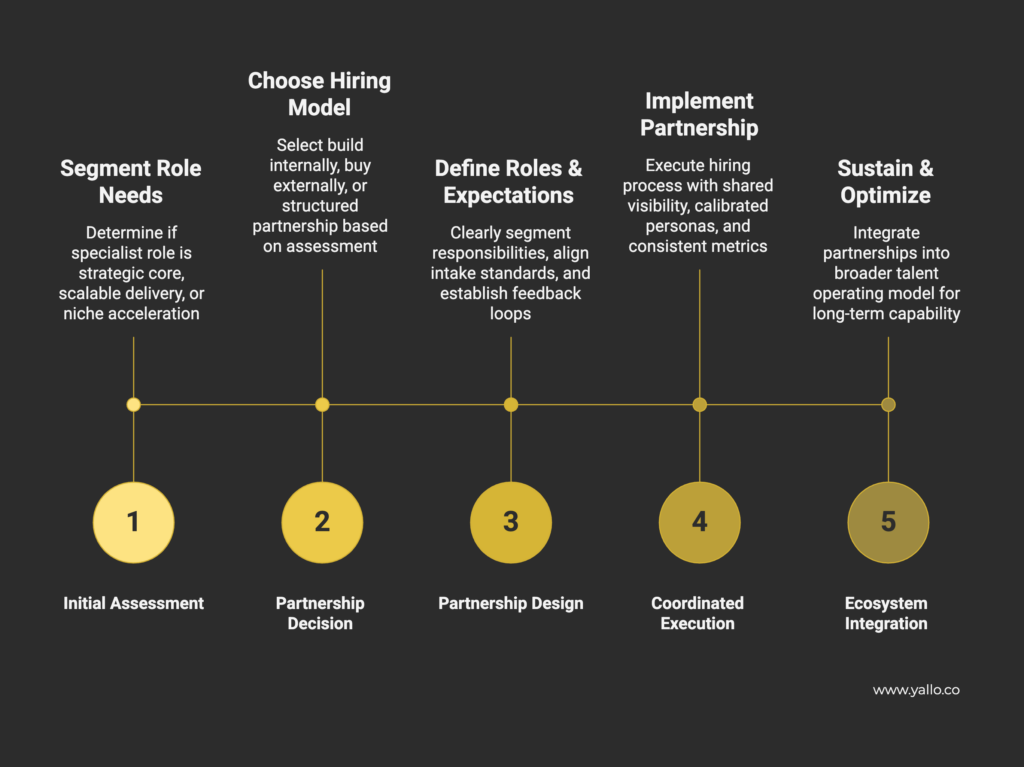
Framework showing five stages of specialist hiring partnerships including role segmentation, hiring model selection, partnership design, coordinated execution, and ecosystem integration.
Common structural breakdowns in specialist hiring that reduce fill rates and create execution bottlenecks across TA ecosystems.

Specialist hiring partnerships are most effective when treated as a structured capability journey rather than a reactive vendor decision. The framework above illustrates how organisations can move from initial role segmentation to sustained ecosystem integration. By deliberately assessing whether to build, buy, or collaborate, defining responsibilities clearly, and embedding specialist hiring partnerships into the broader talent operating model, TA leaders create stability instead of fragmentation. Over time, specialist hiring partnerships become less about supplier choice and more about coordinated execution aligned with business delivery priorities.

A simple evaluation matrix can support clearer decisions:

Scenario TypeRecommended ModelWhy It Works
Long-term core platform rolesBuild internallyProtects knowledge continuity and roadmap alignment
Urgent transformation projectsBuy external capacityPrioritises speed and rapid access to niche skills
Hard-to-source specialist talent with ongoing demandStructured partnershipCombines internal context with external market depth

This framework prevents reactive hiring decisions. Instead of defaulting to expansion or outsourcing, TA leaders can deliberately design specialist hiring partnerships that align with business impact, delivery risk, and capability maturity.

Designing Specialist Hiring Partnerships That Scale

Moving from vendor competition to coordinated execution

Once the decision to partner is made, the effectiveness of specialist hiring partnerships depends on how clearly the model is designed. Many partnerships fail not because of capability gaps, but because roles and expectations remain ambiguous. Internal TA teams may assume vendors will operate independently, while vendors may lack visibility into delivery priorities, architectural requirements, or stakeholder sensitivities. Without defined ownership and transparent operating rhythms, duplication, candidate overlap, and inconsistent messaging quickly emerge.

Scalable specialist hiring partnerships are built on segmentation and clarity. High-performing TA leaders define which specialist domains remain internal, which require external market depth, and where collaborative sourcing is appropriate. They align on intake standards, feedback timelines, and technical validation frameworks before outreach begins. When both internal and external contributors operate from the same calibrated persona and performance metrics, the partnership shifts from transactional to strategic. Rather than competing for placement credit, the ecosystem operates around fill rate stability and delivery continuity.

Another critical factor is information flow. Effective specialist hiring partnerships require shared visibility into pipeline status, stakeholder feedback, and market constraints. When vendors understand programme milestones and internal teams understand external supply realities, decision-making becomes more grounded. This reduces escalation friction and prevents reactive supplier switching. In mature environments, TA leaders act as orchestrators of capability rather than gatekeepers of requisitions. The partnership model becomes less about headcount expansion and more about sustaining execution capacity in complex specialist environments.

Designing Specialist Hiring for Execution Stability

Sustainable improvement in specialist hiring rarely comes from simply increasing the number of sourcing channels. Many organisations respond to specialist hiring pressure by adding more agencies or expanding internal recruiter capacity. While this may increase activity, it does not always improve outcomes.  Geographic delivery models also influence how specialist hiring partnerships should be structured. For example, building retail technology capability in India requires different vendor orchestration strategies depending on whether hiring is concentrated in Bengaluru, Hyderabad, or Pune. As discussed in Building Retail Tech Teams in India: Bengaluru vs Hyderabad vs Pune, talent depth, cost structures, and ecosystem maturity vary significantly across these markets.

Execution stability in specialist hiring depends on how well talent acquisition is integrated with delivery objectives. When TA teams understand programme timelines, platform dependencies, and architectural milestones, they can align hiring priorities accordingly. This reduces reactive decision-making and ensures that specialist roles are sequenced based on business impact rather than urgency alone. 

Organisations that combine embedded TA models with architect-informed screening and targeted specialist pipelines tend to see greater stability in conversion and retention. Across complex enterprise delivery environments in the Middle East and India, Yallo works with organisations to bridge strategy and execution through architect-led screening and structured specialist talent design. When hiring ecosystems are built around capability depth and operational maturity, fill rates improve not through volume, but through alignment.

Recent Post

How We Serve

TS/EA as a Service

Empowering Business Transformation with Expert Technology Strategy

Talent in a Box

Scaling Innovation with World-Class Talent

Managed IT COE

Delivering Seamless IT Operations at Scale

Leave a Comment

Your email address will not be published. Required fields are marked *

Scroll to Top