Why Capability Based Teams in Saudi Arabia Are Reshaping Enterprise Delivery
How capability based teams in Saudi Arabia are emerging as a strategic response to delivery risk, workforce fragmentation, and the execution demands of large scale national programmes
Why Traditional Role Based Team Structures Are Breaking Down in Saudi Enterprises
How the execution demands of large Saudi programmes are exposing the limits of role based staffing models
For decades, role based team structures worked reasonably well in environments where delivery was linear, scope was predictable, and accountability could be distributed across specialised functions. In many Saudi enterprises, however, those assumptions no longer hold. Large programmes are now expected to deliver at national scale, often under intense public and executive scrutiny, while integrating new digital platforms, regulatory requirements, and operational models simultaneously. In this context, role based staffing creates fragmentation rather than control.
What becomes visible very quickly is that roles alone do not equate to execution readiness. Teams may be fully staffed on paper, yet struggle to make timely decisions, resolve cross-domain issues, or absorb complexity without escalation. Architectural decisions wait on committees, delivery slows as dependencies multiply, and accountability becomes diluted across functions that were never designed to operate as a cohesive execution unit. This is precisely where capability based teams in Saudi Arabia are gaining traction, not as an organisational trend, but as a response to delivery conditions that demand tighter integration between skills, authority, and outcomes.
Several structural pressures are driving this misalignment:
Programmes are expected to move faster than traditional governance cycles allow
Delivery success is measured by outcomes, not functional compliance
Risk tolerance is lower due to national importance and public visibility
Under these conditions, role based models struggle because they separate decision-making from delivery responsibility. When problems arise, resolution depends on coordination rather than ownership, and coordination is slow under pressure. Saudi enterprises are increasingly recognising that execution at scale requires teams designed around what needs to be delivered, not just who fulfils which role.
How Capability Gaps Appear Even When Saudi Enterprises Are Fully Staffed
Why capability based teams in Saudi Arabia are emerging as a response to fragmented authority and accountability
One of the most common misconceptions in large organisations is that delivery risk is a function of insufficient headcount. In reality, many Saudi enterprises meet or exceed their hiring targets and still experience stalled programmes, recurring rework, and escalating dependency management. The issue is not the number of people involved, but how capability is distributed and governed. When skills are spread thinly across roles without clear execution ownership, capability gaps emerge even in well-resourced teams.
In role based models, critical decisions often fall between roles. Architects design without full delivery accountability, engineers execute without architectural authority, and programme managers coordinate without the technical leverage to resolve structural issues. This fragmentation creates delays and forces escalation up the hierarchy, increasing leadership load and reducing delivery momentum. Capability based teams in Saudi Arabia address this by concentrating decision authority, technical depth, and accountability within the same team construct.
Between these two models, the difference in execution readiness becomes clear:
| Role Based Team Model | Capability Based Team Model |
|---|---|
| Skills distributed across functions | Skills integrated around outcomes |
| Decision-making escalated through governance | Decisions made close to delivery |
| Accountability fragmented across roles | Accountability owned end to end |
| Progress dependent on coordination | Progress driven by execution authority |
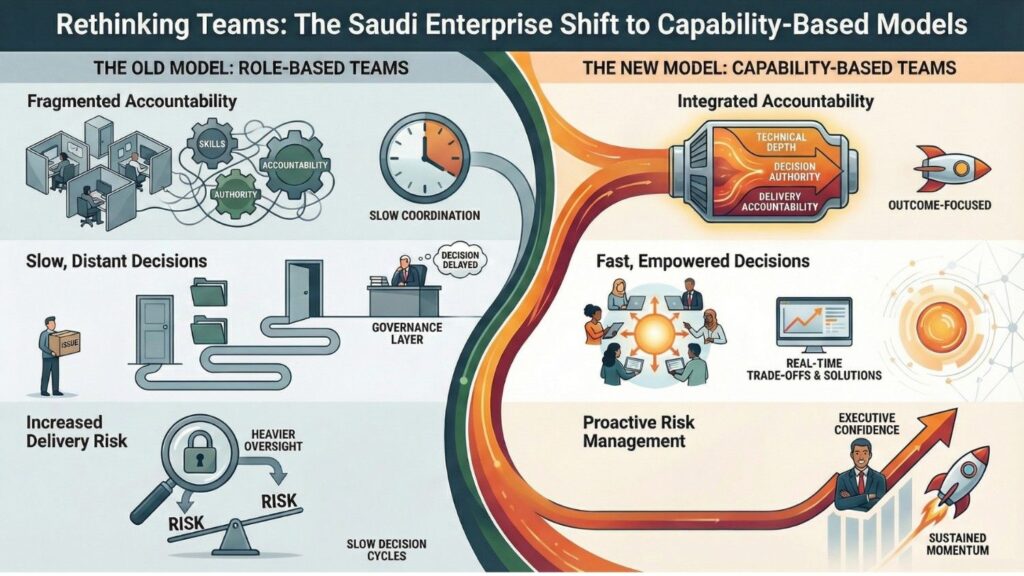
This visual contrasts the structural differences between traditional role-based teams and capability-based teams in Saudi enterprises. It shows how fragmented accountability, slow decision cycles, and heavy governance in role-based models increase delivery risk, while capability-based teams integrate skills, authority, and accountability to enable faster decisions, proactive risk management, and sustained execution momentum. The comparison reinforces why capability-based teams are becoming critical for large, high-visibility programmes in Saudi Arabia.
As Saudi enterprises scale complex programmes across digital, data, cloud, and security domains, these differences are no longer theoretical. Capability gaps surface quickly when teams are unable to absorb complexity without constant intervention. This is why capability based teams in Saudi Arabia are increasingly seen not as an organisational redesign exercise, but as a practical mechanism to reduce delivery risk, shorten decision cycles, and improve execution confidence in environments where failure is not an option.
Why Capability Based Teams Perform Better Under Complexity and Delivery Pressure
How capability based teams in Saudi Arabia align skills, authority, and execution responsibility at scale
As Saudi enterprises take on programmes that span digital platforms, physical infrastructure, regulatory change, and operating model redesign, complexity becomes the defining delivery challenge. In such environments, risk rarely arises from a single technical failure, but from the interaction between systems, vendors, policies, and timelines. Capability based teams in Saudi Arabia are proving effective precisely because they are designed to absorb this complexity rather than distribute it across disconnected roles.
In a capability based model, the team is structured around an outcome that must be delivered under real constraints, not around functional contribution alone. This allows decisions to be made with full awareness of trade-offs between speed, quality, cost, and risk. Instead of waiting for alignment across multiple functions, teams operate with embedded authority, reducing dependency chains and shortening feedback loops. This becomes critical when programmes must move quickly without sacrificing control or compliance.
Several execution advantages consistently emerge in environments where capability based teams are adopted:
Decisions are made closer to the point of delivery, reducing escalation latency
Architectural and delivery considerations are resolved together rather than sequentially
Risk is identified earlier because accountability is clear and concentrated
This does not eliminate governance, but it changes its role. Governance shifts from approving decisions after the fact to setting clear boundaries within which capable teams can operate. For Saudi programmes with high visibility and low tolerance for failure, this balance between autonomy and control is what enables sustained velocity without destabilising execution.
How Capability Based Teams Are Changing Hiring and Governance in Saudi Enterprises
The adoption of capability based teams in Saudi Arabia is forcing a fundamental reassessment of how enterprises approach hiring and workforce planning. Traditional recruitment models focus on filling predefined roles with specific skill sets, often optimised for predictability and cost control. Capability based models, by contrast, prioritise execution readiness, which places greater emphasis on experience, judgement, and the ability to operate across domains.
This shift has significant implications for governance and accountability. When teams are built around capabilities, performance can no longer be measured solely by individual role effectiveness or functional output. Instead, success is evaluated based on delivery outcomes, decision quality, and the team’s ability to manage risk under pressure. This requires leadership to be more explicit about where authority sits and how accountability is enforced.
The contrast between the two approaches is increasingly evident:
| Traditional Enterprise Model | Capability Based Team Model |
|---|---|
| Hire to fill static roles | Hire to assemble execution capability |
| Governance enforces compliance | Governance enables controlled autonomy |
| Accountability spread across functions | Accountability owned by the team |
| Performance measured by activity | Performance measured by outcomes |
For many Saudi enterprises, this transition is not straightforward. It challenges long-established structures, reporting lines, and procurement practices. However, as programmes grow in scale and complexity, the cost of maintaining role based models becomes increasingly visible in delayed decisions, delivery friction, and leadership overload. Capability based teams offer a way to rebalance responsibility and restore clarity in environments where execution matters more than organisational symmetry.
Organisations such as Yallo increasingly observe that enterprises relying solely on traditional role based staffing models compensate with heavier governance, additional reporting layers, and slower decision cycles, all of which increase delivery risk rather than reducing it. By contrast, enterprises that invest in capability based teams in Saudi Arabia are better positioned to manage risk proactively, preserve delivery velocity, and maintain confidence at executive and national levels. The shift is not about introducing a new operating model for its own sake, but about aligning workforce design with the realities of modern programme execution.
Newsletter
Get the latest updates and insights delivered to your inbox.
Thank you!
You have successfully joined our subscriber list.