The Role of Architectural Authority in Complex Programmes
Why large-scale transformation increasingly depends on who has the mandate to decide, not just what standards are defined
Why architectural decisions become contested as programmes scale
How complexity, competing priorities, and delivery pressure dilute technical authority over time
In the early stages of most programmes, architectural decisions tend to be relatively straightforward. Scope is contained, stakeholders are aligned, and trade offs are manageable. Architecture functions as intended: setting direction, constraining risk, and enabling coherent design choices. However, as programmes scale across geographies, vendors, platforms, and timelines those same decisions become progressively more contested.
Complex programmes introduce multiple centres of gravity. Business units prioritise speed and local outcomes, delivery teams focus on meeting milestones, vendors optimise for their own solutions, and leadership responds to commercial and political pressure. In this environment, architecture is no longer evaluated purely on technical merit. It becomes one input among many, often weighed against short-term delivery concerns and competing objectives.
What follows is not a deliberate erosion of architectural intent, but a gradual shift in how decisions are made. Exceptions accumulate, compromises are rationalised, and architectural coherence is deferred in favour of progress. Each individual decision may appear reasonable in isolation, yet collectively they weaken the authority of architecture as a governing force. By the time issues surface at scale through integration challenges, performance bottlenecks, or security exposure, the original architectural rationale has often been diluted beyond recognition.
When standards exist but authority does not
Why principles, frameworks, and reference architectures fail without clear decision ownership
Most complex programmes are not short on architectural standards. They have documented principles, approved reference architectures, target-state diagrams, and formal review forums. On paper, architectural intent is clearly articulated and widely communicated. Yet despite this apparent maturity, many programmes still experience fragmentation, rework, and increasing technical debt as delivery progresses.
The underlying issue is not the absence of architecture, but the absence of authority. In many organisations, architecture is positioned as an advisory function rather than a decision-making one. Architects are asked to guide, review, and recommend, but rarely to decide. As a result, architectural standards influence conversations but do not reliably shape outcomes. This gap becomes especially visible under delivery pressure. When timelines tighten or dependencies escalate, architectural guidance is often reframed as something to be balanced against speed rather than upheld as a condition for progress. Exceptions are granted with the intention of revisiting them later, yet few are ever reversed.
In practice, this leads to a pattern that repeats across programmes:
-
Architectural principles exist, but enforcement is inconsistent
-
Design reviews identify risks, but delivery proceeds regardless
-
Exceptions are logged, but ownership for long-term impact is unclear
-
Governance forums approve deviations without accountability for outcomes
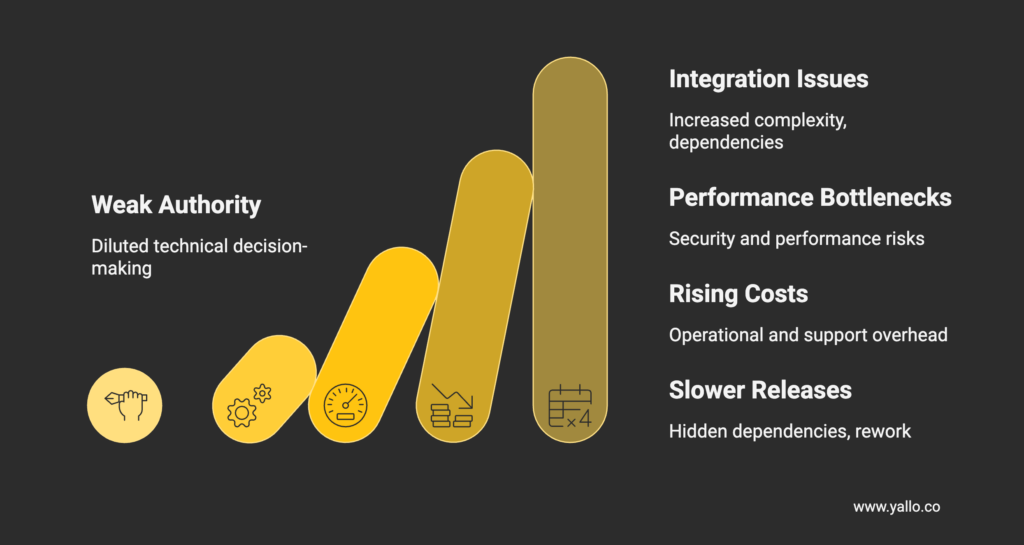
This visual captures how the erosion of architectural authority translates into tangible delivery consequences over time. What begins as diluted technical decision-making gradually manifests as increased integration dependencies, performance and security bottlenecks, higher operational overhead, and slower release cycles. Importantly, none of these outcomes are caused by a single failure or decision.
Newsletter
Get the latest updates and insights delivered to your inbox.
Thank you!
You have successfully joined our subscriber list.
How weak architectural authority quietly increases delivery risk
Why compromise-driven design decisions accumulate into systemic instability
The impact of weak architectural authority rarely shows up as an immediate failure. Instead, risk accumulates gradually through a series of small, locally rational decisions that collectively undermine programme stability. Each compromise is justified in isolation, yet together they create systems that are harder to integrate, scale, and operate over time. As architectural intent is diluted, delivery becomes more fragile. Integration points multiply, complexity increases, and dependencies become harder to manage. What initially appears as flexibility eventually manifests as inconsistency, rework, and operational overhead.
Common symptoms begin to surface as programmes advance:
-
Increased reliance on custom integrations and workarounds
-
Growing inconsistency across environments, regions, or platforms
-
Slower release cycles due to hidden dependencies
-
Rising operational and support costs
-
Security and performance risks emerging late in delivery
These issues are often misattributed to execution quality or tooling choices, when in reality they stem from earlier architectural compromises that were never owned or resolved. Because no single decision triggered the problem, accountability is difficult to trace. Delivery risk becomes diffuse, making it harder to correct without significant disruption. This is how architectural authority affects delivery without being visible on a programme plan. Weak authority does not stop progress outright, but it changes the trajectory of delivery in subtle ways. Over time, programmes remain active, yet increasingly constrained by the very compromises that once enabled them to move forward.
Why architectural authority must evolve with delivery complexity
As programmes increase in scale and interdependency, architectural authority cannot remain static. Models that rely on periodic reviews, advisory input, or retrospective approvals struggle to keep pace with the volume and speed of decisions required in complex delivery environments. What begins as flexibility gradually becomes ambiguity.
Effective programmes recognise that architectural authority is not about control for its own sake, but about enabling confident decision-making under pressure. This requires architects to be positioned closer to delivery, with clearly defined mandates, escalation rights, and accountability for outcomes. When authority is explicit, decisions move faster, trade-offs are resolved earlier, and delivery teams operate with greater confidence.
Across large-scale transformation and enterprise delivery environments, Yallo consistently observes that architectural authority is a decisive factor in programme outcomes. Through our work, case studies, and ongoing insights, a common pattern emerges: organisations that align architectural authority with execution responsibility are better equipped to manage complexity, avoid unnecessary compromise, and sustain delivery momentum over time. Ultimately, architectural authority is less about enforcing design and more about protecting delivery itself. In programmes where complexity is unavoidable, clarity of authority becomes one of the most valuable capabilities an organisation can invest in.