The Real ERP Transformation Cost in Oracle and SAP Programmes
How Hidden Ownership Gaps and Capability Erosion Shape the Long-Term Economics of Enterprise Platforms
February 13, 2026
5 mins Read
Insight
The Visible and Hidden Dimensions of ERP Transformation Cost
Understanding why financial investment is only part of the long-term enterprise equation
Enterprise transformation programmes built around Oracle and SAP platforms are rarely underfunded. They attract board-level scrutiny, multi-year investment commitments, and extensive advisory ecosystems. Business cases are constructed around standardisation, cost control, process harmonisation, and improved visibility. Yet despite rigorous planning, many organisations underestimate the full cost of transformation.
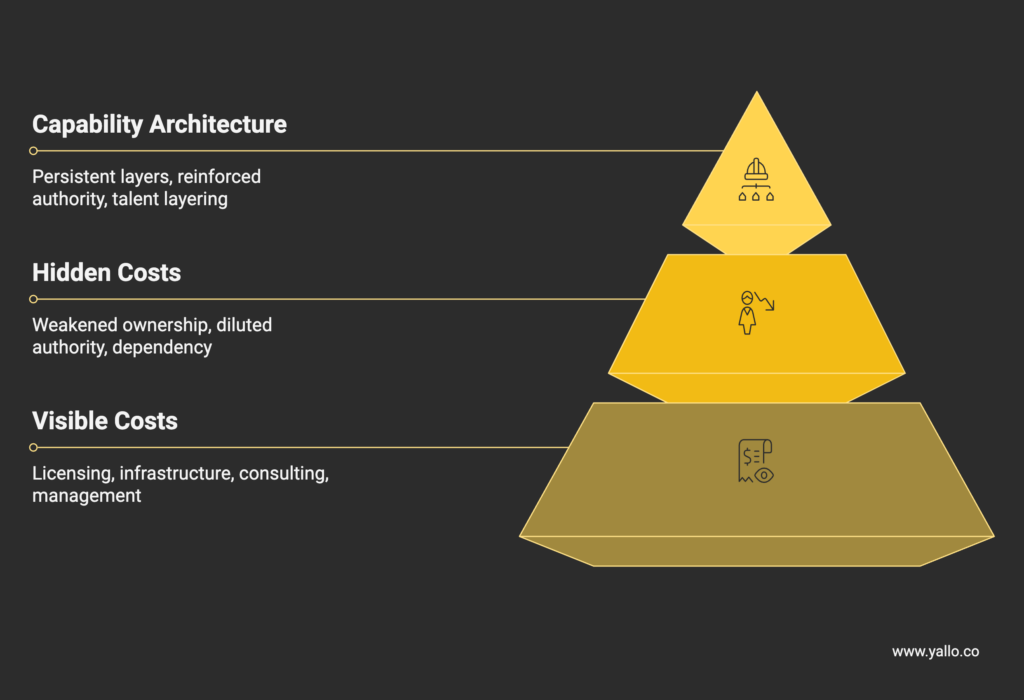
The visible cost is clear: licensing, infrastructure, consulting, and programme management expenditure. The hidden cost accumulates structurally, often emerging only after implementation milestones have been achieved. It appears in weakened internal ownership, diluted architectural authority, extended vendor dependency, and reduced organisational agility. Over time, these factors shape the true long-term economics of the platform far more than initial programme spend.
Oracle and SAP transformation is not simply a system upgrade. It is an enterprise operating model shift. When that shift is not supported by deliberate capability design, fragility is introduced into the core of the organisation.
Commercial Delivery Models and the Erosion of Platform Stewardship
How milestone-driven programmes weaken internal ownership and architectural authority
ERP programmes are typically governed around phase gates, design approvals, testing cycles, and go-live readiness. Programme dashboards measure defect rates, migration accuracy, and milestone adherence. This structure is commercially rational. It drives focus and accountability during execution. However, ERP platforms are persistent enterprise systems that outlive the programme structure that delivered them.
When governance frameworks emphasise milestone completion over long-term stewardship, several patterns tend to develop:
Core architectural decisions become vendor-led rather than enterprise-owned
Internal architects participate but lack sustained enforcement authority
Knowledge transfer is compressed toward programme closure
Post-go-live operating models default to ticket-based support rather than design continuity
These dynamics are rarely visible at steering committee level because the system may technically stabilise at launch. Yet the enterprise may already have ceded practical control of its own architecture. What appears to be transformation success can conceal long-term dependency and capability dilution. This tension between commercial delivery pressure and platform stewardship is one of the most underestimated structural risks in large Oracle and SAP programmes.
Figure: The layered structure of ERP transformation cost, highlighting visible programme spend, hidden ownership and dependency risk, and the long-term capability architecture required for sustainable Oracle and SAP platform control.
The concept of ERP transformation cost extends beyond licensing and consulting expenditure. While visible programme budgets are carefully tracked, the deeper structural cost often resides in weakened ownership, diluted architectural authority, and growing dependency on external expertise. The model below illustrates how visible spend forms only the base layer, while hidden costs and long-term capability architecture determine the true economic impact of Oracle and SAP transformation.
Newsletter
Get the latest updates and insights delivered to your inbox.
Thank you!
You have successfully joined our subscriber list.
Knowledge Dilution and Post Go Live Architectural Drift
Why dependency and design fragmentation increase after implementation
During implementation, system integrators and specialist consultants play a central role in configuration, integration logic, and business process mapping. Their expertise is necessary, particularly in complex, multi-country deployments. The risk arises when internal teams are positioned as recipients of knowledge rather than co-owners of architectural decisions.
As complexity increases, external specialists often become the primary custodians of design rationale. The reasoning behind configuration choices, integration trade-offs, and security models becomes embedded in individuals rather than institutional memory. When programme teams disband after go-live, this knowledge gap becomes operationally significant.
In the years following implementation, organisations frequently experience:
Limited internal capacity to evolve the platform independently
Escalating reliance on change requests routed through external partners
Rising enhancement costs disproportionate to functional complexity
Reduced confidence in making structural changes to the system
Architectural drift compounds the issue. As business units request local enhancements and new integrations are introduced under time pressure, design consistency weakens. Without strong internal governance, incremental deviations accumulate. Over time, this increases technical debt, complicates upgrades, and elevates security exposure. The system remains operational, but its long-term resilience erodes gradually.
Rebuilding Capability Architecture for Sustainable ERP Ownership
The hidden cost of Oracle and SAP transformation ultimately resides in organisational design rather than technology configuration. Sustainable ERP ownership requires more than programme execution. It requires persistent capability layers that endure beyond implementation cycles. Enterprise leaders must therefore shift their framing. Instead of viewing ERP modernisation purely as a capital programme, it should be approached as a multi-year capability architecture exercise. Architectural authority must be reinforced, not diluted, during implementation. Internal design ownership must expand rather than contract. Governance structures must remain active beyond go-live stabilisation.
This demands deliberate choices about talent layering, decision rights, and platform accountability. It requires clarity around which knowledge must remain institutional and which can safely reside with external partners. It requires recognising that ERP platforms anchor financial reporting, supply chain control, compliance posture, and increasingly AI-driven analytics. Weak ownership at this level introduces systemic vulnerability.
Across complex enterprise environments, we consistently observe that long-term ERP success correlates with internal architectural continuity and balanced delivery ecosystems. At Yallo Group, our focus is on closing the strategy–execution gap in technology delivery by designing and deploying the right talent, at the right time, for the right outcomes. In Oracle and SAP transformations, this often means strengthening enterprise design authority and ensuring that platform stewardship remains embedded within the organisation rather than outsourced by default. The visible cost of ERP transformation is accounted for in programme budgets. The hidden cost resides in whether the organisation emerges stronger, more self-sufficient, and structurally resilient. The decisive question for leadership is not whether the platform was implemented successfully, but whether the enterprise truly owns it.