GCC hiring looks like one market. It is actually two.

Most GCC hiring plans assume a single talent market, but volume roles and specialist roles behave very differently.

March 09, 2026 5 mins Read Insight

Why most GCC hiring plans assume one talent market

Many ramp plans treat GCC hiring as a single hiring problem, but the talent market behaves differently depending on the role.

When companies begin building or expanding a Global Capability Center, the first step is usually a hiring ramp plan. These plans estimate how many engineers, analysts, or specialists need to be hired over a certain period of time. In many cases, the plan assumes that all roles follow similar hiring dynamics. Recruiters begin sourcing candidates, interview pipelines are set up, and hiring targets are assigned to teams. On the surface, GCC hiring appears to be a straightforward process of scaling a workforce to meet delivery goals.

This assumption works well for some roles because many positions in a GCC follow predictable hiring patterns. For example, roles such as software developers, analysts, and testing engineers usually have a steady supply of candidates in the talent market. Universities produce new graduates every year, experienced professionals move between companies regularly, and recruitment channels are already well established. Because of this, organizations often build their GCC hiring strategy around the expectation that most roles can be filled within a similar timeframe.

The challenge appears when the same hiring assumptions are applied to every role in the ramp plan. Not all positions belong to the same talent market. While some roles have a large and accessible talent pool, others require very specific experience that exists within a much smaller group of professionals. When ramp plans treat these two hiring environments as one, delays often begin to appear. Certain roles fill quickly, while others remain open for weeks or even months, slowing the overall team ramp.

This is where many organizations begin to realize that GCC hiring does not operate in a single talent market. Instead, it functions across two very different hiring environments, each with its own supply dynamics, timelines, and challenges. Understanding this difference is essential for building realistic ramp plans and avoiding unexpected hiring delays.
The volume hiring market inside GCC hiring

A large portion of GCC hiring operates in a volume driven talent market where supply is relatively predictable.

Many roles inside a Global Capability Center belong to what can be described as the volume hiring market. These are positions where the talent supply is relatively stable, hiring pipelines are mature, and companies can ramp teams in predictable cycles. In India alone, GCCs have created one of the largest technology employment ecosystems in the world, with more than 1,700 centers employing around 1.9 million professionals across engineering, analytics, product development, and operations.

Because of this large workforce base, certain categories of roles tend to follow repeatable hiring patterns. Universities produce thousands of graduates every year, professionals move between companies regularly, and recruitment channels such as job platforms, campus hiring, and referrals are already well established. As GCC expansion continues, companies are able to hire many of these roles at scale. In fact, GCC organizations are currently expanding their workforce by roughly 18–27 percent annually, a hiring pace significantly faster than traditional IT services companies.

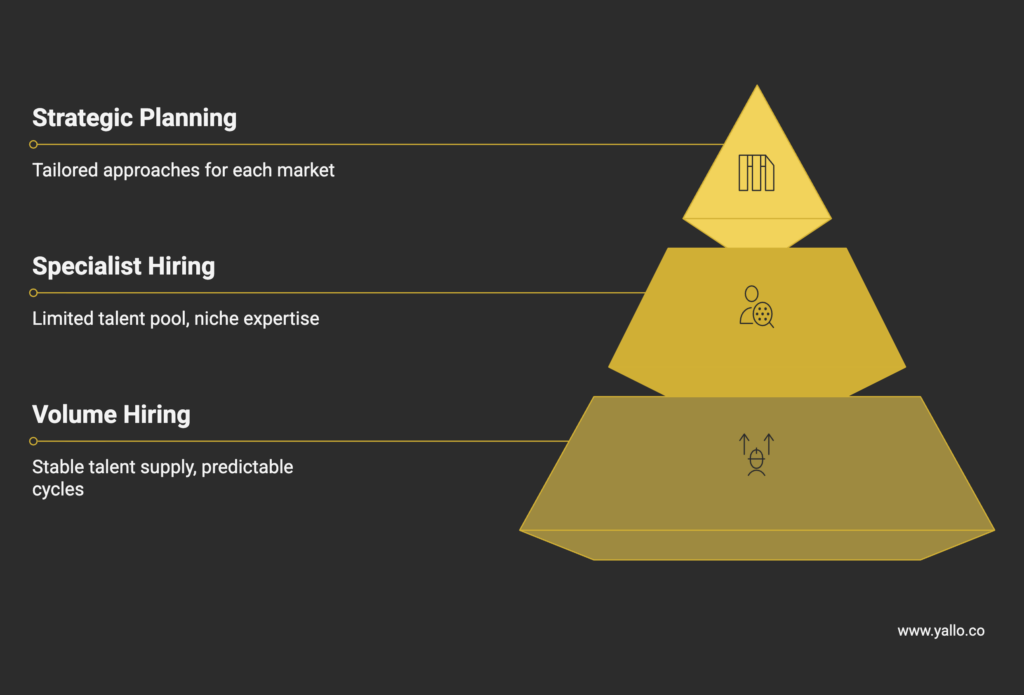
GCC hiring infographic showing the difference between volume hiring, specialist hiring, and strategic planning in GCC hiring strategy.
Understanding GCC hiring requires recognizing two talent markets: volume hiring with stable supply and specialist hiring with limited expertise.

Roles that typically belong to the volume side of GCC hiring include

  • Software developers and engineers in common technology stacks

  • Business analysts and data analysts

  • QA and testing engineers

  • Application support and operations teams

  • Early career engineers and campus hires

These roles tend to share a few common characteristics. The talent pool is large, candidates have transferable skills across companies, and hiring timelines are relatively predictable. Because of this, most GCC ramp plans are initially designed around these roles. Companies assume that hiring velocity for the entire team will follow the same pattern as these volume positions.

However, this assumption creates the first blind spot in GCC hiring strategy. While volume roles can often be filled quickly, they represent only one side of the hiring market inside a GCC. As companies begin filling more specialized positions, they often encounter a completely different talent dynamic—one that behaves very differently from the volume market.

The specialist hiring market inside GCC hiring

Some roles in GCC hiring belong to a much smaller talent market where experience, expertise, and availability are limited.

While many roles in a GCC follow predictable hiring patterns, another category of roles operates in a very different talent market. These are specialist positions that require deep experience in specific technologies, platforms, or domains. Unlike volume roles, the number of professionals with this level of expertise is much smaller. As a result, the hiring timelines for these roles often look very different from the rest of the ramp plan.

The challenge becomes more visible as Global Capability Centers evolve from support operations into advanced engineering and product development hubs. Today, many GCCs are responsible for building complex technology platforms, managing global data infrastructure, and developing AI driven products. According to a NASSCOM report on India’s GCC ecosystem, nearly 45 percent of GCCs are now involved in high value work such as product engineering, data science, and digital platforms, which significantly increases demand for specialized technical talent. As the nature of work shifts toward more advanced capabilities, the demand for experienced specialists grows faster than the available supply.

Roles that typically fall into the specialist side of GCC hiring include

  • Cloud platform architects and infrastructure specialists

  • AI and machine learning engineers

  • Enterprise platform experts such as SAP or Salesforce architects

  • Cybersecurity specialists

  • Senior data engineers and data platform architects

These roles usually require years of experience in complex environments, making the talent pool much smaller. In addition, specialists are often already employed in critical positions at other companies, which means they are less likely to actively search for new opportunities. Instead, they are usually approached through targeted recruitment, referrals, or industry networks. Because of this, hiring cycles for specialist roles are often longer and less predictable than for volume roles.

This is where the second talent market inside GCC hiring becomes clear. While volume roles may be filled quickly through traditional hiring channels, specialist roles often require a completely different approach. When ramp plans assume both markets behave the same way, companies often encounter delays in the very roles that are most critical to programme delivery.

Why GCC hiring strategies must treat these two markets differently

Understanding the difference between these two hiring markets is critical for building realistic ramp plans. Many organizations design their GCC hiring strategy assuming that most roles can be filled at a similar pace. This assumption works when hiring roles with large talent pools, but it becomes problematic when applied to specialist positions that require niche expertise. As teams grow and programmes become more complex, delays in filling these specialist roles can slow down entire projects.

Organizations that recognize this distinction early are able to build stronger ramp plans. Instead of expecting all roles to move at the same speed, they plan hiring timelines differently for volume and specialist positions. This helps avoid delays in critical roles and ensures that key expertise is available when programmes begin. As GCCs continue to expand into areas such as product development, data engineering, and AI, the ability to manage both hiring markets effectively will become increasingly important.

At YALLO Group, the focus is on helping organizations bridge the gap between strategy and execution by aligning hiring plans with the realities of these two talent markets. By supporting companies with specialized technology talent across platforms such as cloud, data, enterprise systems, and AI, Yallo helps GCC teams move from hiring plans to real execution without delays in critical roles.

 
Recent Post

How We Serve

TS/EA as a Service

Empowering Business Transformation with Expert Technology Strategy

Talent in a Box

Scaling Innovation with World-Class Talent

Managed IT COE

Delivering Seamless IT Operations at Scale

Leave a Comment

Your email address will not be published. Required fields are marked *

Scroll to Top