Why Cloud Cost Optimisation Is Creating a New Wave of Talent Shortages

How cloud cost optimisation has evolved into a capability intensive discipline that most enterprises underestimated, quietly exposing structural weaknesses in cloud teams, operating models, and delivery governance

December 18, 2025 5 mins Read Insight

How cloud cost optimisation shifted from a financial hygiene exercise to a determinant of enterprise delivery credibility

Why cloud cost optimisation has become inseparable from execution trust, operational stability, and leadership confidence as cloud estates scale beyond the control of traditional governance models

Cloud cost optimisation was initially treated as a secondary concern during early cloud adoption, positioned as a clean-up activity to be addressed once migration and stabilisation milestones were met. Across large enterprises in the GCC and India, speed to cloud, redundancy, and functional continuity were prioritised, while cost inefficiencies were tolerated as a temporary by-product of transformation urgency. That tolerance no longer exists. As cloud platforms evolved into core production environments supporting critical business and national services, uncontrolled spend became a visible indicator of deeper execution and governance weaknesses.

As cloud estates expanded, leadership teams began to realise that persistent cost overruns were rarely isolated financial anomalies. They often coincided with architectural sprawl, unclear ownership of shared platforms, and delivery teams operating without meaningful economic feedback. In this context, cloud cost optimisation emerged as a proxy measure of organisational maturity, exposing whether teams truly understood the systems they were responsible for operating at scale.

Between these shifts, several structural realities became difficult to ignore:

  • Cloud cost is now a dynamic outcome of architectural and engineering decisions, not a static budget line

  • Repeated cost volatility often signals weak platform accountability rather than inefficient pricing

  • Leadership scrutiny of cloud spend increasingly reflects concerns about delivery control and predictability

This reframing elevated cloud cost optimisation from an operational concern to a determinant of enterprise credibility. When organisations struggle to explain or forecast their cloud costs, the issue extends beyond finance into questions of architectural judgement, risk management, and delivery discipline. Cost optimisation failures, in this sense, are rarely about overspending alone; they reflect an inability to govern complex systems with sufficient senior capability.

Why cloud cost optimisation is exposing talent shortages that traditional cloud hiring models were never designed to address

How the convergence of architecture, engineering behaviour, and financial accountability has created a class of capability that most organisations failed to build intentionally

The talent shortages now emerging around cloud cost optimisation are often misunderstood as a lack of cloud engineers or FinOps specialists. In reality, the shortage is rooted in the absence of practitioners who can operate across architectural design, engineering execution, and financial consequence simultaneously. Most cloud teams were assembled during a period when success was measured by migration velocity and system availability, not by economic efficiency under sustained production conditions.

As a result, organisations invested heavily in tool-centric hiring and certification-driven capability, while underinvesting in system-level thinking and cost-aware decision-making. This has created teams that are technically capable but economically disconnected, with limited authority or incentive to optimise consumption in ways that align with long-term delivery outcomes.

Several patterns consistently surface between these gaps:

  • Engineers are rarely trained or empowered to understand the financial impact of their design choices

  • Architects often lack accountability for how abstractions translate into ongoing operational cost

  • Finance teams depend on retrospective reporting rather than embedded decision influence

These gaps cannot be resolved through incremental hiring because the issue is not role coverage but capability integration. Adding more cloud engineers without economic literacy, or more analysts without architectural authority, increases coordination complexity without improving outcomes. 

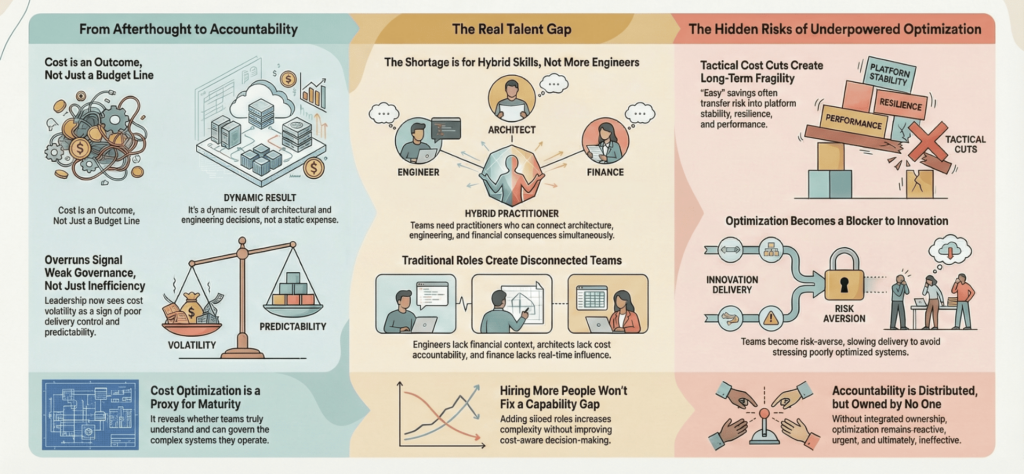
The following visual synthesises a pattern now visible across large cloud environments: cloud cost optimisation failures are rarely caused by excessive consumption alone, but by weak accountability structures and fragmented capability. As cloud estates scale, cost becomes an outcome of architectural and engineering decisions made every day, not a static financial variable. This image illustrates how organisations move from treating cost as an afterthought to recognising it as a direct reflection of delivery maturity, while also highlighting the talent gaps and delivery risks that emerge when optimisation is handled by underpowered or poorly integrated teams.

 
Illustration showing how cloud cost optimisation depends on hybrid talent across architecture, engineering, and finance, highlighting how underpowered optimisation teams create delivery risk, platform fragility, and reduced innovation velocity.
Cloud cost optimisation outcomes increasingly reflect organisational capability maturity, exposing hybrid talent gaps and the hidden delivery risks created by fragmented ownership and tactical cost-cutting.

The shortage is therefore qualitative rather than quantitative, centred on senior practitioners who have managed large-scale cloud platforms in production and understand how cost, risk, and delivery velocity interact over time. Until organisations recognise cloud cost optimisation as a hybrid execution capability rather than a functional responsibility, they will continue to experience talent shortages that no amount of traditional hiring can resolve.

How underpowered cloud teams quietly convert cost optimisation initiatives into long term delivery risk

Why cloud cost optimisation fails most often through gradual erosion of platform resilience, engineering confidence, and execution velocity rather than visible financial overruns

When cloud cost optimisation is driven by teams lacking sufficient seniority or architectural authority, the organisation often mistakes tactical activity for strategic control. Optimisation actions are introduced quickly to demonstrate responsiveness to cost pressure, yet they are rarely grounded in a full understanding of workload behaviour, resilience requirements, or future growth paths. These decisions tend to optimise for immediate spend reduction while transferring risk into platform stability and delivery execution, where it remains largely invisible to financial governance.

As these measures accumulate, the platform environment becomes increasingly fragile. Engineering teams encounter unexplained performance degradation, reduced tolerance for traffic spikes, and longer recovery times during incidents. Delivery plans are quietly reshaped to avoid stressing constrained systems, slowing transformation without any explicit prioritisation decision. In this way, cloud cost optimisation executed without the right capability does not simply fail to deliver value; it actively undermines the organisation’s ability to deliver with confidence.

Several recurring risk patterns tend to emerge in this phase:

  • Rightsizing and consolidation decisions made without sufficient production context

  • Cost controls enforced without alignment to service level or resilience commitments

  • Engineering teams absorbing degradation rather than escalating structural issues

Over time, these conditions create a feedback loop where cost optimisation is perceived internally as a constraint rather than an enabler. Teams become risk-averse, innovation slows, and the organisation begins to trade long-term platform health for short-term financial optics. The absence of experienced practitioners who can balance cost, reliability, and velocity is what allows this erosion to continue unchecked.

Why capability led workforce design is becoming the decisive factor in cloud cost optimisation success rather than tooling or headcount

Many enterprises respond to cloud cost pressure by hiring into narrowly defined roles or launching short-term optimisation initiatives, assuming that additional capacity or tooling will resolve the issue. In practice, these responses often deepen existing structural weaknesses. Role-based staffing separates responsibility for cost, architecture, and delivery, leaving no single individual or team accountable for end-to-end cloud economics. Optimisation becomes something imposed on delivery teams rather than embedded within them, creating friction, mistrust, and fragmented decision-making.

This fragmentation is reinforced by operating models that treat cloud cost optimisation as an episodic intervention rather than a continuous execution discipline. Cost reviews are triggered by budget overruns, corrective actions are applied under pressure, and attention shifts elsewhere until the next spike occurs. Each cycle leaves behind incremental architectural compromise and delivery fatigue. Without sustained senior capability embedded close to execution, the organisation repeats the same patterns while believing it is addressing the problem.

Between these cycles, several systemic constraints consistently emerge:

  • Hiring focuses on isolated cloud or FinOps roles rather than integrated execution capability

  • Accountability for cloud economics is distributed across functions but owned by none

  • Optimisation efforts remain reactive, driven by financial thresholds instead of design intent

Insights and case studies from Yallo reinforce why these models struggle at scale across complex enterprise environments in the GCC and India. In programmes where cloud cost optimisation outcomes improved sustainably, the shift was not towards more aggressive cost control, but towards capability-led workforce design. Architect-vetted, delivery-experienced teams were embedded alongside platform and engineering leaders, restoring decision quality at points where cost, resilience, and delivery velocity intersect. These teams did not operate as auditors or external controllers, but as execution partners with the authority to influence architectural and behavioural choices in real time.

What becomes clear from these examples is that cloud cost optimisation is not primarily a financial challenge, but a test of organisational maturity. Enterprises that continue to rely on fragmented staffing and traditional hiring models will remain exposed to talent shortages and recurring optimisation failure. Those that redesign their workforce around capability, authority, and execution experience are far better positioned to stabilise cloud economics without compromising transformation momentum. In this sense, successful cloud cost optimisation reflects not how aggressively an organisation pursues savings, but how deliberately it designs the teams responsible for delivering them.
Recent Post

How We Serve

TS/EA as a Service

Empowering Business Transformation with Expert Technology Strategy

Talent in a Box

Scaling Innovation with World-Class Talent

Managed IT COE

Delivering Seamless IT Operations at Scale

Leave a Comment

Your email address will not be published. Required fields are marked *

Scroll to Top