Why Traditional Staffing Models Cannot Support Complex SAP or Oracle Delivery
Enterprise programmes fail not from insufficient headcount but from workforce models designed for the wrong type of execution
Volume-Based Staffing and the Illusion of Delivery Capacity
Traditional staffing models optimise for headcount, not execution capability
SAP S/4HANA migrations and Oracle Cloud transformations follow predictable staffing patterns. Programme budgets are approved. Delivery timelines are set. Resource plans are built around headcount projections—50 consultants for Phase 1, 80 for Phase 2, scaling to 120 at cutover. Staffing agencies are engaged. CVs are screened. Teams are assembled based on role categories and day rates. The programme appears adequately resourced. Then execution stalls.
The stall is rarely attributed to staffing. Timelines extend due to “complexity” or “scope changes.” Integration dependencies are escalated. Configuration decisions are deferred. Cutover is postponed. But the underlying issue remains: traditional staffing models optimised delivery capacity as a function of headcount, not capability depth. This creates structural execution risk that compounds as the programme progresses.
Traditional staffing models operate on assumptions that break down in complex enterprise delivery:
- Roles are fungible within categories: Any senior SAP SD consultant is assumed to perform similarly to another. In reality, experience varies drastically in integration complexity, cutover authority, and production stabilisation capability.
- Headcount scales linearly with scope: Adding consultants mid-programme without system-level context increases coordination overhead and decision latency rather than accelerating delivery.
- CV credentials predict delivery capability: Years of experience and certifications do not indicate ability to navigate enterprise-specific constraints, legacy dependencies, or political complexity that characterise large SAP and Oracle programmes.
- Offshore-onshore ratios optimise for cost efficiency: Talent fragmentation between GCC enterprises and India delivery centres multiplies execution risk when role authority and decision-making are split across geographies.
The fourth critical assumption embedded in traditional staffing models is that geographical distribution can be optimised purely for cost arbitrage. Offshore teams execute tasks as defined. Onshore teams retain decision authority. The structural gap creates permanent escalation dependency that slows delivery regardless of total headcount deployed.
The result is programmes staffed to capacity but structurally incapable of executing complex delivery. Teams have sufficient headcount but lack the specific capability composition required to navigate SAP module integration across legacy landscapes, manage Oracle Cloud configuration decisions under regulatory constraints, or execute cutover within operational continuity limits. Traditional staffing models delivered volume. They did not deliver execution capacity. This distinction determines whether enterprise programmes succeed or accumulate delivery risk that surfaces only after significant investment has been committed.
Role Categories Versus Delivery Authority
Generic role labels obscure the authority gaps that create execution failure
Traditional staffing models structure teams around generic role categories: functional consultants, technical consultants, architects, project managers, testers. These categories work for standardised implementations. They fail in complex enterprise environments where execution depends not on role labels but on authority, system-level judgement, and delivery accountability that transcends functional boundaries.
The breakdown manifests across critical decision points:
- Integration design: A team has five integration consultants, but none have authority to make cross-module design decisions that bind SAP FI/CO, MM, and SD. Integration architecture is delegated to committees. Decisions are deferred. Delivery slows.
- Configuration lock-down: Functional consultants outnumber technical resources three to one, but configuration decisions that impact performance, data migration, and cutover sequencing require technical authority no one on the team possesses.
- Cutover orchestration: The programme has project managers, but no single individual has both the technical depth and organisational authority to own end-to-end cutover execution across SAP, Oracle, and legacy system dependencies.
- Production stabilisation: Post go-live support is staffed with junior and mid-level consultants. Senior resources who understand root cause analysis within enterprise-specific customisations have rolled off. Issues escalate without resolution.
This is not a skills gap. It is an authority and accountability gap created by traditional staffing models that prioritise role distribution over delivery ownership. The team structure assumes coordination will substitute for authority. It does not. Coordination without authority creates decision latency. Decision latency creates execution risk. Execution risk accumulates until the programme stalls or fails.
The gap widens in GCC enterprises relying on India delivery centres:
- Offshore teams are staffed with functional and technical consultants who execute tasks as defined but lack decision authority
- Onshore teams retain decision authority but lack system-level technical depth to make informed choices quickly
- The split creates a structural bottleneck where offshore teams wait for decisions and onshore teams lack capacity to make them with confidence
- The programme operates in permanent escalation mode where issues move up rather than get resolved at the appropriate level
Traditional staffing models created this structure to optimise cost. They created execution fragility instead. The coordination overhead required to bridge the authority gap often exceeds any cost savings achieved through offshore ratios.
Newsletter
Get the latest updates and insights delivered to your inbox.
Thank you!
You have successfully joined our subscriber list.
Experience Depth Versus CV Tenure in High-Risk Delivery
Traditional staffing models screen for credentials, not execution capability in comparable complexity
Traditional staffing models prioritise CV credentials—years of SAP or Oracle experience, module certifications, prior project participation. These credentials signal baseline competence. They do not predict capability to execute delivery in environments where complexity is non-standard, where legacy dependencies constrain design choices, or where political and operational risk must be navigated alongside technical execution.
The mismatch surfaces in predictable failure modes:
- A consultant with ten years SAP SD experience is assumed capable of leading order-to-cash design and integration. In reality, they have implemented SD in standardised environments but struggle with legacy pricing engine integration and multi-ERP cutover sequencing.
- An Oracle Cloud HCM certified consultant understands Oracle configuration but lacks experience navigating regulatory compliance in GCC labour law contexts or integrating with legacy payroll systems that cannot be decommissioned.
- An SAP Solution Architect with eight implementations has worked on greenfield or bolt-on projects but lacks authority to make binding decisions in politically complex matrix organisations where functional stakeholders resist architectural constraints.
- A Senior Programme Manager with fifteen years delivery experience has managed coordination and reporting but has never owned technical cutover execution or production stabilisation accountability
This creates teams that appear experienced on paper but lack the capability composition required to execute delivery when programmes encounter non-standard challenges—custom code remediation, legacy middleware dependencies, cutover rollback scenarios, or production performance issues rooted in enterprise-specific data volumes and transaction patterns. Traditional staffing models optimised for credential verification. They did not optimise for delivery capability. The difference determines whether programmes execute or accumulate hidden risk that surfaces during cutover when remediation options are limited and business pressure is highest.
SAP and Oracle delivery succeeds when workforce design prioritises execution authority over headcount volume
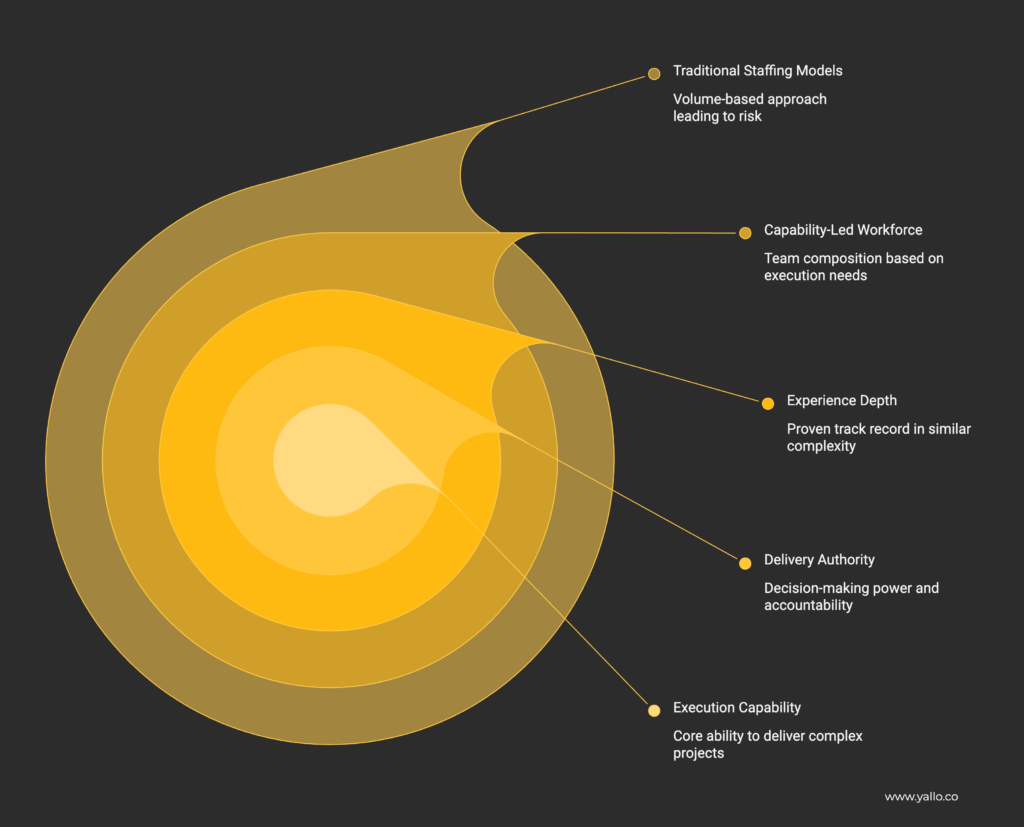
SAP and Oracle delivery risk is mitigated not by increasing headcount or refining role ratios but by designing workforce models around verified capability and delivery authority from programme inception. This requires shifting from volume-based staffing to capability-led team composition where roles are defined by execution accountability, not task categories, and where talent is sourced based on demonstrated delivery outcomes in comparable complexity.
A capability-led workforce model operates on different principles than traditional staffing models. Senior roles are defined by decision-making authority and system-level accountability, not by task delegation. Talent is assessed based on verifiable delivery outcomes in environments with similar technical, operational, and political complexity. Teams are sized based on the specific capabilities required at each programme phase, not generic resource-to-scope ratios. Roles bridge functional, technical, and delivery boundaries rather than operating within siloed specialisations.
Yallo‘s case studies from SAP and Oracle delivery programmes in GCC enterprises validate this approach. Programmes succeed when workforce models prioritise capability depth and delivery authority over headcount volume. Insights from complex enterprise delivery demonstrate that architect-vetted talent with execution track records in comparable environments reduces delivery risk more effectively than scaling teams through traditional staffing models. The pattern repeats across programmes: execution capability, not staffing scale, determines whether SAP and Oracle delivery produces operational outcomes without accumulating the execution risk that characterises volume-based workforce models designed for credential screening rather than delivery certainty.