Talent Velocity vs Business Velocity Why GCC Transformations Fall Out of Sync

How mismatched talent velocity in the GCC is slowing enterprise transformation despite aggressive business timelines and digital investment.

December 19, 2025 5 mins Read Insight

The Hidden Gap Between Business Ambition and Talent Velocity in the GCC

Why transformation programmes accelerate faster than the talent systems meant to deliver them.

Across the GCC, enterprise transformation programmes are moving at unprecedented speed. Governments and large organisations are launching national platforms, AI-led initiatives, cloud migrations, and sector-wide modernisation efforts with aggressive timelines and high expectations. Business velocity has accelerated as leadership pushes for faster outcomes, shorter payback cycles, and visible progress aligned to national economic agendas. However, beneath this momentum lies a growing misalignment between how quickly organisations want to move and how fast they can realistically mobilise the right talent to deliver.

This misalignment is rooted in talent velocity rather than talent availability. While the region continues to attract global professionals and invest in workforce development, the systems responsible for sourcing, evaluating, and deploying specialist capability have not evolved at the same pace as business ambition. The talent velocity gcc enterprises experience is often constrained by slow hiring cycles, rigid role definitions, and recruitment-led processes that prioritise compliance over delivery readiness. As a result, transformation initiatives begin with strong intent but struggle to maintain execution speed once complexity increases and specialist skills become critical.

The impact of this gap is subtle at first. Programmes start on time, but teams operate under-staffed or overextended, architectural decisions are postponed, and delivery dependencies accumulate. Over time, this erodes confidence, increases reliance on a small number of individuals or vendors, and introduces delivery risk that is difficult to reverse mid-programme. In fast-moving transformation environments, even small delays in talent mobilisation can compound into significant execution challenges, causing business velocity and talent velocity to fall increasingly out of sync.

How Slow Talent Velocity Disrupts High-Speed Transformation Programmes

The operational and architectural consequences of delayed or mismatched capability.

When talent velocity fails to match business velocity, the consequences extend far beyond hiring delays. High-speed transformation programmes depend on timely access to specialised capabilities at precise moments in the delivery lifecycle. Architecture definition, platform stabilisation, integration, and scale-out phases each require different skill concentrations. If these capabilities are introduced too late or in insufficient depth, programmes lose momentum at the points where precision matters most.

In the GCC, this challenge is amplified by the scale and interdependence of transformation initiatives. Large enterprises often run multiple programmes in parallel, sharing critical resources across cloud, data, cybersecurity, ERP, and AI domains. Slow talent velocity forces teams to stretch existing capability across too many initiatives, increasing burnout and reducing quality of decision-making. As complexity rises, teams compensate by escalating work to system integrators or external partners, often at significant cost and with limited knowledge transfer. This creates short-term progress but weakens long-term organisational capability.

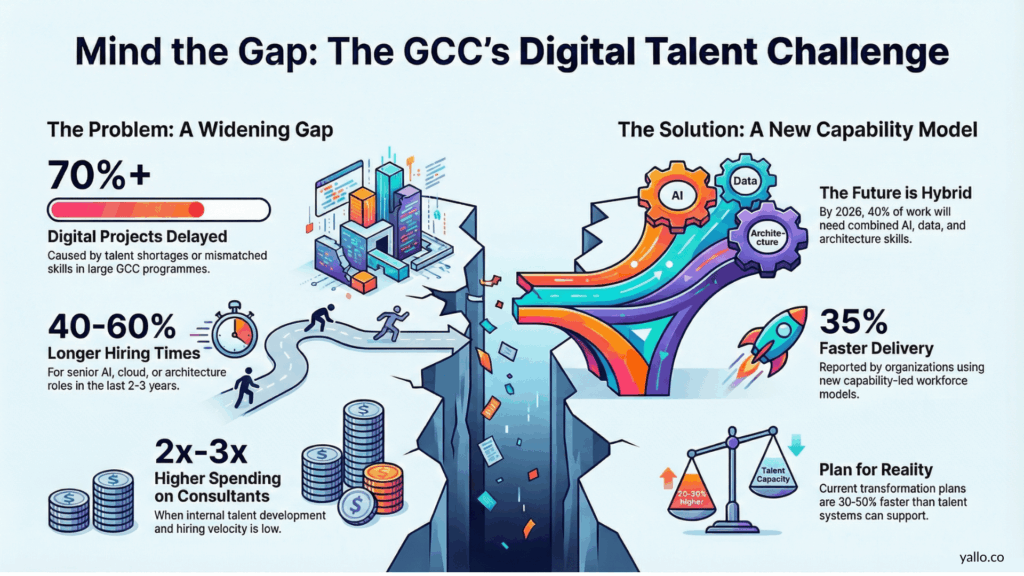
One of the clearest indicators that GCC transformations are falling out of sync is the widening gap between how fast organisations want to move and how quickly talent systems can respond. While business leaders accelerate timelines to meet digital, AI, and national transformation goals, talent velocity remains constrained by outdated hiring models and capability mismatches. This gap manifests not as a single failure point, but as accumulated delivery friction across programmes. The visual below captures how this imbalance is forming and why a different workforce model is now required.

Infographic showing the GCC digital talent gap, highlighting delayed digital projects, longer hiring timelines, higher consultant spending, and the shift toward capability-led workforce models to improve delivery speed.
The widening gap between business velocity and talent velocity in the GCC is delaying digital programmes, increasing dependency on consultants, and forcing enterprises to rethink how capability is sourced and deployed.

The deeper issue is that traditional talent systems are not designed to operate at transformation speed. Recruitment processes assume stable role requirements and predictable timelines, while modern programmes demand rapid adjustment as scope and technology evolve. Without mechanisms to dynamically reinforce teams, align talent to delivery risk, and redeploy capability as programmes mature, organisations struggle to sustain execution velocity. Over time, the gap between business ambition and talent velocity gcc enterprises can achieve becomes one of the primary reasons transformation initiatives stall, overspend, or fail to deliver their intended outcomes.

Why Traditional Hiring Models Cannot Match Business Velocity

Structural reasons recruitment-led models fall behind modern delivery needs.

Traditional hiring models were built for environments where change was incremental and roles were clearly bounded. They assume that requirements can be defined upfront, approved through multiple layers, and filled through linear recruitment processes. In today’s GCC transformation landscape, this assumption no longer holds. Programmes evolve continuously, delivery risks emerge unexpectedly, and critical capability gaps surface mid-execution. When talent systems move slower than delivery needs, they become a structural constraint on progress.

A key reason traditional hiring fails to keep pace is that it optimises for process completion rather than delivery impact. Roles may be filled on paper, but the talent introduced often lacks the contextual experience required to operate in complex, fast-moving environments. This slows decision-making, increases dependency on a few senior individuals, and forces teams into reactive workarounds. In practice, slow talent velocity gcc enterprises experience is rarely about a lack of candidates; it is about misalignment between hiring models and real execution demands.

Several structural limitations repeatedly surface in traditional hiring approaches:

  • Static job descriptions that fail to reflect evolving delivery realities

  • Long approval and onboarding cycles that delay access to critical capability

  • Screening processes led by recruitment metrics rather than delivery context

  • Difficulty evaluating depth of experience in AI, cloud, and architecture-heavy roles

  • Over-reliance on system integrators when internal hiring cannot move fast enough

These limitations become increasingly visible as business velocity accelerates. Transformation programmes may start with momentum, but they lose speed as talent gaps widen and delivery complexity increases. Without changes to how talent is sourced and assessed, enterprises remain locked into a cycle where business ambition consistently outpaces execution capacity.

Reengineering Talent Velocity to Match Business Velocity

Synchronising talent velocity with business velocity requires more than incremental improvement to existing hiring processes. It demands a fundamental shift in how enterprises design and manage their workforce. Rather than treating talent acquisition as a downstream activity, leading organisations integrate it directly into transformation planning. Talent availability becomes a design constraint alongside architecture, budget, and timelines.

At the core of this shift is a move from role-based hiring to capability-led workforce design. Instead of focusing on filling predefined positions, enterprises identify the specific capabilities required at each phase of delivery and mobilise them dynamically. This approach recognises that different stages of a programme carry different risks and therefore require different concentrations of expertise. When implemented effectively, it allows organisations to maintain execution speed without overbuilding permanent teams.

Enterprises that successfully improve talent velocity gcc-wide tend to adopt several common practices:

  • Aligning talent planning with delivery milestones rather than organisational headcount plans

  • Reinforcing teams dynamically during high-complexity or high-risk phases

  • Using deeper, architect-led evaluation to assess real-world delivery capability

  • Blending permanent teams with specialist talent to maintain flexibility without losing control

  • Continuously adjusting workforce composition as technology and scope evolve

This reengineered approach enables organisations to respond to change without destabilising execution. It shortens decision cycles, improves delivery confidence, and reduces long-term dependency on external vendors. In an environment where transformation speed is a strategic differentiator, aligning talent velocity with business velocity becomes one of the most important capabilities GCC enterprises can build.

Building a Sustainable Talent Velocity Advantage in the GCC

As transformation becomes a permanent state rather than a finite initiative, GCC enterprises must recognise that sustaining business velocity depends on their ability to engineer talent velocity deliberately. This requires moving beyond reactive hiring and toward a systemic approach where talent flow, capability depth, and delivery risk are managed as interconnected elements. Organisations that succeed will be those that treat talent supply not as an administrative function, but as a strategic capability embedded within their transformation operating model.

A sustainable talent velocity advantage is built through foresight and precision. Enterprises need visibility into where capability gaps are likely to emerge, the flexibility to reinforce teams before delivery slows, and evaluation models that prioritise real execution experience over surface-level credentials. This approach reduces reliance on emergency hiring and vendor escalation, allowing organisations to maintain momentum even as programmes scale or change direction. Over time, it strengthens internal capability while preserving the agility required in fast-moving transformation environments.

This is where Yallo supports enterprises navigating the gap between ambition and execution. We help organisations strengthen talent velocity by providing architect-vetted specialist talent across cloud, data, AI, cybersecurity, ERP, DevOps, and large-scale programme delivery. Our focus is on aligning capability with delivery complexity, enabling teams to scale intelligently rather than reactively. Through our Insights, we analyse workforce trends, emerging capability gaps, and delivery risks shaping transformation across the GCC and India. Through our Case Studies, we demonstrate how capability-led talent interventions have helped enterprises stabilise programmes, accelerate execution, and reduce long-term dependency on external vendors.


Recent Post

How We Serve

TS/EA as a Service

Empowering Business Transformation with Expert Technology Strategy

Talent in a Box

Scaling Innovation with World-Class Talent

Managed IT COE

Delivering Seamless IT Operations at Scale

Leave a Comment

Your email address will not be published. Required fields are marked *

Scroll to Top