The Talent Risk Inside Most GCC Transformation Programmes

Why most delays in GCC transformation programmes are caused long before they become visible

April 10, 2026 5 mins Read Insight

The Delay Starts Before the Programme Begins

Most GCC transformation programmes that miss their delivery milestones do not fail because of strategy, technology selection, or budget. They fail because the right person was not available at the right moment in the programme.
 
This is not a recruitment problem. It is a planning problem that looks like a recruitment problem by the time it surfaces.
 
We have observed this pattern consistently across SAP, Oracle, Microsoft, and Salesforce implementations in the UAE and wider GCC over the past 18 months. The mechanism is almost identical each time. The timing is almost always the same. And the fix is simpler than most programme leaders expect, but only if it is applied before week two, not week eight.

Finding 1: Week 8 is when the warning signal appears, but the decision that caused it was made back in week 2.

When a programme misses its first milestone, the conversation in the steering committee almost always centres on the week the problem became visible. Week eight. The build phase has started. A key workstream is blocked. The specialist is not in place.

The instinct is to escalate to HR or a recruiter. The recruiter begins searching. Four to six weeks pass. The programme absorbs the delay and calls it a resource issue.

But the gap did not open in week eight. It opened in week two — when the programme plan was confirmed, the governance structure was agreed, the solution design workstream was resourced, and nobody asked: when does the talent workstream start, and who owns it?

The talent workstream almost never appears in a GCC programme plan as a parallel track with its own milestones, its own lead time, and its own owner. It appears as a line item in the HR plan, triggered reactively when a vacancy is confirmed.

By the time a vacancy is confirmed in a transformation programme, the role has already been needed for four weeks.

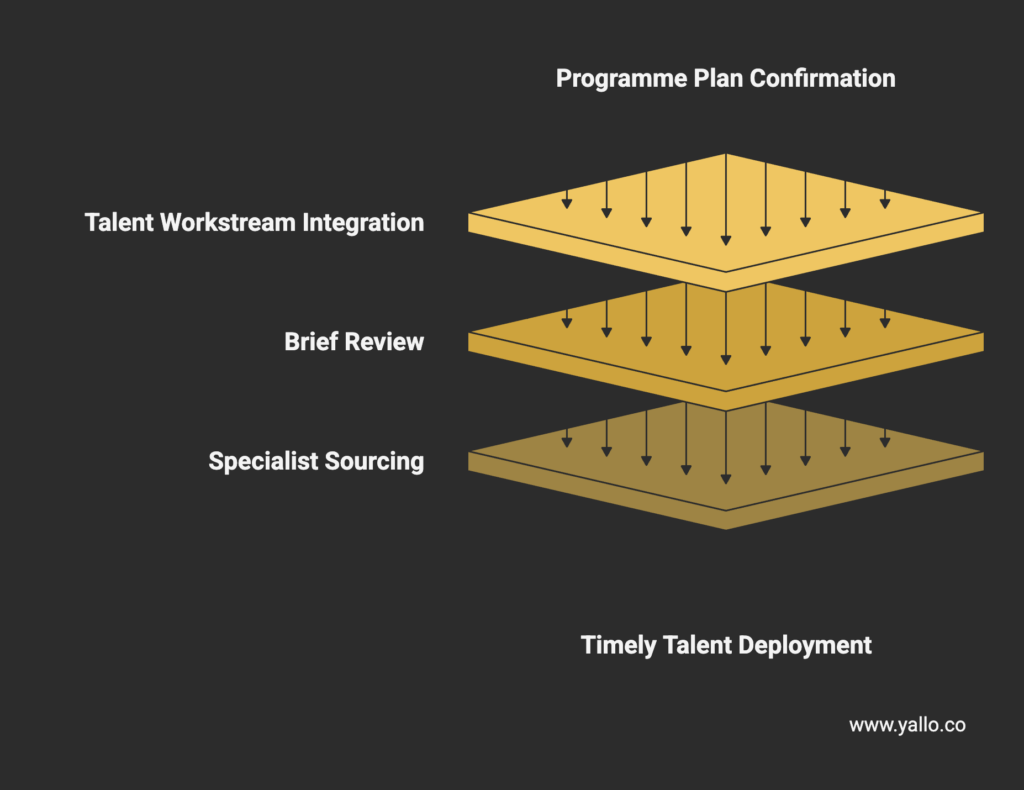
The fix: Start the talent workstream at the same time as the solution design workstream. Not after the design is complete. Not after the programme kickoff. At the same time. The talent plan should be a deliverable of week two alongside the programme governance framework, with role profiles, sourcing lead times, and deployment dates mapped against the programme timeline.

Layered diagram showing programme plan confirmation at the top, followed by talent workstream integration, brief review, and specialist sourcing leading to timely talent deployment
Timely programme delivery depends on integrating talent planning early — from workstream alignment and brief review to specialist sourcing

What this shows in practice is simple: delivery outcomes are not decided during execution — they are set much earlier, when talent is planned, defined, and sourced. When these layers are aligned from the start, programmes move without friction. When they are not, delays are almost inevitable, regardless of how strong the strategy or technology may be.

Finding 2: Generic recruitment adds 4–6 weeks even when it eventually delivers the right person.

When a specialist role does go to recruitment,  whether internal HR or an external agency,  the average time from brief submission to consultant on-site for a specialist technology role in the UAE is between eight and fourteen weeks through traditional channels.

That is not because the UAE talent market is empty. It is because the process has structural delays that compound:

The brief goes to a generalist recruiter who does not know the difference between an Oracle EBS consultant and an Oracle Fusion Cloud consultant. The search goes wide. CVs arrive that meet the keyword criteria but not the programme criteria. Screening rounds consume three weeks. The shortlist is wrong. The brief is revised. The search restarts.

Four to six weeks of that timeline is not talent scarcity,  it is process friction that a specialist sourcing model eliminates entirely.

A specialist talent partner who maintains a pre-vetted pool of UAE-experienced consultants in a specific platform can deliver a shortlist of two to three genuinely relevant profiles within 24 to 48 hours of receiving a properly structured brief. The difference is not speed for its own sake, it is the elimination of the screening rounds that consume most of the calendar time in a generic recruitment process.

The data point that matters: For a programme running on a sixteen-week implementation cycle, a four to six week recruitment delay represents twenty-five to thirty-seven percent of the total programme timeline. That is not a resource issue. That is a structural planning risk.

Finding 3: The most common cause is a brief that was not reviewed at programme level before sourcing began.

This is the finding that surprises most programme sponsors when we share it, because it points inward rather than at the market.

A brief that reads “Oracle Fusion Finance functional consultant, minimum five years experience, UAE residency preferred” will return the wrong profiles almost every time it goes to a generalist recruiter. Not because the recruiter is incompetent. Because the brief is incomplete in ways that are only visible to someone who knows what the programme actually needs.

What the programme typically needs is something considerably more specific:

An Oracle Fusion Finance functional consultant who has delivered in a UAE enterprise context, not just any Oracle Fusion Finance consultant. One who has EBS background, because the programme is in a parallel-run phase with EBS still live. One who understands UAE VAT configuration, IFRS compliance, and ideally Islamic finance module requirements if the client is a bank. One who has operated in a dual-environment configuration before, because the reconciliation work between two Oracle estates requires consultants who can navigate both systems simultaneously.

Those three specificity requirements,  UAE context, EBS background, dual-environment experience, eliminate approximately eighty percent of available Oracle Fusion Finance profiles in the UAE market. They are not niche requirements. They are programme requirements. And they are almost never in the brief that goes to the recruiter, because the brief was written by an HR business partner who did not attend the programme design workshop.

The fix: The role brief for every specialist position on a GCC transformation programme should be reviewed and signed off by the programme director or solution architect before it goes to sourcing. The brief should specify not just the platform and the module, but the programme context, the UAE-specific requirements, the parallel system environment if applicable, and the delivery phase the consultant is joining. A brief reviewed at programme level before sourcing begins cuts time-to-deployment by half, not because the market changes, but because the search starts in the right place.

What this means in practice

Three actions that address all three findings, in priority order:

Action 1 — Add a talent workstream to your programme plan from day one. Map every specialist role against the programme timeline. Assign sourcing lead times. Identify which roles have UAE-specific requirements that narrow the available pool. Treat talent planning as a programme deliverable, not an HR task.

Action 2 — Review the brief at programme level before it goes to sourcing. The programme director or solution architect should review and approve every specialist brief. The brief should include programme context, UAE-specific requirements, and system environment. This is a thirty-minute conversation that eliminates weeks of misdirected search.

Action 3 — Use a specialist pool for UAE-specific roles. Generic recruitment is appropriate for generalist roles. For specialist technology positions with UAE-specific configuration requirements, Oracle EBS, SAP S/4HANA, Salesforce in UAE public sector, Microsoft Dynamics with UAE VAT,  a pre-vetted specialist pool with UAE enterprise context on every profile is the only model that delivers within programme timelines.

A note on the data

The observations in this article are based on YALLO’s Oracle and SAP practice lead assessment of UAE and GCC enterprise programme patterns across Q3 2024 to Q1 2026. Sourcing time benchmarks reflect traditional UAE market recruitment timelines, not YALLO’s deployment model. Individual programme experiences vary based on role specificity, organisation procurement process, and programme phase.

Recent Post

How We Serve

TS/EA as a Service

Empowering Business Transformation with Expert Technology Strategy

Talent in a Box

Scaling Innovation with World-Class Talent

Managed IT COE

Delivering Seamless IT Operations at Scale

Questions About Specialist Hiring, Answered

Because the right talent isn’t available when it’s needed. Most delays aren’t caused by strategy or technology — they come from roles that were planned too late and filled reactively.

Usually in week two — when the programme plan is finalised but talent isn’t treated as a parallel workstream. The issue only becomes visible around week eight, when delivery is already blocked.

A brief that focuses only on job titles and years of experience. Without programme context, system environment, and region-specific requirements, recruiters search in the wrong part of the market.

Roles are defined with precision, sourcing begins early, and deployment aligns with programme milestones. Instead of reacting to gaps, the programme prevents them.

Treat talent as a core workstream from day one — with clear ownership, defined timelines, and programme-level review of every specialist role before sourcing begins.

Leave a Comment

Your email address will not be published. Required fields are marked *

Scroll to Top