The “Slop Layer” Crisis: Why Your AI Code Pilot Is Costing You Millions
Is your AI-driven productivity really improving your bottom line, or simply mortgaging your company’s future?
February 10, 2026
5 mins Read
Insight
Is your AI-driven productivity really improving your bottom line, or simply mortgaging your company’s future?
In today’s rush to implement generative AI across software delivery teams, many organizations are mistaking busywork for value. Sure, AI can help complete specific tasks up to 35% faster, but behind the scenes, most businesses are creating a dangerous byproduct we call the “Slop Layer”: vast layers of unmaintainable code that nobody understands, and worse, nobody can fix.
At YALLO, we’ve watched this trend unfold across global enterprises, especially within the Middle East’s booming tech landscape and the UK’s competitive retail and BFSI sectors. The optimism around AI coding assistants quickly collides with the harsh reality of enterprise software engineering, leaving organizations to pay the price in technical debt, lost developer productivity, and failed ROI.
The Myth of AI-Driven Software Productivity
Generative AI code assistants are marketed as productivity powerhouses, tools that will overhaul your software delivery process overnight. Demos may look impressive: AI writes code from simple prompts, refactors legacy modules, or scaffolds entire services with a few keystrokes.
But there’s a critical problem:
AI doesn’t understand long-term enterprise software architecture.
It doesn’t see the ecosystem. It doesn’t understand domain boundaries. And most importantly, it doesn’t carry forward context. What it produces is syntactically valid, but often architecturally purposeless code that creates more problems than it solves.
This phenomenon manifests as:
Vibe coding — where developers “vibe” software into existence without architectural intent.
Code sprawl — AI contributes to code duplication and inconsistent engineering patterns.
Structural debt — emergent systems lacking connective tissue between modules.
The result? A growing crater of unmanageable code that undermines long-term delivery velocity.
The Empirical Reality: AI Pilots That Didn’t Deliver ROI
While AI continues to inspire pilots and buzzword-filled PoCs, the numbers tell a different story:
95% of generative AI pilots in enterprise software fail to deliver measurable ROI.
The time developers spend correcting AI code or fixing hallucinations can be 11+ hours per week.
The aggregate technical debt from AI-generated code, if measured, would translate to billions of workdays to pay off globally.
These aren’t hypothetical figures, they reflect trends we’ve observed firsthand with executives and delivery teams working through ambitious AI strategies with limited structural support. In many large enterprises, AI tools are being used as a shortcut. But short-cuts without strategy create shortfalls, not success.
Newsletter
Get the latest updates and insights delivered to your inbox.
Thank you!
You have successfully joined our subscriber list.
Why the “Slop Layer” Matters in Retail and BFSI
If you’re a CIO or CTO leading delivery in retail or BFSI (especially in the UK or Middle East), you’re operating in industries where:
Regulatory compliance is non-negotiable
Security and resiliency must be built in, not bolted on
System dependencies span decades of legacy investments
In this context, AI-spawned code that fails to respect architectural boundaries is not just inefficient, it’s dangerous.
Every extra layer of unstructured code becomes:
A blocker to scalability
A vector for defects or vulnerabilities
A catalyst for spiraling delivery costs
Traditional approaches to software delivery already struggle with complexity. Multiply that by AI’s short-sighted code suggestions? You compound the problem.
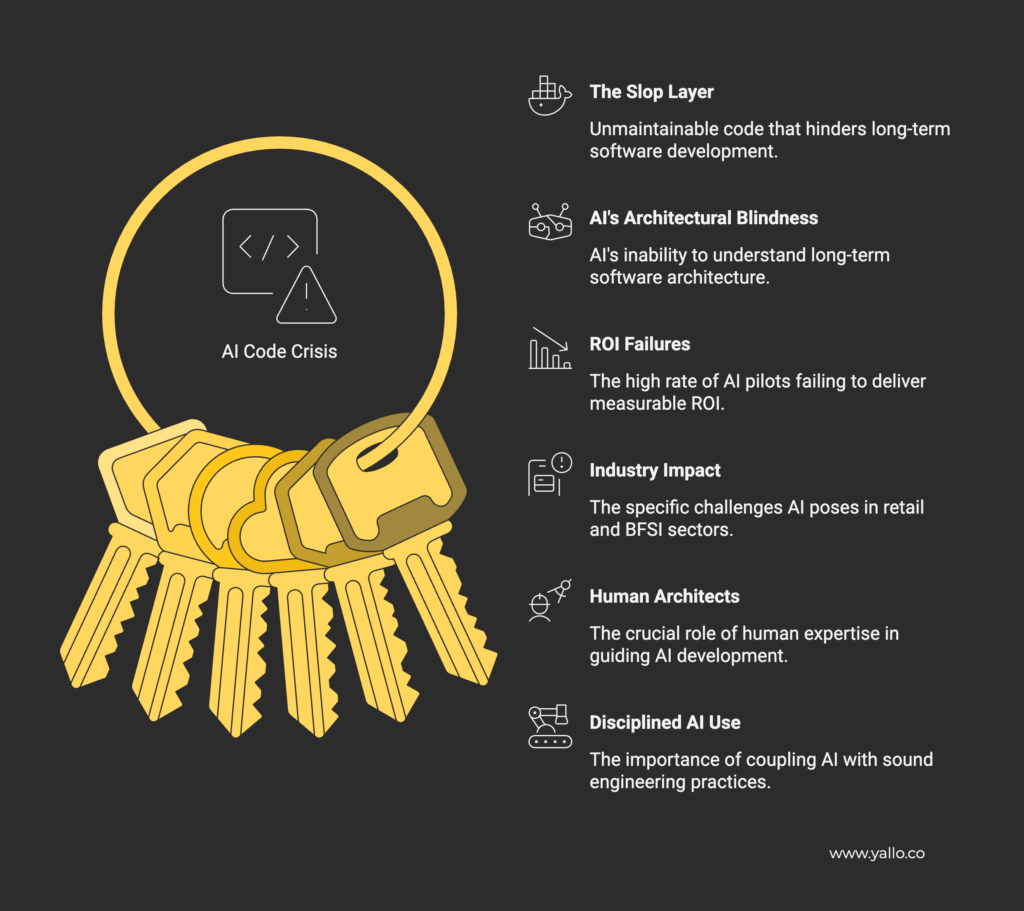
The “Slop Layer” — how AI-generated code, without architectural discipline, quietly turns productivity gains into long-term technical debt.
The slop layer forms when AI-generated code prioritizes immediate task completion over system-wide coherence. Lacking an understanding of long-term software architecture, AI tools unintentionally introduce structural blind spots, inflate technical debt, and contribute to AI pilots that fail to deliver measurable ROI. In complex industries like retail and BFSI, where systems must remain secure, compliant, and scalable, this architectural erosion becomes a serious business risk, not just a technical inconvenience.
Successful Digital Transformation Requires More Than Prompts
The industry hype wants you to believe that:
“If you just ask the AI the right way, the solution emerges.”
But prompting your way to success is like expecting a house to build itself because you provided a blueprint. Without expert builders, structural engineers, and project leadership, you end up with something that looks like a house on the outside… and collapses under strain.
AI is a tool, not a strategist.
To actually reduce technical debt and deliver measurable value, organizations need:
Human Architects With Enterprise Perspective Enterprise architects bring:
A holistic view of system architecture
Expertise in design patterns and integration
Long-term thinking beyond individual tasks
AI excels at repetitive code generation. Humans excel at making sense of complexity.
Introducing the “Talent in a Box” Model
At YALLO, we’ve developed a delivery model designed to bridge the gap between strategy and execution:
What It Solves
Eliminates reliance on junior “AI babysitters”
Ensures architectural intent is preserved across development
Reduces time spent fixing and reworking AI output
Prevents future technical debt before it forms
How It Works
Our Talent in a Box model provides:
Vetting by senior architects
Ongoing architectural guidance
Delivery teams aligned with enterprise-grade quality standards
Context-aware talent that can pay down existing debt instead of accumulating more
This approach transforms AI from a cost center into a productivity enhancer — but only when backed by architectural discipline.
AI Isn’t the Problem — Misuse Is
AI tools will continue to proliferate, and they will only improve over time. But the organizations that succeed won’t be those that adopt AI thoughtlessly. They’ll be the ones that:
Couple AI with disciplined engineering practices
Prioritize architectural integrity over short-term gains
Invest in talent with deep domain knowledge
AI can accelerate software delivery, but only when it’s part of a thoughtful, human-led engineering process.
Don’t Let Your Codebase Become a Liability
The costs of embracing AI without architectural discipline are real, and they’re compounding. It’s not just about fixing a bug here or there. It’s about safeguarding your software ecosystem, your delivery velocity, and your bottom line.
If your AI pilot is creating a “Slop Layer” of code that’s expensive to maintain and impossible to scale, it’s time to rethink your approach. AI should augment strategy, not replace it. And the organizations that understand this will be the ones that thrive, not just survive, in the era of AI-assisted software delivery.