How Saudi Arabia’s Greenfield Advantage Is Accelerating AI Talent Innovation
Saudi Arabia’s new digital ecosystems, giga projects, and AI native platforms are creating an unmatched opportunity to build modern talent capabilities from the ground up.
The Greenfield Advantage Transforming Saudi Arabia’s AI Talent Landscape
Building digital foundations from scratch allows the Kingdom to skip legacy constraints and design modern capability systems.
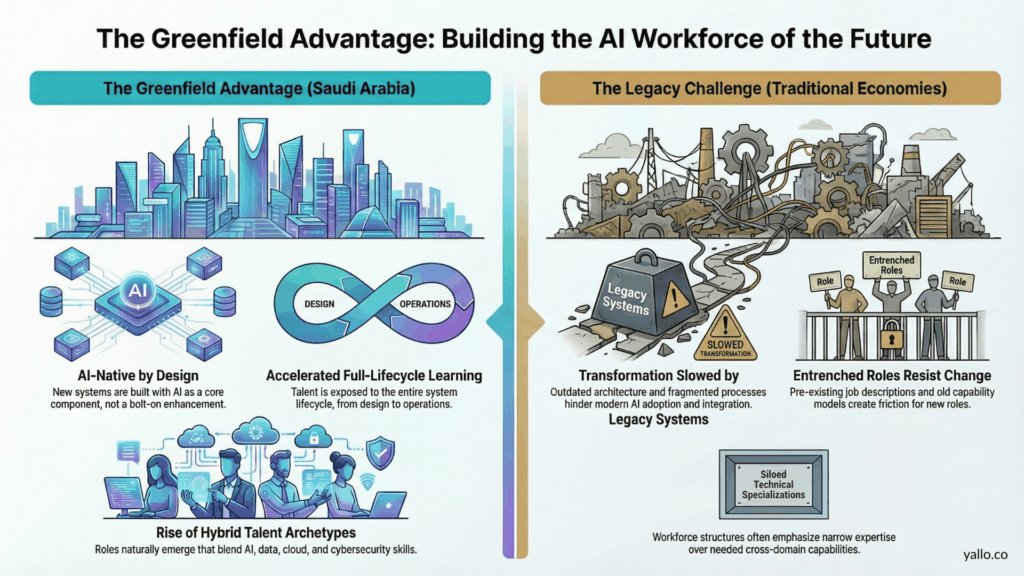
Saudi Arabia is in a unique moment of digital acceleration. Unlike regions where AI adoption must contend with legacy systems, fragmented processes, and outdated organisational models, the Kingdom is building many of its most ambitious platforms entirely from the ground up. This greenfield advantage is creating an environment where technology stacks, governance models, operating frameworks, and workforce structures can all be designed with AI as a first-class component rather than as a bolt-on enhancement. The absence of inherited constraints allows enterprises and government entities to innovate at a pace that global markets find difficult to match.
This greenfield environment has significant implications for talent development. Traditional digital economies often struggle to reshape their workforce because entrenched roles, legacy job families, old delivery rhythms, and outdated capability models slow transformation. Saudi Arabia, by contrast, is constructing digital ecosystems where new roles, modern engineering practices, and AI-native operating models can be institutionalised from the beginning. This means that organisations can define talent architecture based on current and future needs rather than historical patterns or inherited structures.
What makes this transformation particularly powerful is the way Saudi teams are learning to operate across integrated digital foundations. Platforms powering Vision 2030 initiatives—ranging from smart cities and national identity systems to logistics, public services, and financial innovation—require talent capable of engaging with AI, data, cloud, cybersecurity, and sector-specific workflows simultaneously. The greenfield nature of these systems allows organisations to design roles that reflect real operational requirements rather than retrofitting outdated job descriptions. As a result, AI talent innovation is not being slowed by legacy design. It is being shaped in real time as new systems, capabilities, and governance models emerge.
To understand the depth of this shift, consider how greenfield programs allow organisations to introduce capability structures that would otherwise be difficult to impose. These include:
- talent models built around system stewardship rather than task execution
- hybrid roles that combine architectural judgment with operational fluency
- workforce structures that emphasise cross-domain capability rather than siloed technical specialisation
These elements highlight why Saudi Arabia’s greenfield advantage is accelerating the formation of a new AI-ready workforce. Instead of adapting old roles to fit new realities, enterprises can design talent for the AI era from inception.
Why Greenfield Digital Ecosystems Accelerate AI Talent Innovation
Emerging AI platforms, giga projects, and national initiatives create unique conditions for next generation skill formation.
The acceleration of AI talent innovation in Saudi Arabia is driven by a combination of structural, technological, and organisational factors that rarely align in traditional markets. Greenfield digital ecosystems are not merely technology projects; they are environments where enterprise capabilities, delivery patterns, and workforce expectations evolve together. This integrated evolution creates a powerful platform for developing AI talent at a speed and scale that established digital economies cannot easily replicate.
The pace of innovation increases further because greenfield environments allow teams to engage with AI from foundational layers onward. Professionals involved in early-stage platform development gain exposure to the full system lifecycle—use case design, data architecture, AI workflow construction, model operations, governance, and system reliability. This exposure accelerates learning curves, deepens cross-functional fluency, and builds stronger judgment across technical and operational domains. Unlike in legacy enterprises, where talent interacts with AI only at the final integration stage, Saudi teams are learning through direct involvement in full-stack AI development.
Within these ecosystems, the emergence of hybrid capability clusters is particularly noticeable. Greenfield programmes make it possible to define roles that naturally blend multiple disciplines, such as:
• AI consistent data engineering capability aligned with governance and quality requirements
• architecture roles that span cloud, integration, AI inference, and security layers
• operational functions that understand both system behaviour and domain workflows
These clusters reflect the reality that AI systems do not operate in isolated domains. They function within interconnected environments where data, compute, security, and business processes converge. Saudi Arabia’s greenfield context allows these multidimensional roles to form organically at scale, creating a new generation of AI talent that is both technically proficient and system-aware.
The New AI Talent Archetypes Emerging in Saudi Arabia’s Greenfield Economy
Cross functional, multi disciplinary roles are becoming central to operating AI first national systems.
Saudi Arabia’s greenfield digital expansion is not only modernising technology infrastructure; it is reshaping the architecture of enterprise roles themselves. As organisations build AI-native platforms, smart city systems, data governance layers, and autonomous workflows from scratch, entirely new categories of talent are emerging. These roles reflect the nature of AI systems operating in complex, interconnected environments, where traditional job boundaries no longer apply.
Within this evolution, one of the most distinct patterns is the rise of hybrid intelligence roles. These roles operate where human oversight and machine autonomy converge and require strong reasoning, structured decision-making, and the ability to anticipate system drift. They often emerge in greenfield programmes because teams participate in building core logic rather than merely maintaining legacy systems. They represent:
- architectural roles that integrate AI models into operational workflows and enterprise decision layers
- governance roles that supervise model integrity, system behaviour, and compliance alignment
- operations roles that maintain reliability across AI inference, data pipelines, and cloud platforms
These archetypes illustrate the type of workforce Vision 2030 requires. They demonstrate why Saudi Arabia’s greenfield advantage is producing AI talent with deeper, broader capability than what is possible in constrained legacy markets. The roles emerging today will form the backbone of the Kingdom’s AI-enabled economy for decades ahead.
How Saudi Enterprises Can Build and Sustain Greenfield Ready AI Capability
For Saudi enterprises, the opportunity created by greenfield digital ecosystems is significant, but capitalising on it requires deliberate talent strategy. Building and sustaining a workforce capable of operating AI-native systems is not achieved by conventional hiring or traditional training pathways. It requires a capability-led model that focuses on depth, adaptability, and system-level judgment.
This is the strategic gap Yallo helps Saudi enterprises close. We provide architect-vetted specialists across AI, cloud, cybersecurity, data engineering, ERP, DevOps, and digital operations, ensuring organisations have the capability required to build, supervise, and evolve greenfield digital systems. Through our Insights, we analyse emerging talent patterns and capability risks across the GCC. Through our Case Studies, we show how specialist deployment reduces execution friction, improves system reliability, and builds sustainable internal expertise.
Saudi Arabia’s greenfield digital momentum is reshaping the future of enterprise capability in the region. The organisations that succeed will be those that align their workforce architecture with the complexity, velocity, and ambition of national transformation. AI-native systems require AI-ready talent, and building that capability is now a strategic imperative for every enterprise engaged in Vision 2030.
Newsletter
Get the latest updates and insights delivered to your inbox.
Thank you!
You have successfully joined our subscriber list.