Oracle Retail vs SAP S/4HANA for GCC enterprise, the talent implications
Beyond platform choice, how talent availability and specialist depth shape execution in UAE and KSA programmes
The platform decision shapes the talent problem
The choice between platforms is often framed as a technology decision. In practice, it defines the talent strategy that follows.
Each platform brings its own ecosystem of specialists, with different levels of availability, geographic concentration, and delivery experience. SAP S4HANA offers a broader global pool, while Oracle Retail operates within a smaller, more concentrated specialist base. That difference directly impacts how quickly teams can be built, how roles are structured, and how much flexibility exists in sourcing.
This becomes more pronounced in the GCC context. Programmes are not just looking for functional expertise, but for consultants who understand regional requirements such as UAE VAT, KSA compliance, and stakeholder dynamics across large enterprise environments. The platform choice determines how many of these profiles actually exist in the market.
What this really means is that the platform decision is also a resourcing decision. It sets the boundaries for how easy or difficult it will be to find the right people, how early hiring needs to start, and how much reliance there will be on hybrid or remote delivery models.
SAP S/4HANA larger pool, but not always relevant
SAP S4HANA has a clear advantage in terms of scale. The global talent pool is significantly larger, and in the GCC this translates into a broader set of available consultants across functional and technical roles. On the surface, this makes SAP easier to staff compared to more niche platforms.
The challenge is relevance. A large portion of the available pool does not carry the specific experience required for GCC enterprise programmes. There is a material difference between a generic SAP consultant and one who has delivered S4HANA transformations in UAE or KSA, understands localisation requirements, and has worked within complex multi stakeholder environments.
As programme requirements become more specific, the effective talent pool narrows quickly. A broad list of available SAP consultants may reduce to a much smaller group when filtered for retail domain experience, migration exposure, and GCC context. This creates a false sense of supply in early planning stages.
For hiring teams, this means the question is not whether SAP talent is available, but whether the right SAP talent is available at the time it is needed.
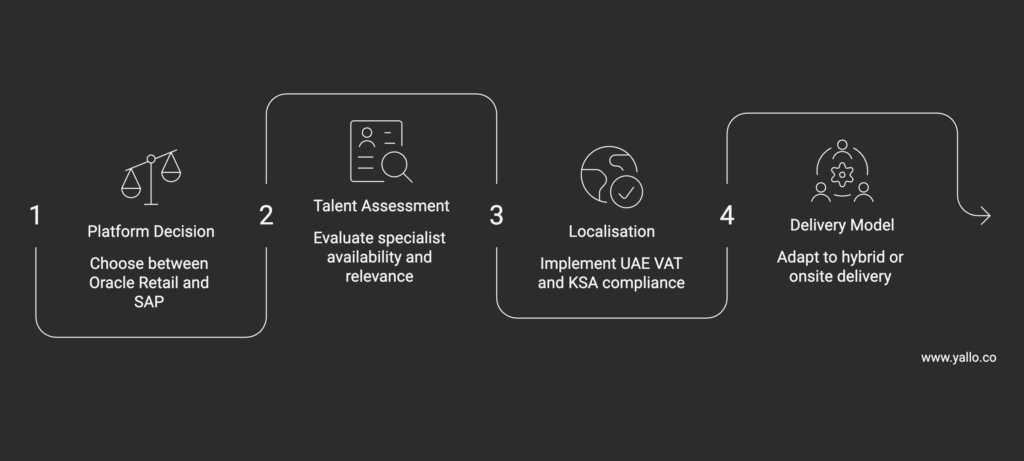
The platform decision is only the starting point. What follows is a sequence of talent decisions that directly shape delivery outcomes. From assessing the availability of specialists with relevant GCC experience to addressing localisation requirements such as UAE VAT and KSA compliance, each step introduces its own constraints. The final decision around delivery model whether hybrid or fully onsite then determines how effectively organisations can access and deploy that talent. Programmes that treat these steps as a single connected system move faster and avoid last minute sourcing pressure.
Oracle Retail smaller pool and tighter hiring constraints
Oracle Retail operates within a much smaller specialist ecosystem, and that changes the hiring dynamic immediately. Compared to SAP, the number of consultants with hands on experience in RMS RPAS or Xstore is limited, and a large share of them are already engaged in active programmes. This creates a tighter and more competitive market. When demand increases, as seen in recent UAE retail programmes, the available pool reduces quickly. Shortlists are smaller, timelines extend, and organisations often find themselves competing for the same set of candidates.
The constraint is not just about numbers but also about context. Many Oracle Retail roles require prior exposure to GCC retail environments, localisation requirements, and integration across complex system landscapes. When these filters are applied, the pool becomes even narrower.
For programme teams, this means less flexibility in sourcing and a greater need for early planning. Delays in defining requirements or initiating hiring cycles often translate directly into longer lead times and higher costs.
Newsletter
Get the latest updates and insights delivered to your inbox.
Thank you!
You have successfully joined our subscriber list.
What this means for programme planning
The most constrained roles in the current market are not always the most obvious ones. Programme Directors with GCC delivery experience, for example, are among the hardest to source quickly. These roles require not just technical understanding, but the ability to navigate stakeholders, manage dependencies, and drive execution across complex environments.
Timing becomes critical here. Organisations that begin sourcing these roles 10–12 weeks in advance are able to access a wider pool of candidates. India-based specialists are increasingly acting as a bridge in this environment. Roles such as Oracle Fusion Finance, Azure architecture, and Salesforce can often be delivered in a hybrid model, combining remote expertise with onsite presence during key phases.
What this market dynamic highlights is the need for more proactive and context-driven talent planning. Teams that align hiring timelines with programme needs early are better positioned to maintain delivery momentum. This is also where companies like Yallo operate, helping enterprise teams navigate these constraints by aligning specialist talent to programme context and timing, rather than treating hiring as a separate, reactive process.
Localisation and delivery model change the equation
Localisation requirements add another layer of complexity. While both platforms support UAE VAT and KSA compliance, the way these are implemented differs. In many Oracle Retail programmes, localisation often requires an additional specialist beyond the core functional team.
The delivery model also varies between platforms. SAP functional roles are well established in hybrid setups, where part of the team operates remotely from India while key roles remain onsite. The ecosystem, training infrastructure, and documentation support this model effectively.
Oracle Retail roles, particularly in areas like RPAS and Xstore, are less suited to remote delivery. The smaller talent pool and higher dependency on programme context often require more onsite presence, which impacts both cost and hiring flexibility.
What this highlights is that platform choice is not just a technical decision. It shapes how teams are built, how quickly they can scale, and how easily gaps can be filled during execution. This is where a more context-driven approach to hiring becomes important, and where companies like Yallo work closely with programme teams to align specialist talent with platform, localisation, and delivery realities from the start.
Recent Post
Questions About Specialist Hiring, Answered
SAP S/4HANA has a larger global specialist pool, making it generally easier to staff in GCC. However, both platforms become significantly harder to staff when the brief requires GCC-specific localisation experience — UAE VAT, Saudi ZATCA, or Arabic language handling. Oracle Retail specialists with GCC retail programme experience are particularly scarce.
Oracle RMS and RPAS specialists in UAE command AED 1,600–2,200 per day for contract roles in Q2 2026, with Xstore specialists ranging from AED 1,400–1,900 per day. Senior Oracle Retail architects with GCC retail programme delivery experience command rates at the higher end.
SAP functional roles (MM, SD, FI, CO) are well-suited to India-remote delivery on GCC programmes, with a deep specialist pool. Oracle Retail roles, particularly RPAS demand planning and Xstore, are less commonly delivered remotely from India due to a smaller specialist base and higher programme context requirements.
A typical GCC Oracle Retail implementation requires: RMS functional lead, RPAS demand planner, Xstore POS specialist, integration architect (Oracle to other systems), localisation specialist (UAE/KSA specific), and a Programme Manager with Oracle Retail GCC delivery experience.
Due to the smaller specialist pool, Oracle Retail sourcing in GCC typically takes 2–3 weeks longer than SAP sourcing. YALLO maintains a pre-screened network of Oracle RMS, RPAS, and Xstore specialists with active GCC delivery experience, reducing this timeline significantly.