The Middle East Talent Gap and the Workforce Strategies Required for Sustainable GCC Growth
A strategic examination of the Middle East talent gap and the capability development required to support rapid transformation across the GCC
December 02, 2025
5 mins Read
Insight
Understanding the Scale and Urgency of the Middle East Talent Gap
Why the Middle East talent gap is widening as GCC economies accelerate national transformation and shift toward knowledge-based growth
The Middle East talent gap has become one of the defining structural constraints facing GCC economies as they move through the most ambitious period of modernisation in their history. While global growth is expected to slow, PwC highlights that GCC GDP continues to strengthen, supported by diversification away from hydrocarbons and significant expansion in digital infrastructure, logistics, tourism, and public-sector transformation initiatives. Yet this progress has surfaced a critical deficit: the capabilities required to sustain transformation are evolving faster than organisations can develop them. As national visions in Saudi Arabia, the UAE, Qatar, and Oman push the region toward knowledge-based competitiveness, the depth and sophistication of skill requirements have increased sharply across technology, leadership, sustainability, and data-driven operations. (PwC)
This acceleration has exposed a substantial misalignment between current workforce capabilities and the competencies required for emerging roles. PwC’s analysis reveals that only 35 percent of assessed employees across more than 20 public sector organisations had the capabilities necessary to operate effectively in their roles, leaving the majority with significant skill gaps that hinder operational continuity and strategic progress . This finding illustrates that the Middle East talent gap is not simply a recruitment challenge but a capability readiness challenge. Organisations now face rising delivery risks, bottlenecks in programme execution, and increased dependency on external vendors because their internal talent pipelines are not scaling at the pace transformation demands. Without structured intervention, these capability deficits widen over time, diminishing both organisational competitiveness and national productivity.
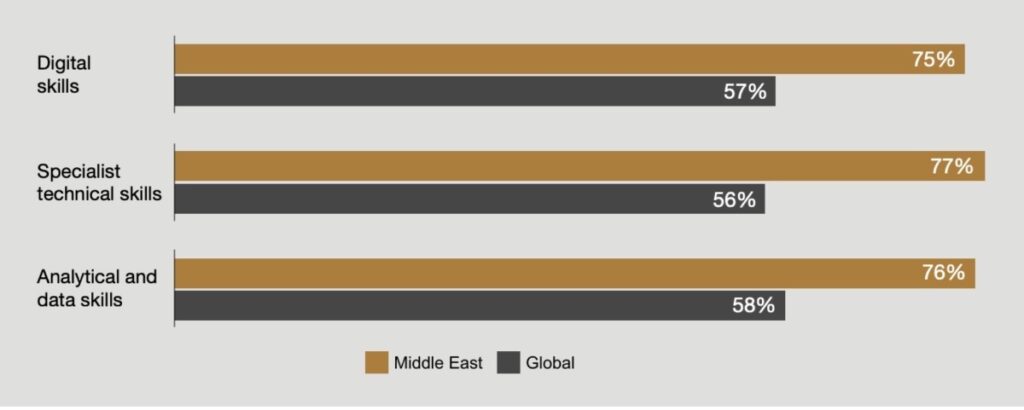
The urgency becomes even more pronounced when examining the shifting expectations of the workforce itself. According to PwC’s Workforce Hopes and Fears Survey, a majority of employees in the region believe their jobs will change significantly within the next five years, requiring new skills in analytics, digital operations, green transformation, and specialist technical domains; 75 percent cite digital skills as a top priority, well above global averages, and 77 percent emphasise specialist technical capabilities as essential for their career progression . This sentiment reflects both the opportunity and the pressure confronting GCC organisations. Employees recognise the need to evolve, but the structures to support that evolution remain uneven. As the Middle East talent gap continues to expand, the organisations that act early, through capability assessments, targeted upskilling, and redesigned workforce architectures—will be the ones positioned to sustain momentum across complex transformation programmes. (PwC)
Why GCC Organisations Must Act Now to Build Capability and Reduce Workforce Risk
How accelerating transformation initiatives are intensifying pressure on organisations to address the Middle East talent gap before it undermines long term progress
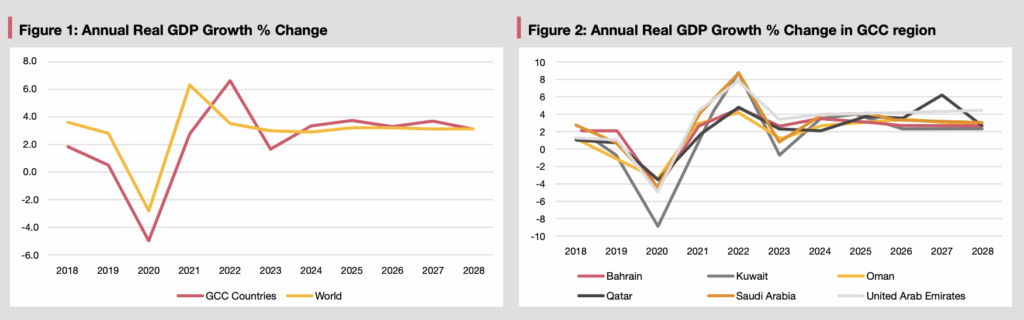
The urgency for GCC organisations to respond to the Middle East talent gap becomes clearer when viewed alongside the region’s macroeconomic trajectory. As PwC highlights, GCC economies continue to outperform global averages, driven by diversification, infrastructure investment, and large national transformation programmes. This sustained growth is not theoretical it is visible in the region’s GDP performance. Before positioning new workforce strategies, it is important to understand the magnitude of this acceleration, because economic expansion without parallel capability development creates immediate and long-term delivery risk. The first set of charts illustrates how the GCC has outpaced global growth since 2020 and is projected to maintain a stronger upward trend. These figures matter because they show an economy expanding faster than its workforce capabilities, widening the Middle East talent gap at the exact moment when transformation programmes require deeper technical and leadership competence.
GCC vs global GDP growth performance and individual GCC country growth trends, highlighting the scale of regional expansion and increasing capability demands. Source: PwC.
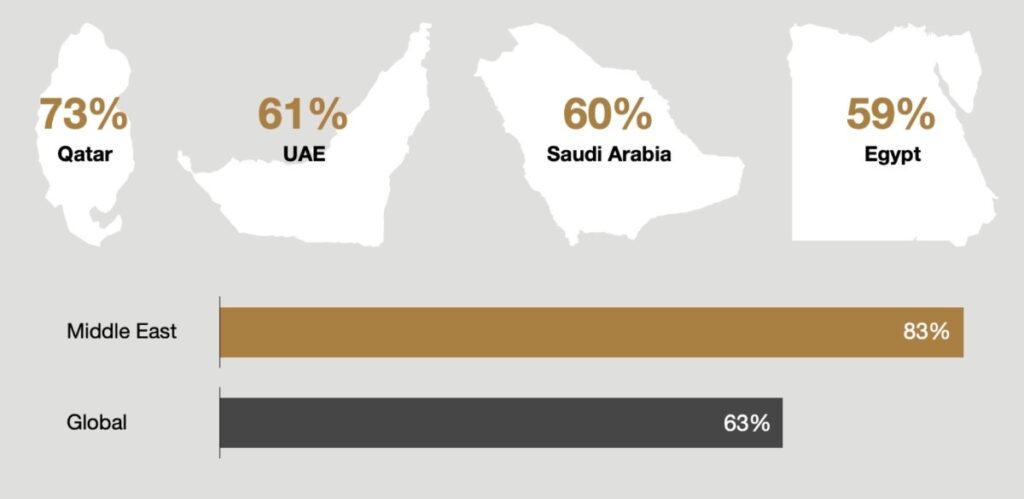
The divergence between national economic momentum and workforce capability maturity is a fundamental driver of organisational pressure. As transformation programmes scale across Saudi Arabia, the UAE, Qatar, and Oman, organisations face widening capability gaps that directly affect delivery timelines, programme stability, and long-term competitiveness. The urgency is further reinforced by shifts within the workforce itself. Employees across the region recognise that the skills required for their roles will change significantly within the next five years, driven by digital transformation, data-driven operations, and sustainability mandates. PwC’s survey data shows a striking regional readiness for green, digital, and specialist technical skills, but it also exposes a capability depth challenge: employees may understand the need to upskill, but organisational structures and training pathways are not evolving quickly enough. (PwC)
Regional prioritisation of green and leadership skills vs global averages, illustrating workforce expectations and emerging skill demands. Source: PwC.
This data reinforces a critical organisational challenge. The workforce is signalling readiness for skill evolution, but without structured capability assessments, targeted development pathways, and investment in continuous learning, organisations cannot convert this readiness into operational outcomes. The Middle East talent gap is therefore expanding from both ends, from the demands of accelerating national transformation, and from the workforce recognising but not yet receiving the development required to meet these new expectations.
How Capability Assessments Provide the Foundation for Closing the Middle East Talent Gap
Why GCC organisations must build a precise understanding of current workforce capabilities before investing in large scale upskilling
The expansion of digital, cloud, AI, sustainability, and data-driven initiatives across the GCC is creating a rapidly evolving skills environment that organisations can no longer manage through traditional training or reactive hiring. The PwC report shows that while employees across the region recognise the importance of digital and analytical skills, most organisations do not have a clear view of their workforce’s current capability baseline. This is the core reason the Middle East talent gap continues to widen. Capability assessments offer a structured mechanism to evaluate skills systematically, identify gaps with precision, and determine which employees require targeted development to support ongoing transformation. Without this diagnostic foundation, organisations risk deploying fragmented upskilling programmes that consume resources but fail to shift organisational readiness. The following graphic highlights a critical insight: employees across the Middle East prioritise digital skills, specialist technical expertise, and analytical and data skills at significantly higher levels than the global average. This is not just an expression of preference it is a reflection of the capabilities required to keep pace with the region’s transformation agenda.
Regional prioritisation of digital, specialist technical, and analytical skills compared with global averages, revealing the scale of capability shifts underway. Source: PwC.
This skills prioritisation data demonstrates why capability assessments are becoming indispensable for GCC organisations. Employees are signalling readiness to evolve, but organisations need clear, data-driven insight into where their capability gaps sit and which high-priority roles require immediate intervention. Capability assessments make this possible by generating objective data that can be directly mapped to transformation programmes, leadership pipelines, and mission-critical technical roles. For organisations navigating the Middle East talent gap, this approach shifts upskilling from ad hoc training to targeted capability building, ensuring every investment contributes to measurable readiness and reduces delivery risk across large-scale transformation initiatives. (PwC)
The Strategic Workforce Shifts Required to Close Capability Gaps and Enable Transformation Readiness
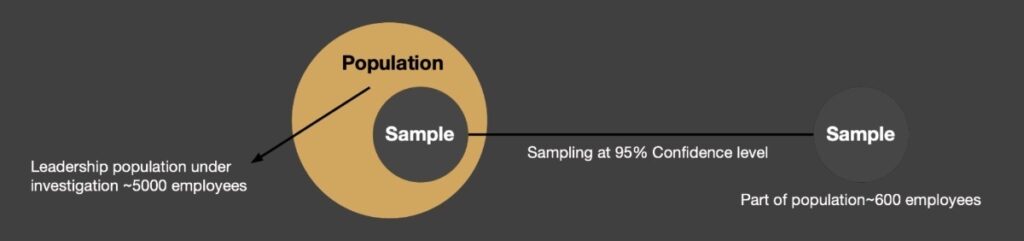
The complexity of transformation programmes across the GCC means organisations cannot rely on intuition or surface-level performance indicators to identify what skills they lack. PwC’s findings emphasise that the Middle East talent gap is driven not only by shortages in digital and analytical capabilities but also by uneven leadership readiness, inconsistent workforce maturity, and the absence of mechanisms to assess large populations efficiently. This reality has prompted organisations to adopt statistical, data-driven capability assessments that move beyond traditional HR evaluations. By sampling large leadership populations with rigorous confidence levels, organisations can identify skill gaps with accuracy, prioritise critical development areas, and reduce the risk of overtraining or misallocating resources. The following graphic provides an example of how large-scale capability assessment can be streamlined using representative sampling. Instead of assessing all 5,000 employees, a statistically significant sample of 600 individuals at a 95 percent confidence level can be used to reveal organisational capability patterns with precision.
Statistical sampling model demonstrating how organisations can assess large leadership populations efficiently. Source: PwC.
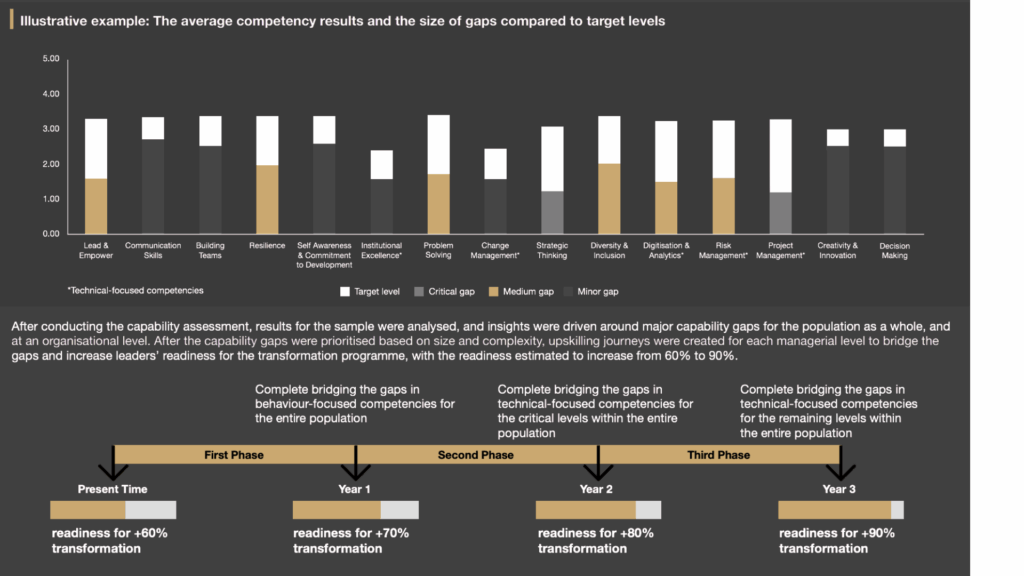
This method gives organisations the ability to understand capability gaps at scale without disrupting operations or incurring prohibitive costs. It also ensures that upskilling programmes are aligned with real-world skill deficits rather than assumptions, allowing leaders to prioritise competencies that directly impact transformation readiness and long-term organisational performance. The next graphic illustrates how competency gaps translate into staged upskilling roadmaps. This is critical because transformation readiness is not achieved through one-off training initiatives. Organisations must close behavioural and technical gaps in waves, starting with foundational competencies like communication and problem-solving, before advancing toward analytics, digitisation, strategic thinking, and project management. This staged approach strengthens both capability depth and organisational resilience, enabling teams to absorb change, manage risk, and deliver at scale. (PwC)
Competency gaps and a phased readiness roadmap demonstrating how targeted upskilling increases transformation capability over time. Source: PwC.
This structured model underscores an essential truth for GCC organisations: transformation readiness is a measurable outcome, not an abstract aspiration. When organisations identify the right capability gaps, build targeted interventions, and execute development journeys over multiple cycles, they materially increase their ability to deliver complex transformation programmes. As organisations across the region confront the widening Middle East talent gap, the challenge is no longer simply skill acquisition, it is the stabilisation of the entire workforce engine that underpins transformation. This is where strategic talent partners become essential. At YALLO, we design architect-led capability models, deploy specialist contract and project-based talent, and build ME–India blended teams that strengthen delivery outcomes across cloud, data, AI, ERP, DevOps, cybersecurity, and application modernisation. Our approach ensures that organisations do not merely hire for roles, they reinforce the capability layers that determine delivery stability. In many cases, YALLO can fix the Talent Supply Chain, ensuring organisations have the specialised skills they need at every stage of transformation. For deeper evidence, our Insights and Case Studies illustrate how the right talent structure can accelerate timelines, reduce dependency risk, and raise transformation readiness across the region.
Newsletter
Get the latest updates and insights delivered to your inbox.