Hiring senior engineers and the rising demand for AI and data engineers

Hiring senior engineers has become more challenging as companies increasingly compete for experienced AI and data engineering talent.

March 23, 2026 5 mins Read Insight

Hiring senior engineers is changing because AI roles are expanding

Hiring senior engineers now includes growing demand for AI engineers and data engineers across technology teams.

Hiring senior engineers has evolved significantly as companies continue to invest heavily in artificial intelligence and data driven technologies. Engineering teams are no longer focused only on traditional backend or application development roles. Today, hiring senior engineers increasingly includes specialists who can work on machine learning systems, data platforms, and intelligent automation. As organizations adopt AI capabilities across products and operations, the need for experienced engineers who understand both software engineering and data systems continues to grow.

Another factor shaping hiring senior engineers is the shift toward building internal AI infrastructure. Many companies are developing their own data pipelines, machine learning platforms, and AI driven applications instead of relying only on external tools. This creates demand for engineers who can design scalable data architectures, deploy machine learning models in production, and manage large datasets efficiently. Because these skills combine software engineering, data engineering, and AI expertise, the number of qualified senior engineers in this space remains limited.

As a result, hiring senior engineers today often means competing for candidates who have experience working with machine learning systems, distributed data platforms, and modern AI frameworks. Organizations across industries are investing in similar capabilities, which increases demand for these roles across the entire technology ecosystem. This shift is one of the key reasons hiring senior engineers with AI and data expertise has become more competitive and time consuming for many companies. Many of the challenges around hiring senior engineers are also influenced by broader market dynamics, which we explored earlier when discussing how hiring timelines can stretch across competitive tech ecosystems.
The Core Layers of an Effective AI Stack for Enterprises

Understanding the data, infrastructure, model, application, and governance foundation

Hiring senior engineers involves a much deeper evaluation compared to most other engineering roles. Companies expect senior engineers to contribute beyond writing code. They are expected to design systems, make architecture decisions, review technical trade offs, and guide other engineers on the team. Because of these expectations, hiring senior engineers usually includes several interview rounds that test system design thinking, problem solving ability, and real world engineering experience.

Another reason hiring senior engineers takes longer is the structure of the interview process itself. Most companies include multiple stages such as technical screening, system design discussions, coding rounds, and leadership interviews. In many cases hiring senior engineers also involves interviews with engineering managers and senior architects who want to understand how a candidate approaches large scale engineering problems. Coordinating these interviews across different teams often adds extra time to the process.

During the process of hiring senior engineers, companies also take more time to evaluate cultural fit and long term impact. Since senior engineers often influence technical direction and mentor junior developers, engineering leaders want to ensure the candidate aligns with the team’s working style and technical standards. This careful evaluation helps companies make better hiring decisions, but it also means that hiring senior engineers rarely happens quickly and usually takes several weeks to complete.

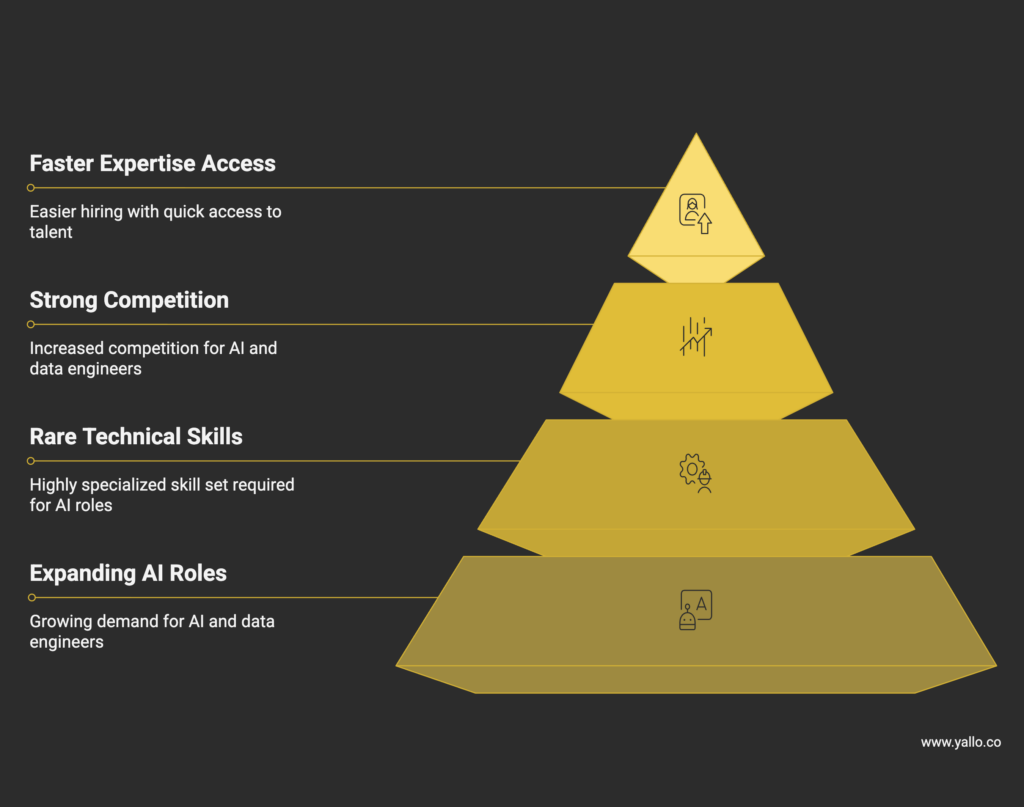
Hiring senior engineers infographic showing expanding AI roles, rare technical skills, strong competition for AI engineers, and faster expertise access.
Key factors influencing hiring senior engineers for AI and data roles including expanding AI demand, specialized technical skills, increasing market competition, and faster access to expertise.

The rise of artificial intelligence and data driven systems is significantly changing how organizations approach hiring senior engineers. In the past, many engineering teams primarily focused on hiring backend developers, application engineers, or infrastructure specialists. Today, however, companies are increasingly investing in AI capabilities, advanced analytics, and intelligent platforms. As a result, hiring senior engineers now often involves roles such as AI engineers, machine learning engineers, and data engineers who can design and operate complex data and AI systems.

This shift has introduced new challenges for companies that are hiring senior engineers. AI and data engineering roles require a combination of software engineering expertise, strong understanding of data systems, and practical experience with machine learning technologies. Engineers who possess these capabilities are relatively rare because building production ready AI systems requires both deep technical knowledge and real world project experience. When many organizations begin hiring senior engineers with similar AI and data skills, the available talent pool becomes highly competitive.

Hiring senior engineers in Bangalore means competing with many tech companies

Hiring senior engineers becomes harder when multiple companies target the same experienced engineers in the Bangalore tech ecosystem.

Hiring senior engineers in Bangalore is particularly challenging because the city is one of the largest technology hubs in India. Many global product companies, technology giants, and fast growing startups operate from the same ecosystem. When these organizations begin hiring senior engineers at the same time, they often compete for the same group of experienced developers who already have strong system design and large scale engineering experience.

Another factor that slows down hiring senior engineers is the number of opportunities available to experienced candidates. Senior engineers in Bangalore frequently receive multiple interview calls and job offers from different companies. This creates a situation where candidates take more time to evaluate options, negotiate compensation, or explore roles that offer stronger technical challenges. As a result companies hiring senior engineers often experience delays because candidates may pause processes or accept competing offers.

The competition also pushes companies to be more careful when hiring senior engineers. Engineering leaders want to ensure they attract candidates who can contribute long term and influence technical direction. Because of this, companies may spend additional time refining job expectations, evaluating candidate experience, and aligning internally before making an offer. This competitive environment is another reason hiring senior engineers in Bangalore often takes several weeks instead of happening quickly.

Hiring senior engineers faster requires a structured talent approach

Hiring senior engineers often becomes slow not because companies lack intent but because the process of finding the right expertise takes time. Engineering leaders need people who can contribute to architecture, guide teams, and handle complex systems from day one. When companies rely only on traditional recruitment pipelines, hiring senior engineers can stretch to several months because sourcing, screening, and evaluating experienced candidates becomes difficult at scale.

This is where a more structured talent model can help. Instead of searching for individual hires one by one, some organizations now focus on bringing in experienced engineers through pre-structured teams designed around specific technology needs. For companies hiring senior engineers for complex platforms, cloud environments, or data driven systems, having access to ready expertise significantly reduces delivery risk and shortens the hiring cycle.

At YALLO Group, the focus is on closing the gap between technology strategy and execution by deploying the right engineering talent at the right time. Rather than traditional staffing, the model is built around architect designed teams that support complex enterprise technology programs across platforms such as cloud, data, AI, and large enterprise systems. For organizations hiring senior engineers to accelerate critical technology initiatives, this approach helps move faster while ensuring the right technical expertise is in place from the start.

Recent Post

How We Serve

TS/EA as a Service

Empowering Business Transformation with Expert Technology Strategy

Talent in a Box

Scaling Innovation with World-Class Talent

Managed IT COE

Delivering Seamless IT Operations at Scale

Questions About Specialist Hiring, Answered

The average SAP specialist hire in UAE takes 4–6 weeks from brief to on-site through traditional staffing channels. With architect-led brief review and a pre-screened specialist network, YALLO delivers pre-vetted profiles within 72 hours of receiving a programme brief.

GCC SAP programmes require localisation knowledge that is not common outside the region — UAE VAT configuration, Saudi ZATCA e-invoicing compliance (mandatory since 2022), and Arabic language handling in specific modules. Candidates without this experience require significant onboarding time, which is rarely available close to a go-live.

Architect-led screening means the talent brief is reviewed by someone with enterprise programme experience before sourcing begins. At YALLO, every brief is reviewed at chief architect level — assessing programme context, delivery phase, team dependencies, and domain fit — before a single candidate is identified.

Beyond the recruitment fee, a wrong hire on a SAP critical path typically costs 6–8 weeks of programme delay. At UAE contractor rates of AED 1,800–2,400 per day, this equals AED 65,000–120,000 in direct delay cost — before counting rework, re-onboarding, and go-live risk.

YALLO maintains a pre-screened network of SAP, Oracle, Microsoft, and enterprise architecture specialists across UAE, KSA, and India. When a brief is received, architect-level review maps the programme context to the right specialist profile — and pre-vetted candidates are presented within 72 hours, ready for one interview round.

Leave a Comment

Your email address will not be published. Required fields are marked *

Scroll to Top