The Hidden Delivery Risks Caused by Underpowered Teams
Why capability gaps inside project teams quietly derail enterprise delivery long before failures become visible.
The Hidden Delivery Risks Caused by Underpowered Teams
Understanding how projects appear stable in planning stages while structural capability weaknesses build beneath the surface during execution.
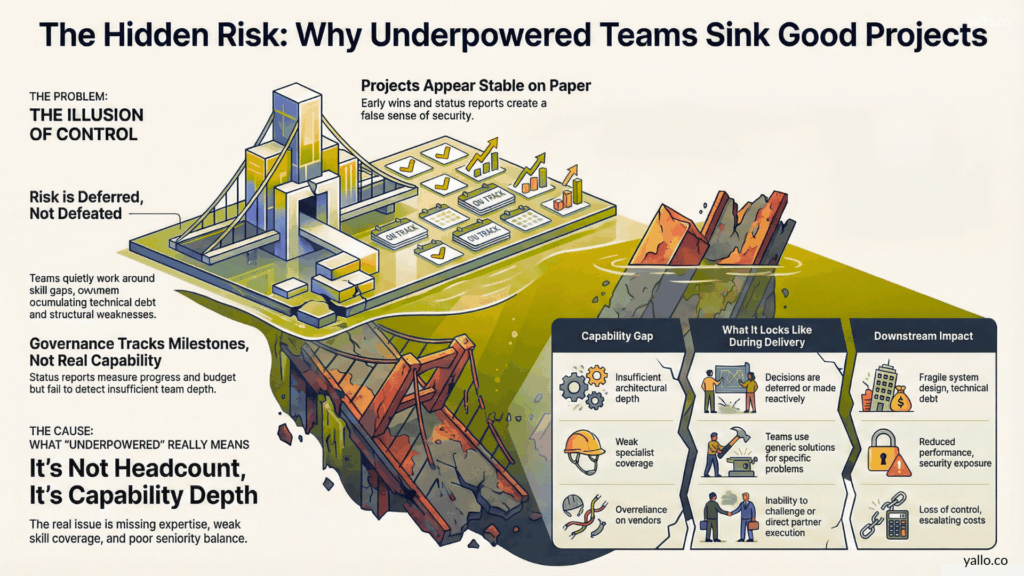
Enterprise programmes rarely fail at inception. In fact, most begin with strong governance structures, detailed plans, and leadership confidence that execution is under control. Business cases are approved, delivery roadmaps are signed off, and milestones are tracked through dashboards that signal progress. This sense of stability is reinforced by early wins, such as vendor onboarding, platform selection, or initial releases, which create the impression that delivery risk is being effectively managed. Yet this apparent control often masks a deeper issue: the teams responsible for execution may lack the capability depth required to sustain momentum once complexity increases.
Underpowered teams do not immediately reveal themselves as a problem because early phases of delivery are often forgiving. Initial work tends to be well-scoped, supported by external partners, or buffered by contingency. As a result, capability gaps remain latent. Decisions that require deep architectural judgment are deferred, technical debt accumulates quietly, and key individuals compensate for missing expertise by working around structural weaknesses. From a governance perspective, everything still appears functional, but the foundation is already weakening. The delivery risk is not absent; it is simply deferred.
As programmes progress, the illusion of control becomes more dangerous. Integration points multiply, dependencies tighten, and delivery timelines compress. At this stage, underpowered teams struggle to absorb change without destabilising execution. Leadership often interprets emerging issues as isolated delivery challenges rather than symptoms of insufficient team capability. By the time the true source of risk becomes visible, corrective action is significantly more complex and costly. What began as a manageable gap in capability evolves into a systemic delivery risk that governance mechanisms were never designed to detect early.
Why Underpowered Teams Often Create a False Sense of Delivery Control
Tracing the path from missing expertise and shallow skill coverage to architectural blind spots, rework, and cascading execution delays.
Underpowered teams rarely fail because of effort or intent. They fail because they lack the depth and balance of capability required to absorb complexity as delivery scales. In enterprise programmes, especially those involving cloud, data, AI, cybersecurity, or core platform modernisation, complexity does not increase linearly. It compounds. Teams that are not designed with sufficient capability depth begin to struggle precisely at the moments when judgement, experience, and architectural clarity matter most.
The earliest symptoms are often subtle and easy to rationalise. Decisions take longer because they are repeatedly escalated. Teams rely on assumptions rather than evidence when making trade-offs. Architectural concerns are deferred in favour of short-term progress. Individually, these issues appear manageable. Collectively, they create structural weaknesses that undermine delivery resilience. What looks like progress on the surface is often achieved by borrowing against future stability.
Several recurring failure patterns emerge when teams lack sufficient capability balance:
-
Critical decisions concentrate around a small number of senior individuals, creating bottlenecks and burnout
-
Specialist gaps force teams to design around limitations rather than optimal solutions
-
Rework increases as early design choices fail under real-world load or integration
-
Dependencies on vendors grow without adequate internal capability to challenge or govern decisions
-
Delivery velocity slows even as effort and spend increase
These patterns are not caused by poor execution discipline. They are caused by teams that were never sufficiently powered to carry the weight of enterprise complexity.
To make this more concrete, the table below highlights how capability gaps translate into delivery risk:
| Capability Gap | What It Looks Like During Delivery | Downstream Impact |
|---|---|---|
| Insufficient architectural depth | Decisions deferred or made reactively | Fragile system design, long-term technical debt |
| Weak specialist coverage | Teams workaround gaps with generic solutions | Reduced performance, security exposure |
| Overreliance on vendors | Limited ability to challenge or direct execution | Loss of control, escalating costs |
| Imbalanced seniority | Too much execution, not enough judgement | Rework, inconsistent quality |
| Lack of integration expertise | Issues surface late in testing or rollout | Delays, unstable releases |
What makes these risks particularly dangerous is that governance structures often fail to detect them early. Status reports track milestones, budgets, and scope, but they rarely measure whether teams have the capability depth required to sustain delivery as complexity increases. By the time failure patterns become visible, they are embedded into the programme’s structure, making remediation costly and disruptive.
Structural delivery failure is therefore not the result of a single missed hire or bad decision. It is the cumulative outcome of teams that were underpowered from the outset, operating in environments that demand far more depth, balance, and judgement than traditional staffing models are designed to provide.
Why Traditional Hiring, Staffing, and Resource Allocation Models Systematically Fail to Address Real Delivery Risk
Examining how static role definitions, slow talent mobilisation, and overreliance on vendors leave enterprise teams underpowered at critical moments.
Most enterprise hiring and staffing models were built for predictability, not for the fluid complexity of modern delivery environments. They assume roles can be defined upfront, capacity can be planned in advance, and execution will follow a relatively linear path. In reality, enterprise programmes evolve continuously as technical dependencies surface, regulatory requirements shift, and business priorities change. When talent models remain static, they fail to respond to the moments where delivery risk is highest.
Traditional approaches also prioritise process completion over delivery readiness. Roles are filled, onboarding is completed, and headcount targets are met, yet teams still lack the capability depth required to make high-impact decisions under pressure. Screening mechanisms focus on credentials and past titles rather than contextual experience, leaving organisations with teams that look complete on paper but are underpowered in practice. As complexity increases, these limitations surface quickly.
Common failure points in traditional staffing models include:
-
Role definitions that lag behind evolving delivery realities
-
Hiring cycles that move slower than programme timelines
-
Difficulty assessing real-world decision-making and architectural judgment
-
Resource allocation driven by availability rather than risk
As a result, delivery risk is not reduced through hiring. It is merely deferred until it emerges later in the programme, when corrective action is far more disruptive and expensive.
The Compounding Business and Operational Costs of Running Underpowered Delivery Teams
Underpowered teams persist in enterprise programmes not because organisations underestimate delivery risk, but because their talent systems are not designed to surface that risk early. Traditional hiring and staffing models operate on static assumptions about roles, timelines, and capacity. They struggle to respond when delivery complexity increases mid-programme, when architectural decisions require deeper judgment, or when specialist expertise is needed temporarily but urgently. As a result, organisations often discover capability gaps only after execution has slowed, quality has degraded, or vendor dependency has increased.
The business impact of this delay is rarely immediate, but it is cumulative. Underpowered teams introduce long-tail costs through rework, deferred decisions, technical debt, and fragile systems that require constant intervention. Leadership confidence erodes as programmes miss milestones despite sustained effort and investment. Over time, enterprises compensate by escalating work to external partners, further weakening internal capability and control. What began as a manageable staffing issue becomes a structural delivery risk embedded into the programme itself.
Reducing this risk requires a deliberate shift toward capability-led team design. Enterprises must move beyond headcount-based staffing and focus on whether teams have the depth, balance, and timing of expertise required at each stage of delivery. This means reinforcing teams before complexity peaks, evaluating talent through delivery and architectural lenses, and aligning workforce decisions directly to risk rather than organisational convenience.
This is where Yallo supports enterprises operating in complex transformation environments. We help organisations reduce delivery risk by providing architect-vetted specialist talent across cloud, data, AI, cybersecurity, ERP, and large-scale programme delivery. Our approach focuses on strengthening teams precisely where capability gaps create the greatest execution risk. Through our Insights, we analyse emerging delivery patterns, capability shortfalls, and workforce risks shaping enterprise programmes across the GCC and India. Through our Case Studies, we demonstrate how targeted capability reinforcement stabilises delivery, reduces dependency, and improves long-term execution outcomes.
Enterprises that address underpowered teams early gain more than faster delivery. They gain resilience, confidence, and control over transformation outcomes. Those that delay will continue to experience risk not as a single failure point, but as a persistent drag on performance that is far harder to correct once embedded.
Newsletter
Get the latest updates and insights delivered to your inbox.
Thank you!
You have successfully joined our subscriber list.