The GCC Talent Bottleneck and Why Critical Tech Roles Are Becoming Harder to Fill
An examination of the GCC talent bottleneck and the structural forces making high-impact technology roles increasingly difficult to hire across the region.
December 10, 2025
5 mins Read
Insight
Why the GCC Talent Bottleneck Has Become a Structural Constraint
How national transformation agendas have outpaced the region’s ability to supply high-impact technology talent
The pace and ambition of national transformation programmes across the GCC have created a hiring environment unlike any other global region. Saudi Vision 2030, UAE Vision 2031, Qatar’s digital government strategy, Oman’s economic diversification plans, and the rapid expansion of public and private megaprojects have elevated demand for deep technical capability at a scale the region has never experienced. The result is a widening GCC talent bottleneck that no longer reflects a simple shortage of candidates, but a structural imbalance between what transformation requires and what the talent market can supply. Cloud engineering, AI architecture, cybersecurity, data platforms, SAP modernisation, omnichannel engineering, product
management, and DevOps/SRE roles now sit at the centre of every major transformation. Yet these are precisely the roles for which the regional talent pool is thinnest. Organisations are running faster than their talent ecosystems can mature, and the consequences surface in delivery delays, rising vendor dependency, and increased programme risk.This bottleneck is further intensified by the region’s unique execution model. Unlike other markets where digital transformation evolves incrementally, GCC programmes tend to operate at national scale, accelerated timelines, and high public visibility. That places extraordinary pressure on organisations to secure talent that can operate across complexity from day one.
Traditional hiring cycles—slow, linear, and based on job descriptions rather than capability simply cannot keep pace. Many enterprises find themselves in prolonged searches for specialist roles that require architecture-level judgment, cross-functional fluency, and real-world delivery experience. These are not skills that can be replicated quickly, sourced easily, or imported without careful alignment to domain and cultural context. As a result, the GCC talent bottleneck has moved from being a recruitment challenge to a systemic constraint shaping the speed, sequencing, and success of transformation across the region. It is no longer a talent issue; it is a strategy and execution challenge.
How Digital Transformation, Cloud Adoption, and AI Demand Are Outpacing Talent Supply
Why demand for specialist capability is accelerating faster than the workforce can adapt
The scale of digital transformation underway in the GCC has exposed a widening capability gap that legacy hiring systems were never designed to absorb. Cloud migration is in its steepest adoption curve across Saudi Arabia and the UAE, with hyperscalers investing heavily in regional cloud regions and sovereign setups. AI adoption has accelerated dramatically, driven by national strategies and sector-specific mandates to embed machine learning, automation, and data governance across public and private entities. Each of these shifts requires deep specialist capability—cloud reliability engineering, data platform design, AI productisation, cybersecurity hardening, observability engineering, and modern ERP transformation.
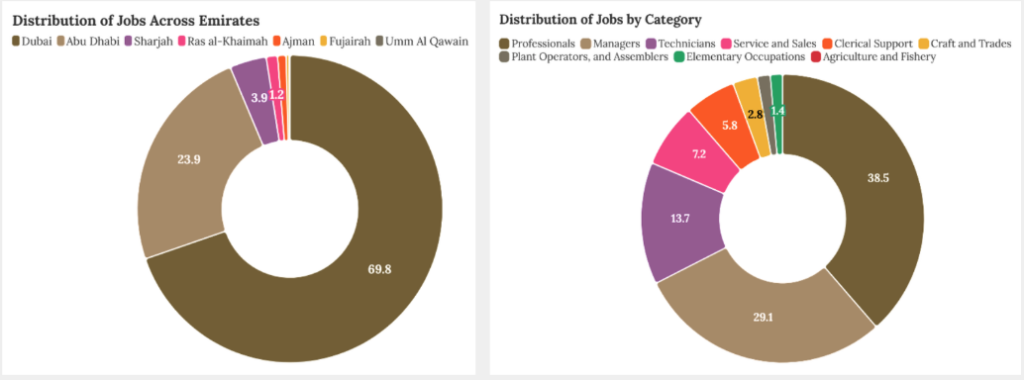
Yet these capabilities evolve faster than education systems, internal training programmes, and global mobility pipelines can supply. As a result, the GCC talent bottleneck is not simply a hiring friction; it is a reflection of structural misalignment between transformation ambition and capability maturity. A closer look at hiring patterns across the UAE reveals how economic concentration shapes talent demand. Certain emirates continue to dominate job creation due to their sector mix, infrastructure, and policy incentives, while others play a more specialised role in the labour market. This uneven distribution contributes to localised skill shortages, differing salary dynamics, and varying hiring cycles across regions.
Distribution of jobs across UAE emirates based on 23,739 job postings collected in June–July 2025. Source: Author’s analysis using ORFME.org data.
These regional differences reinforce why employers in Dubai and Abu Dhabi face considerably higher competition for specialist roles, while emirates such as Sharjah and Ras Al Khaimah show more niche hiring activity.
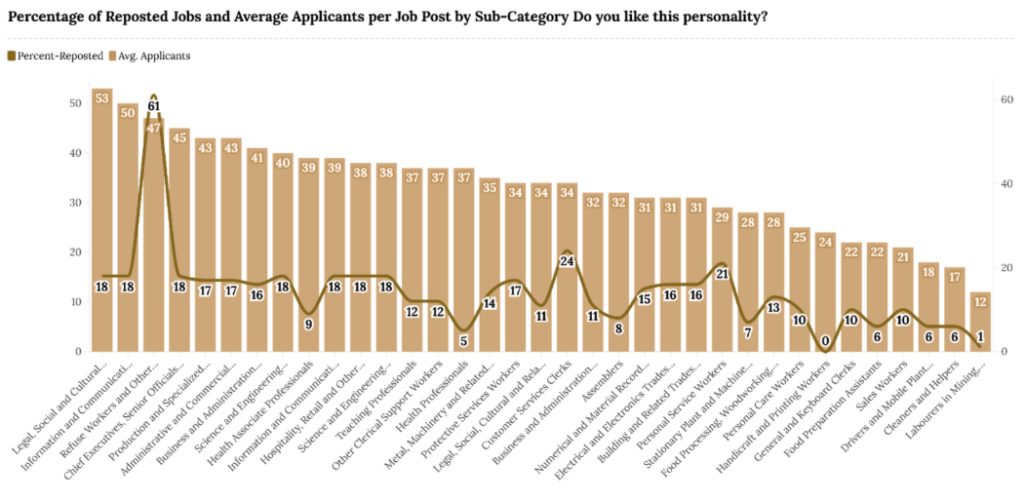
Reposting trends provide a direct indicator of hiring difficulty. Roles that are reposted frequently signal skill scarcity, misalignment between job requirements and market capability, or extended evaluation cycles. When mapped against the average number of applicants per role, these insights reveal which occupations experience the highest hiring friction.
Percentage of reposted jobs and average applicants. Source: Author’s analysis using ORFME.org data.
The combination of high reposting rates and low applicant volume in several professional and technical categories confirms the emergence of acute skill shortages particularly in managerial, technical, and specialised knowledge roles. For GCC employers, this signals the need to redesign hiring processes, rethink capability development, and adopt new talent-supply models that align with the realities of a constrained labour market.
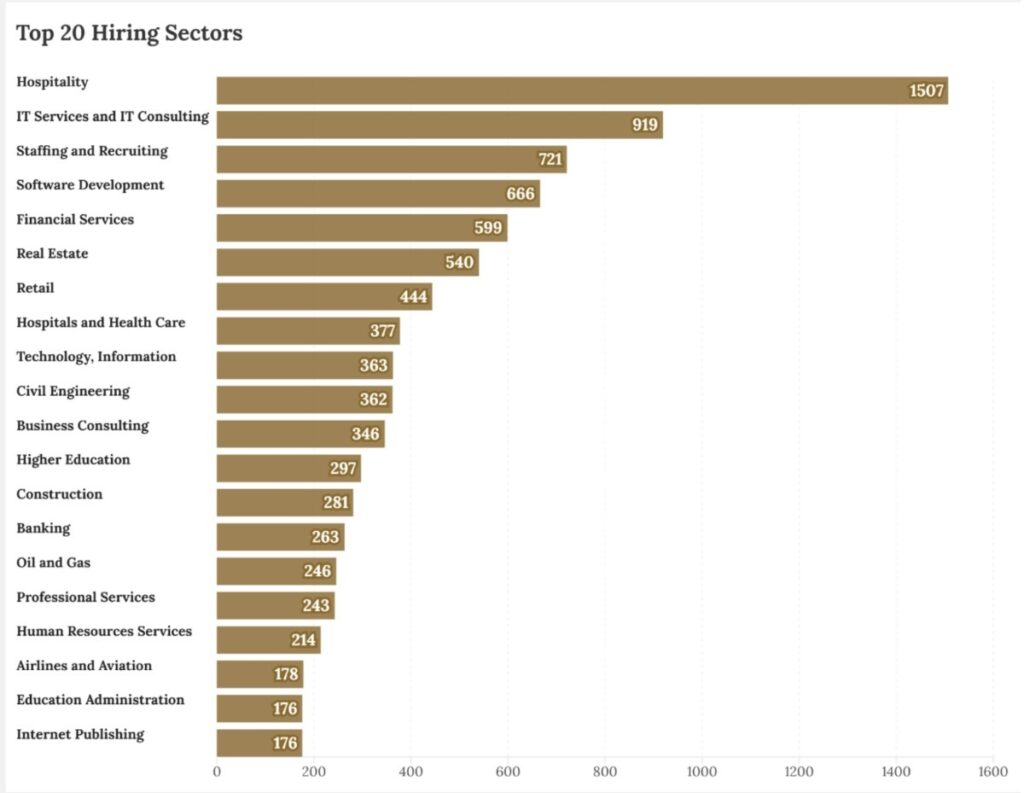
Sector-level hiring activity shows where organisational growth and talent pressures are intensifying. Hospitality remains one of the highest-volume employers, driven by ongoing tourism and events investments. Meanwhile, IT services, software development, and staffing/recruiting appear among the top sectors clear evidence of accelerating digitalisation and rising demand for skilled tech workers across the GCC.
Top hiring sectors in the UAE. Source: Author’s analysis using ORFME.org data.
The strong representation of technology-focused sectors underscores the structural talent challenge facing employers. As IT services, software engineering, financial technology, and digital infrastructure expand, demand for architects, data engineers, cybersecurity specialists, developers, and platform engineers continues to outpace supply intensifying the GCC talent bottleneck across critical roles.
Compounding this challenge is the increasing sophistication of enterprise technology stacks. GCC organisations are no longer upgrading isolated systems they are re-architecting entire operating models. Banks are modernising core systems while deploying AI-driven risk engines. Retailers are rebuilding omnichannel platforms. Governments are digitising citizen services at scale. Healthcare systems are implementing real-time data platforms and AI triage models. Every one of these initiatives requires a type of hybrid talent that can work across product, engineering, data, and governance layers. However, these roles are globally scarce, heavily competed for, and require years of cumulative delivery experience.
This mismatch between demand and availability creates upward pressure on salaries, longer hiring cycles, increased attrition, and escalating reliance on consultants and global integrators. The GCC talent bottleneck therefore deepens with every new transformation wave because capability shifts faster than supply, and without targeted intervention, the gap continues to widen.
Why Critical Tech Roles Take Far Longer to Hire in the GCC
The hidden dynamics behind slow hiring cycles, scarce capability, and rising delivery risk
Breaking the GCC talent bottleneck requires more than accelerated hiring cycles it demands a structural shift in how organisations define capability, build teams, and manage workforce architecture. Traditional job-based staffing models cannot keep pace with the region’s transformation demands, particularly in cloud, AI, data engineering, cybersecurity, and platform delivery. Instead, enterprises must move toward capability-based hiring, ensuring talent is assessed on problem-solving depth, cross-functional fluency, and readiness to operate within modern digital ecosystems. This shift enables companies to focus on the skills and outcomes required at each stage of transformation rather than rigid titles that rarely match the realities of emerging technology work.
To move beyond the bottleneck, leading organisations are adopting new talent strategies such as:
Capability-based workforce models that define skills, not roles, as the foundation of workforce planning.
Blended delivery models that combine onshore leadership with India-based execution for scale, speed, and resilience.
Targeted specialist deployment to reinforce architecture, engineering, data, AI, and security capabilities at critical programme stages.
Continuous upskilling systems aligned to transformation roadmaps rather than traditional training calendars.
Structured capability assessments that surface hidden skill gaps and align teams to the demands of cloud, AI, and modern delivery.
Enterprises that adopt these practices reduce dependency risk, increase execution velocity, and stabilise transformation programmes. More importantly, they build a workforce architecture capable of evolving with the demands of national digital agendas something static hiring models can no longer achieve in a region moving as fast as the GCC
How Yallo Helps GCC Organisations Overcome the Talent Bottleneck Through Specialist and Capability-Led Talent Models
The GCC talent bottleneck is not simply a hiring challenge, it is a capability supply chain challenge. That is why Yallo was built to operate at the intersection of talent and transformation. Our model begins with architect-led screening, ensuring that every specialist we deploy—across cloud, data, AI, DevOps, cybersecurity, ERP, product, or enterprise architecture—is evaluated for capability, not just credentials. This reduces mis-hiring risk and gives enterprises predictable access to high-calibre talent at the exact level of sophistication their programmes demand. Our 72-hour talent delivery framework, combined with ME–India blended teams, allows organisations to stabilise execution, accelerate critical workstreams, and fill capability gaps that traditional hiring cycles cannot address. Whether the need is for a cloud architect, SAP consultant, AI product engineer, data platform specialist, or DevOps/SRE talent, Yallo provides a capability layer that aligns directly with programme outcomes, not job descriptions.
More importantly, Yallo helps organisations rebuild their entire Talent Supply Chain so they can scale sustainably. We assist enterprises in shifting from role-based hiring to capability-based workforce models that reflect how modern digital programmes actually operate. Our work across Retail, BFSI, Healthcare, and Public Sector programmes shows that targeted deployment of specialist talent, combined with ongoing capability development—reduces vendor dependency, prevents programme drift, and strengthens long-term internal capability. In many cases, YALLO can fix the Talent Supply Chain, giving organisations a stable, flexible, and transformation-ready workforce foundation. For leadership teams seeking evidence, our Insights and Case Studies demonstrate how capability-led talent interventions have shortened delivery timelines, improved architectural quality, and reduced operational risk across complex GCC transformations. The enterprises that overcome the GCC talent bottleneck will be those that treat talent as strategic infrastructure and Yallo is designed to help them build exactly that.
Newsletter
Get the latest updates and insights delivered to your inbox.