GCC IT talent market 2026 rate intelligence and demand signals for enterprise programmes

What enterprise teams in UAE and KSA are paying today, where demand is rising, and what it means for programme planning

April 14, 2026 5 mins Read Insight

The market has shifted demand is ahead of supply

Two things are true about the GCC IT talent market in Q2 2026. Demand is higher than it has been in years, and the supply of domain-specific specialists has not kept pace.

This imbalance is not evenly distributed. It is most visible in enterprise programmes that require deep system experience, regional context, and the ability to operate in complex delivery environments. As more organisations across UAE and KSA accelerate transformation initiatives, the same pool of experienced specialists is being pulled into multiple programmes at once.

For teams planning the second half of the year, this creates a timing problem. Talent planning can no longer start when the requirement becomes urgent. By then, the market has already moved.

What the market is actually paying in 2026

Rates across GCC have remained strong, especially for roles that sit on the critical path of enterprise programmes. While numbers vary by domain and experience, some clear benchmarks have emerged in Q2 2026:

RoleUAE (AED/day)
Enterprise Architect2,200 – 2,800
SAP S/4HANA Functional Lead1,800 – 2,400
Oracle Fusion Finance1,500 – 2,100
Solution Architect1,800 – 2,600
Programme Director2,400 – 3,200
Workday HCM Specialist1,600 – 2,000

In Saudi Arabia, compensation structures differ slightly, but in practical terms, rates tend to be around 65–70% of UAE benchmarks when adjusted for monthly contracts.
India-based specialists working remotely on GCC programmes typically operate at around 35–45% of UAE onsite rates, depending on experience and role. This gap is one of the reasons hybrid delivery models are becoming more common.

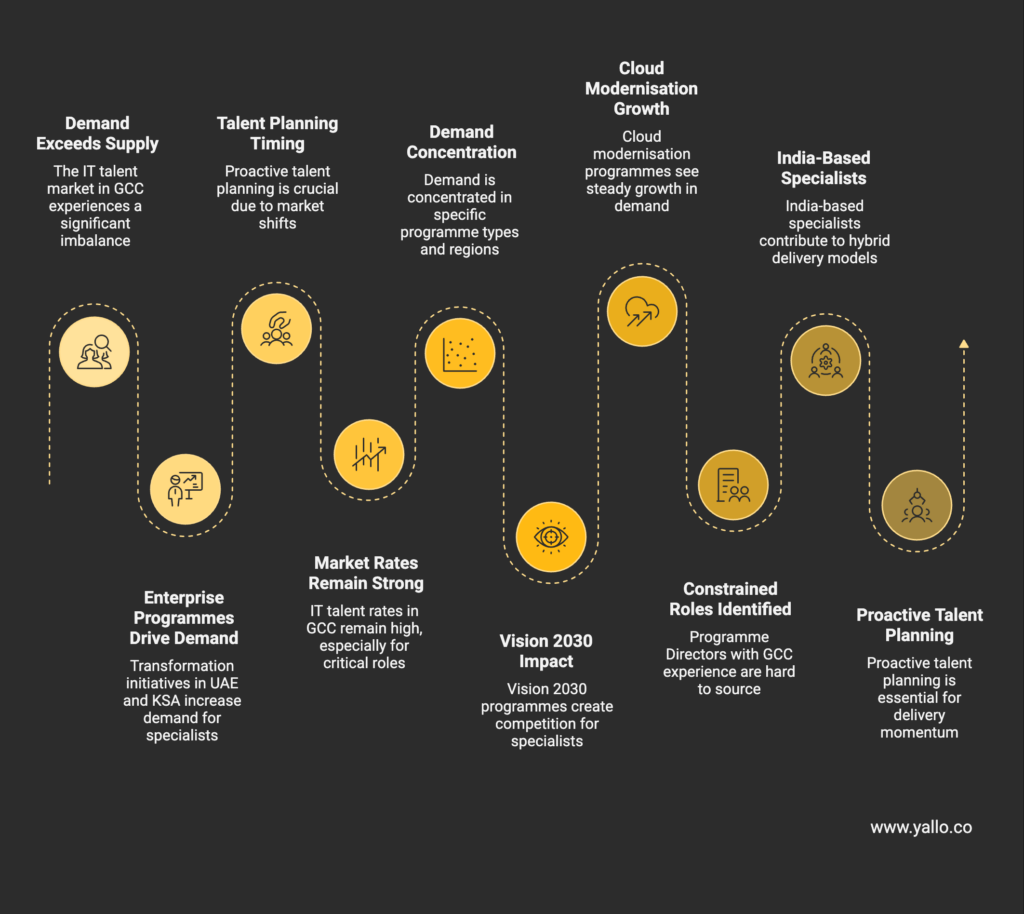
Infographic showing GCC IT talent market trends in 2026, including demand exceeding supply, enterprise programme growth, cloud modernisation demand, Vision 2030 impact, and the role of India-based specialists in hybrid delivery models.
Key demand and supply signals shaping GCC IT talent rates in 2026

The GCC IT talent market is being shaped by a clear imbalance, demand is accelerating across enterprise programmes while the supply of experienced, region-specific specialists remains tight. Large-scale transformation initiatives, particularly in the UAE and KSA, are concentrating demand in a few critical roles, pushing rates upward and forcing organisations to plan talent earlier. At the same time, hybrid delivery models, with India-based specialists supporting GCC programmes, are becoming a practical way to bridge this gap.

Where demand is most concentrated

Not all roles are equally difficult to fill. Demand is highly concentrated in specific programme types and regions.

UAE retail SAP programmes are seeing very high demand, particularly for specialists with localisation experience. In KSA, Oracle Fusion roles in BFSI are in strong demand, while government-led ERP programmes under Vision 2030 are creating sustained pressure on the talent pool.

The effect of Vision 2030 is especially important to understand. Multiple large-scale programmes are running in parallel, often requiring similar profiles with prior Saudi experience. This creates a concentration problem, where several organisations are competing for the same limited group of specialists.

Cloud modernisation, particularly Azure-led programmes, is also seeing steady growth in demand, though supply here is relatively more stable compared to ERP ecosystems.

What this means for programme planning

The most constrained roles in the current market are not always the most obvious ones. Programme Directors with GCC delivery experience, for example, are among the hardest to source quickly. These roles require not just technical understanding, but the ability to navigate stakeholders, manage dependencies, and drive execution across complex environments.

Timing becomes critical here. Organisations that begin sourcing these roles 10–12 weeks in advance are able to access a wider pool of candidates. Those that start 3–4 weeks before the requirement becomes urgent often find themselves competing with multiple programmes for the same shortlist.

India-based specialists are increasingly acting as a bridge in this environment. Roles such as Oracle Fusion Finance, Azure architecture, and Salesforce can often be delivered in a hybrid model, combining remote expertise with onsite presence during key phases. This improves cost efficiency and expands access to talent, though certain roles, particularly those involving stakeholder management or go-live ownership, still require onsite presence.

What this market dynamic highlights is the need for more proactive and context-driven talent planning. Teams that align hiring timelines with programme needs early are better positioned to maintain delivery momentum. This is also where companies like Yallo operate, helping enterprise teams navigate these constraints by aligning specialist talent to programme context and timing, rather than treating hiring as a separate, reactive process.
Recent Post

How We Serve

TS/EA as a Service

Empowering Business Transformation with Expert Technology Strategy

Talent in a Box

Scaling Innovation with World-Class Talent

Managed IT COE

Delivering Seamless IT Operations at Scale

Questions About Specialist Hiring, Answered

Enterprise Architects in Dubai command AED 2,200–2,800 per day for contract roles in Q2 2026. SAP S/4HANA functional leads range from AED 1,800–2,400 per day. Programme Directors with GCC transformation experience command AED 2,400–3,200 per day. Rates vary by programme type, domain depth, and localisation experience.
Programme Directors with GCC delivery context, SAP S/4HANA retail specialists with UAE localisation experience, and Oracle Fusion Finance consultants with BFSI domain knowledge are the three hardest roles to fill quickly in GCC in 2026.

Yes, for specific roles. Oracle Fusion Finance, Azure cloud architecture, Salesforce, and some SAP functional roles can be delivered in a hybrid model — India-based remote with onsite presence at key programme milestones. Roles requiring senior stakeholder management or go-live leadership typically require onsite presence in UAE or KSA.

Vision 2030 has accelerated multiple large-scale SAP, Oracle, and cloud transformation programmes simultaneously in KSA, creating concentrated demand for the same specialist pool. Programmes that began talent sourcing in Q4 2025 are significantly better positioned than those starting in Q2 2026.

India-based SAP S/4HANA functional specialists on GCC remote engagements typically earn ₹2.8–4.2 lakh per month depending on experience and programme type. Oracle Fusion specialists earn ₹2.5–3.8 lakh per month. These are significantly above equivalent India-domestic programme rates.

Leave a Comment

Your email address will not be published. Required fields are marked *

Scroll to Top