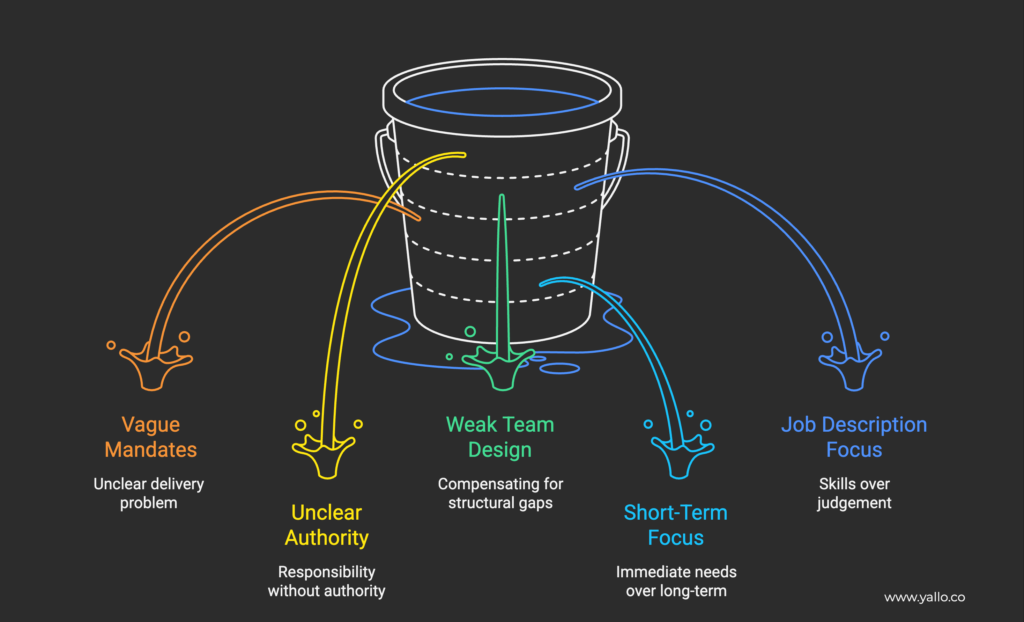
This visual highlights why many enterprise hiring decisions fail to produce the intended impact. When roles are created with vague mandates, limited authority, and a short-term focus, they are forced to compensate for weaknesses in team design rather than resolve them. Over time, responsibility accumulates without corresponding decision power, and effort is dissipated across coordination and escalation. The central issue is not the quality of the individuals hired, but the way roles are designed in isolation from delivery outcomes. Without clear ownership and authority, even well-staffed teams struggle to contain risk, resulting in leakage that only becomes visible once delivery pressure increases.
Before You Make Your Next Enterprise Hiring Decision, Ask These 5 Hard Questions
Why enterprise hiring decisions often increase delivery risk and how better workforce design starts before the role is approved
January 26, 2026
5 mins Read
Insight
Large enterprises rarely struggle to hire. They struggle to hire in ways that improve delivery outcomes. Roles are approved quickly, job descriptions are refined, and requisitions are filled, yet programmes continue to slow, dependencies multiply, and accountability remains unclear. The issue is not effort or intent. It is that hiring decisions are often made without interrogating whether the role being created actually reduces delivery risk.
Before approving the next role, leaders should pause and ask questions that go beyond headcount and skills. These are not comfortable questions, but they are necessary ones if hiring is meant to strengthen execution rather than add organisational weight.
1. What delivery problem is this role actually meant to solve
Many roles are created as responses to symptoms rather than causes. A programme is slow, so a coordinator is added. Integration is difficult, so another architect is hired. Risk feels high, so a governance role is introduced. In each case, the role addresses visible friction without clarifying the underlying delivery problem.
If the problem cannot be articulated clearly in terms of outcomes, the role is unlikely to help. Vague mandates such as “alignment,” “oversight,” or “support” usually signal that the organisation is compensating for a deeper structural gap. Hiring without clarity often results in overlapping responsibilities and increased coordination overhead rather than improved execution.
A useful test is whether success for the role can be measured in delivery terms rather than activity. If the answer is no, the role may add motion without momentum.
2. Where will decision authority for this role actually sit
One of the most common hiring failures in enterprises is creating roles with responsibility but no authority. Individuals are hired to own outcomes, yet critical decisions remain distributed across committees, leadership layers, or adjacent functions. The role becomes advisory by default, regardless of seniority.
This is particularly damaging in complex programmes where delays are caused by unresolved trade-offs rather than lack of effort. When authority is unclear, decisions are escalated, deferred, or avoided. The organisation responds by adding more roles, further diluting ownership.
Before hiring, leaders should be explicit about what decisions the role is empowered to make without escalation. If that authority cannot be granted, the role will not reduce delivery risk, regardless of how capable the individual is.
3. Is this role filling a capability gap or compensating for weak team design
Roles are often created to patch weaknesses in team structure rather than to build missing capability. For example, a programme manager is hired to coordinate teams that should already be aligned, or a senior specialist is added to offset fragmentation across functions.
This approach scales poorly. Each new role adds another interface that must be managed, increasing dependency and slowing feedback loops. Over time, the organisation becomes role-heavy but capability-light, with more people involved in delivery but fewer empowered to move it forward.
A better question is whether the work could be reorganised so that existing teams own outcomes more completely. If a role exists primarily to bridge gaps between teams, it may be masking a design problem rather than solving a capability one.
4. How will this role reduce delivery risk six months from now
Hiring decisions are often justified on immediate needs, but their impact is felt over time. Roles that seem helpful initially can create long-term drag if they introduce additional approval steps, reporting requirements, or coordination layers.
Leaders should look beyond onboarding and ask how the role changes the delivery system. Will decisions happen earlier? Will accountability become clearer? Will dependencies reduce? If the answers are uncertain, the role may increase structural complexity even as it adds capacity.
This question forces a shift from short-term resourcing to long-term execution thinking. It also highlights whether the role is designed to mature with the programme or remain a permanent workaround.
5. Are we hiring for experience and judgement or for a job description
Job descriptions tend to emphasise skills, tools, and years of experience. What they rarely capture is judgement, the ability to make difficult decisions under pressure with incomplete information. In high-risk delivery environments, judgement matters more than perfect skill alignment.
When hiring is driven by job descriptions alone, organisations optimise for defensibility rather than effectiveness. Candidates are selected because they match requirements, not because they have navigated similar complexity before. This often results in technically capable teams that struggle when conditions deviate from plan.
Before hiring, leaders should ask what kinds of decisions the role will need to make and whether candidates have made comparable decisions in environments with real consequences. This reframes hiring from a compliance exercise into a delivery investment.
Why these questions matter more than the role itself
Enterprises that consistently ask these questions tend to hire fewer roles but get more impact from each one. They design teams around outcomes rather than functions and place authority closer to execution. Over time, delivery becomes more predictable not because there are more people involved, but because responsibility and capability are better aligned.
This pattern is evident in the work of Yallo, which focuses on reducing delivery risk through capability-led workforce design. Across our case studies, organisations that pause to interrogate hiring decisions at this level avoid role sprawl and improve execution confidence. The insights emerging from these environments suggest a simple but often overlooked truth: hiring is not a resourcing activity, it is an architectural decision. When roles are designed deliberately, they strengthen delivery. When they are not, delivery absorbs the cost.
Newsletter
Get the latest updates and insights delivered to your inbox.
Thank you!
You have successfully joined our subscriber list.