Enterprise AI in 2026: The Gap Everyone is Ignoring
AI adoption is growing rapidly across the GCC, but most enterprises still lack the governance and operating models needed to scale AI successfully. In 2026, execution infrastructure — not AI access will define enterprise success.
May 28, 2026
5 mins Read
Insight
Most enterprises have AI running somewhere. Very few can point to what it actually changed.
That is the defining tension of 2026. AI adoption across the GCC has reached 84%, according to McKinsey — yet Roland Berger research published this year found that fewer than one in three GCC organisations have the operating model and formal governance needed to scale it. Capital and ambition are not the problem. Execution infrastructure is.
From chatbots to agents — and a brutal failure rate
The conversation has moved decisively from generative AI to agentic AI. Gartner estimates that 80% of enterprise applications shipped in Q1 2026 now embed at least one AI agent. The market is valued at $11 billion and growing at nearly 46% annually through 2030.
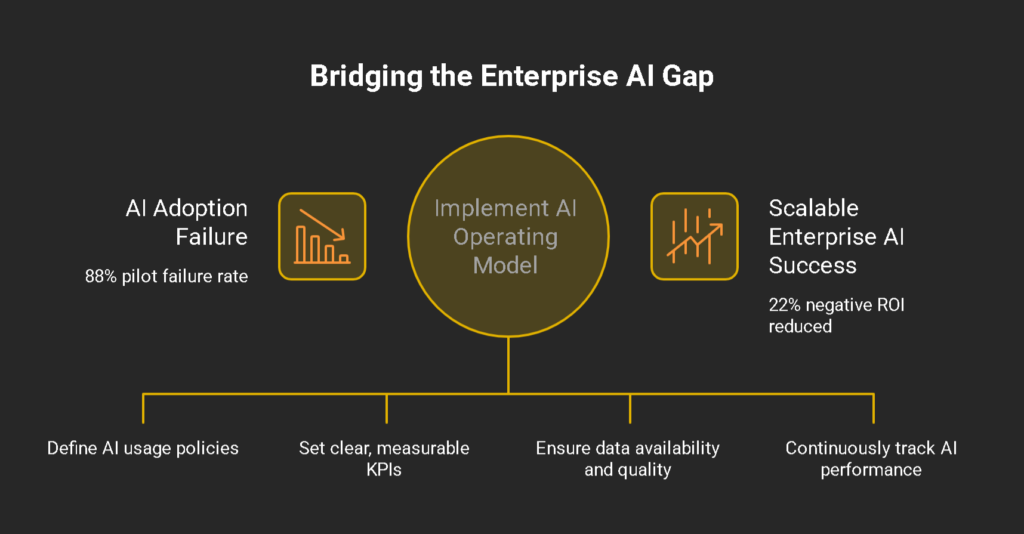
The less-discussed number: 88% of AI agent pilots never reach production. Of the deployments that do go live, 22% report negative ROI at 12 months. Gartner projects that 40% of agentic AI projects will be cancelled by 2027 if governance, observability, and clear success criteria are not established first.
Forrester’s root-cause analysis of failed deployments is instructive. Unclear success criteria account for 41% of failures. Insufficient data or tool access accounts for 33%. Evaluation drift accounts for 26%. Not one of those is a model-quality problem. All three are operating model problems.
The organisations consistently clearing the pilot-to-production barrier share one trait: they defined governance and evaluation frameworks before they deployed, not after.
Governance is now the competitive variable
Shadow AI — employees using unauthorised tools without IT oversight — has become a material risk. Nearly two in five enterprises have now introduced formal AI platforms specifically in response to bottom-up adoption that outpaced policy.
In the GCC specifically, the compliance stakes are rising. Saudi Arabia’s SDAIA data residency framework is now a regulatory baseline. UAE AI governance regulations are tightening. ISO/IEC 42001 is appearing in procurement requirements. The EU AI Act has cross-border implications for multinationals across the region.
The organisations making visible progress on AI in 2026 are not the ones with the largest budgets. They are the ones that treated governance as architecture — built into workflows from the start — rather than as a compliance checkbox added at the end.
Newsletter
Get the latest updates and insights delivered to your inbox.
Thank you!
You have successfully joined our subscriber list.
What this means for enterprise leaders
The pilot phase is over. The question now is not whether to deploy AI but whether the operating structure around it — ownership, governance, delivery frameworks, talent — can support production-grade outcomes.
Deloitte’s 2026 State of AI in the Enterprise report puts it plainly: AI has moved from experimentation to impact. Worker access to AI rose 50% in 2025, and the number of companies with 40% or more of their AI projects in production is set to double within six months.
The enterprises that will capture that value are the ones that stopped treating AI as a technology initiative and started treating it as an operating model.
Most enterprise AI projects fail because organisations focus on deploying AI tools without building governance, evaluation frameworks, and operating models. The issue is usually execution infrastructure — not AI capability itself.
The biggest challenge is moving from pilot projects to production-grade deployment. Many organisations struggle with unclear KPIs, poor data access, governance gaps, and lack of operational ownership.
AI governance is becoming essential because enterprises now face risks related to compliance, data residency, shadow AI, security, and observability. Governance helps organisations scale AI safely and effectively.
Successful enterprises treat AI as an operating model rather than a standalone technology initiative. They prioritise governance, AI Centers of Excellence (CoE), clear success metrics, and scalable implementation frameworks from the beginning.