The Talent Bottleneck Slowing Digital Banking Initiatives

Why the digital banking talent bottleneck is no longer about hiring volume but about capability depth, execution authority, and workforce design

January 28, 2026 5 mins Read Insight

Why Digital Banking Ambition Is Outpacing Organisational Capability

How the digital banking talent bottleneck forms when strategy advances faster than workforce readiness and delivery maturity

Across global and regional banks, digital banking ambition has accelerated sharply over the past few years. Product roadmaps are increasingly aggressive, customer experience expectations continue to rise, and regulatory bodies are pushing for stronger resilience, security, and transparency. On the surface, most institutions appear well positioned, with transformation strategies defined and investment committed.

Yet delivery outcomes increasingly lag intent. Programmes stall, scope is repeatedly reworked, and timelines stretch despite sustained funding and leadership attention. When these delays are examined closely, technology limitations are rarely the primary constraint. Instead, the digital banking talent bottleneck emerges as the critical friction point, slowing execution even where strategy and tooling appear sound.

This bottleneck forms when organisational capability fails to evolve at the same pace as ambition. Digital banking initiatives demand teams that can operate across technology, risk, compliance, and customer experience simultaneously. However, many banks continue to rely on workforce structures optimised for incremental change rather than continuous, platform-led delivery. As a result, capability gaps surface not as obvious skill shortages, but as an inability to translate intent into coordinated execution at scale.

How the Digital Banking Talent Bottleneck Is Created Inside Large Institutions

Why fragmented roles, diluted accountability, and legacy operating models prevent digital banking talent from translating into outcomes

The digital banking talent bottleneck is rarely the result of a single decision. It is created gradually through a series of structural compromises that, individually, appear reasonable. Teams are staffed with experienced professionals. Delivery partners are engaged to accelerate progress. Governance forums are expanded to manage risk. Over time, however, these choices interact in ways that weaken execution.

In many banks, digital initiatives are decomposed into streams aligned to existing organisational boundaries. Product teams focus on features, technology teams focus on platforms, risk teams focus on controls, and compliance teams focus on assurance. While each function performs its role competently, no single group owns outcomes end to end. Accountability becomes shared in theory but fragmented in practice.

As this fragmentation deepens, authority drifts away from delivery. Decisions that should be resolved close to execution are escalated through layers of governance. Trade-offs between speed, risk, and customer impact are deferred rather than decided. Talent with the capability to make judgement calls exists within the organisation, but is constrained by role definitions that limit decision rights.


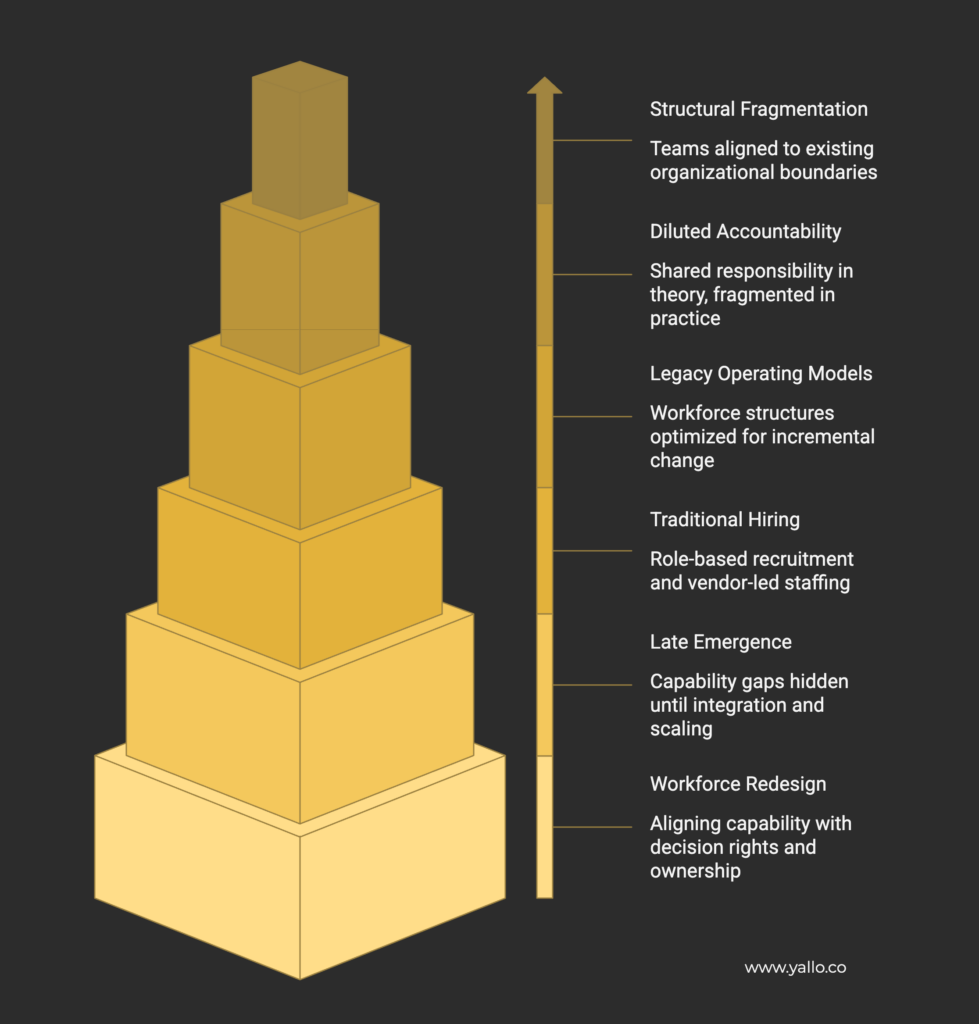
Diagram showing layered causes of the digital banking talent bottleneck, including structural fragmentation, diluted accountability, legacy operating models, traditional hiring practices, late emergence of capability gaps, and the need for workforce redesign aligned to decision rights.
How structural choices in workforce design progressively create a digital banking talent bottleneck that only becomes visible at scale.

This visual illustrates how the digital banking talent bottleneck is not driven by a single failure, but by the accumulation of structural decisions over time. Teams are aligned to legacy organisational boundaries, accountability is shared in theory but fragmented in practice, and hiring continues to reinforce role-based models rather than outcome ownership. These layers mask capability gaps until programmes reach integration and scaling phases, at which point remediation becomes expensive and disruptive. Removing the bottleneck requires redesigning the workforce so that capability, authority, and ownership are deliberately aligned around delivery outcomes rather than inherited structures.

Several patterns consistently appear as this bottleneck forms:

  • Experienced individuals operating without clear outcome ownership

  • Delivery teams optimising locally rather than for system-wide coherence

  • Decision latency increasing as governance expands

  • Capability gaps emerging at the intersections between technology, risk, and operations

Over time, the organisation appears busy but struggles to move decisively. Progress is measured through activity rather than outcomes, masking the accumulation of delivery risk.

Why Traditional Hiring Models Cannot Resolve the Digital Banking Talent Bottleneck

How role-based recruitment and vendor-led staffing approaches quietly increase delivery risk in digital banking programmes

When execution slows, the most common response is to hire. New roles are created, external specialists are brought in, and programme teams expand. While this can temporarily relieve pressure, it rarely addresses the underlying bottleneck. In many cases, it amplifies it. Traditional hiring models focus on filling predefined roles rather than closing capability gaps. Banks recruit for job descriptions that reflect existing organisational structures, even when those structures are the source of the problem. As a result, new hires inherit the same constraints as existing staff, limiting their ability to influence outcomes.

Vendor-led staffing introduces a similar dynamic. External teams often bring deep expertise in specific domains, but operate within narrowly defined scopes. Without clear authority to shape end-to-end decisions, their impact remains localised. The organisation gains capacity, but not coherence. Over time, the workforce becomes larger but less effective. Coordination overhead increases, accountability blurs further, and the digital banking talent bottleneck tightens rather than loosens. The issue is not the quality of people being hired, but the absence of a workforce design that aligns capability with decision rights and delivery responsibility.

How the Digital Banking Talent Bottleneck Surfaces Late and Becomes Expensive

One of the most damaging aspects of the digital banking talent bottleneck is its timing. Early phases of programmes often appear successful. Teams are mobilised, platforms are configured, and pilot features are delivered. Confidence builds, reinforcing the belief that the organisation is on track. It is only during integration, scaling, or regulatory review that structural weaknesses become visible. Dependencies multiply, exceptions increase, and decision-making slows under scrutiny. At this stage, rework is costly and options are limited. What initially looked like a resourcing issue is revealed to be a systemic capability problem. Because these failures emerge late, they are often misdiagnosed. Additional controls are added, more reporting is introduced, and further hiring is approved. Each response treats the symptom while leaving the underlying bottleneck intact.

Banks that make sustained progress take a different approach. Rather than focusing solely on hiring or tools, they examine how capability is positioned within the organisation. Decision authority is brought closer to delivery. Roles are defined around outcomes rather than tasks. Teams are structured to own digital banking capabilities end to end, spanning technology, risk, and operations. This shift requires deliberate workforce design and a willingness to challenge legacy operating models. It also requires recognising that delivery risk is an organisational concern, not a staffing problem.

This is the lens applied by Yallo, which works with banks and regulated enterprises to reduce execution risk by aligning capability, authority, and delivery ownership. Across its case studies and insights, a consistent pattern emerges: digital banking initiatives accelerate not when more people are added, but when the right capabilities are empowered to make decisions at the point of execution.

Recent Post

How We Serve

TS/EA as a Service

Empowering Business Transformation with Expert Technology Strategy

Talent in a Box

Scaling Innovation with World-Class Talent

Managed IT COE

Delivering Seamless IT Operations at Scale

Leave a Comment

Your email address will not be published. Required fields are marked *

Scroll to Top