Why Decision Latency Is Now the Biggest Source of Delivery Risk

Slow decisions create more execution failure than wrong decisions in complex enterprise programmes

February 03, 2026 5 mins Read Insight

The Escalation Pattern That Signals Structural Delivery Risk

Decision latency accumulates when authority is unclear or absent

Enterprise programmes operate under a persistent illusion: that careful deliberation reduces risk. Decisions are escalated to governance boards. Stakeholder alignment is pursued across multiple layers. Technical options are analysed through extended review cycles. Architecture choices are deferred until more information is available. The assumption is that slower, more inclusive decision-making produces better outcomes and reduces delivery risk. The opposite is true.

Decision latency—the time between when a decision is required and when it is actually made—has become the primary source of delivery risk in complex SAP, Oracle, and enterprise transformation programmes. This is not because fast decisions are inherently superior to slow ones. It is because the delay itself creates cascading consequences that compound execution risk far beyond the impact of any individual decision, regardless of whether that decision proves correct or suboptimal.

These delays are not edge cases. They are the standard operating pattern in enterprise programmes where decision authority is unclear, fragmented, or deliberately diffused to avoid accountability. A cross-module integration decision between SAP FI/CO and MM is required in week four but escalates through stakeholder alignment and governance approval until week twelve. Eight weeks of downstream design work must be reworked. Oracle Cloud HCM configuration must be finalised to begin data migration, but disagreement between HR leadership and IT cycles through three governance layers over six weeks. Data migration timelines compress and quality suffers. The delivery risk created by this delay exceeds the risk that would have resulted from making a suboptimal decision quickly and adjusting course as execution progressed.

How Decision Latency Multiplies Through Programme Dependencies

Delayed decisions create compounding execution risk across interconnected workstreams

Decision latency does not remain localised. In complex enterprise programmes, decisions form dependencies. A delayed integration design decision blocks data mapping. Delayed data mapping blocks migration scripting. Delayed migration scripting blocks testing. Delayed testing compresses cutover preparation. By the time the original decision is finally made, the delivery risk has multiplied across every dependent workstream, and the programme no longer has the timeline flexibility to absorb further delays.

The compounding effect operates through several mechanisms:

  • Rework accumulation when teams proceed with assumptions that are later invalidated
  • Resource misallocation as teams waiting for decisions shift focus and must later context-switch back
  • Timeline compression as decision latency consumes buffer time and forces downstream activities into shorter windows
  • Authority erosion as repeated escalation signals that decisions will not be made locally, creating a reinforcing cycle
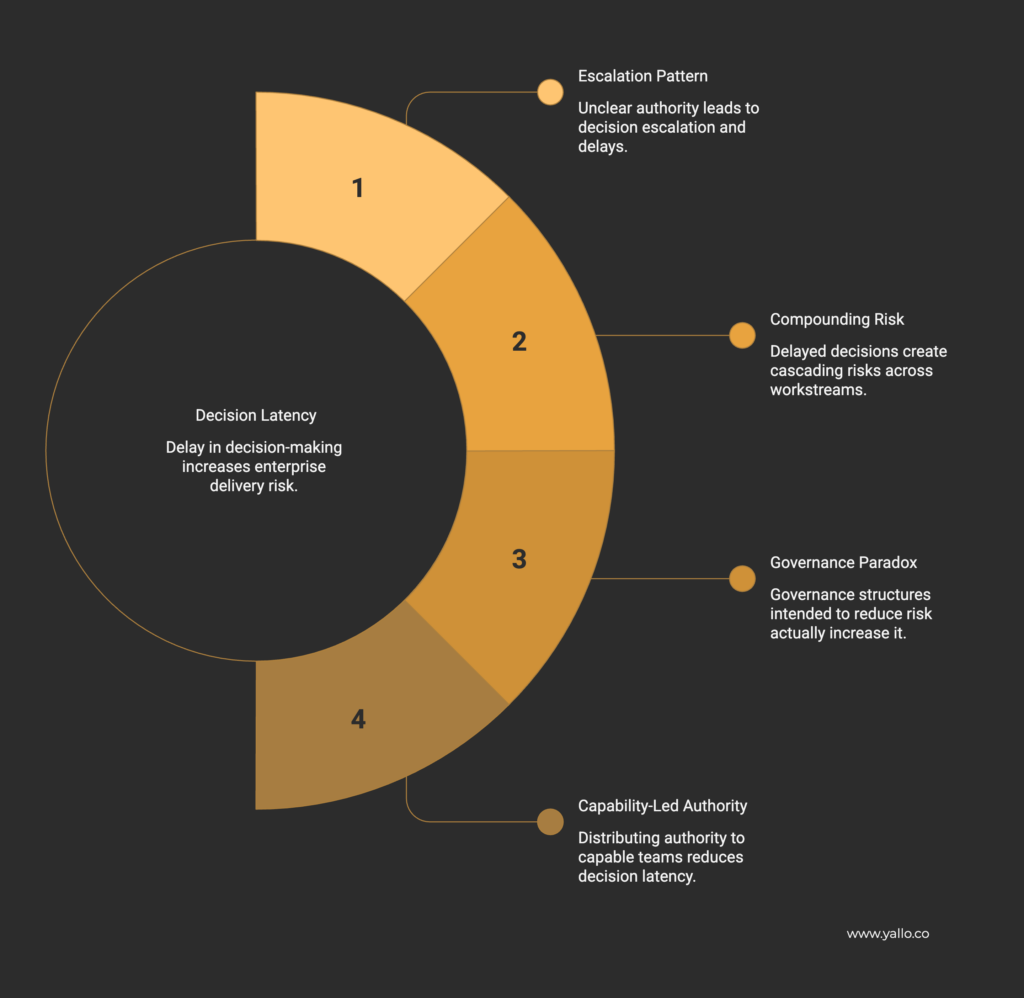
Circular diagram showing four stages of decision latency in enterprise programmes from escalation patterns through compounding risk, governance paradox, to capability-led authority solutions
The four layers of decision latency: from escalation patterns to capability-led authority structures that reduce delivery risk

Decision latency operates in four predictable layers that compound delivery risk across enterprise programmes. The pattern begins with unclear authority structures that force decisions into escalation cycles. This creates the first layer of delay. The second layer emerges as delayed decisions cascade across dependent workstreams, integration waits for architecture, data migration waits for integration, testing waits for migration. The third layer is the governance paradox, where oversight structures intended to reduce risk through review actually introduce more delivery risk through the time they consume.

A single delayed decision creates cascading delivery risk. An SAP integration approach delayed by eight weeks forces data mapping rework, configuration reversal, and testing script invalidation.  Testing approach decisions delay further, invalidating test cases and compressing UAT from six weeks to three weeks. Cutover sequencing decisions arrive too late to develop complete plans or mitigate business continuity risk. This pattern is the documented reality of SAP and Oracle programmes that appear green in status reporting until they encounter cutover, when accumulated delivery risk from months of decision latency becomes visible but the programme no longer has time or budget flexibility to absorb it.
Why Governance Structures Designed to Reduce Risk Actually Create It

Decision committees and alignment processes slow execution without improving decision quality

Enterprise programmes deploy governance structures intended to reduce risk through oversight, stakeholder alignment, and structured decision-making. Steering committees, architecture review boards, change control boards, and cross-functional working groups are established on the assumption that multiple review layers improve decision quality and reduce costly errors. In practice, these structures create decision latency that introduces more delivery risk than the decisions themselves could ever generate.

Governance-induced decision latency operates through predictable patterns:

  • Committee scheduling delays where decisions wait weeks for the next scheduled meeting regardless of urgency
  • Sequential review requirements where decisions move through multiple governance layers, each adding two-week cycles
  • Alignment over authority where consensus is pursued until all stakeholders agree or disagreement escalates higher
  • Information asymmetry where governance boards review summarised information without delivery context, producing slow decisions made with less understanding than delivery teams possess

The governance paradox emerges clearly. Governance layers are added to reduce delivery risk through oversight. Each layer introduces decision latency through review cycles and alignment requirements. Decision latency creates delivery risk through rework, resource misallocation, and timeline compression. The delivery risk introduced by governance-induced latency exceeds the risk the governance structure was designed to mitigate. Programmes respond to delivery pressure by adding more governance, which further increases latency and compounds the original problem. 

Capability-Led Authority Structures and What Reduces Decision Latency

A capability-led authority structure operates on the principle that decisions should be made at the lowest organisational level where sufficient technical capability and programme context exist to evaluate trade-offs and accept accountability for outcomes. An SAP integration architect with ten years of experience navigating FI/CO and MM dependencies in legacy-heavy environments possesses more decision-making capability for integration design choices than a governance committee reviewing a summary presentation. The architect should have authority to make binding decisions within defined parameters, with escalation reserved for decisions that exceed those parameters or require cross-programme resource trade-offs.

Yallo’s case studies from SAP and Oracle delivery programmes demonstrate that decision latency correlates inversely with programme success. Programmes that succeed distribute authority to senior architects and delivery leads who can make binding decisions within their domains without committee review. Insights from complex enterprise delivery validate that execution velocity improves when governance shifts from approval-based to exception-based models, where delivery teams operate with authority until specific risk thresholds trigger escalation. 

Recent Post

How We Serve

TS/EA as a Service

Empowering Business Transformation with Expert Technology Strategy

Talent in a Box

Scaling Innovation with World-Class Talent

Managed IT COE

Delivering Seamless IT Operations at Scale

Leave a Comment

Your email address will not be published. Required fields are marked *

Scroll to Top