Why GCC Enterprises Need Capability-Based Workforce Models, Not Job Descriptions

A strategic examination of why capability based workforce models are emerging as the only sustainable approach to talent, delivery, and organisational performance across GCC digital and transformation programmes.

December 06, 2025 5 mins Read Insight

The Limits of Job Descriptions and Why GCC Organisations Are Facing a Workforce Mismatch

Why traditional role definitions cannot support the speed, complexity, and cross-functional nature of modern GCC transformation programmes

For more than a decade, most GCC organisations have relied on static job descriptions to define roles, responsibilities, and hiring decisions. These descriptions were built for linear operating models where technology cycles were predictable, workforce expectations were stable, and business strategy evolved gradually. Today’s environment bears no resemblance to that world. GCC enterprises are navigating overlapping waves of cloud migration, AI adoption, regulatory shifts, customer experience redesign, national digital strategies, and large-scale programme delivery. In this context, job descriptions are unable to reflect the actual work employees must perform. They capture tasks, not capability. They codify legacy expectations, not emerging skill patterns. And most critically, they cannot adapt to the evolving demands of AI-driven, cloud-native, data-intensive, multi-disciplinary environments. As a result, organisations hire talent that matches the description on paper but not the capability required in practice.

This disconnect is now visible across sectors. In KSA and the UAE especially, organisations frequently discover that employees hired for traditional titles such as “developer,” “data analyst,” or “project manager” are operating in roles that require far more sophisticated skill clusters. A software engineer is expected to understand CI/CD, cloud provisioning, AI integrations, observability, and risk management. A data analyst is expected to interpret machine learning outputs, understand data lineage, and collaborate with domain experts. A project manager is expected to orchestrate cross-functional teams, manage product increments, and respond to shifting requirements. None of this is reflected in traditional job descriptions. This gap between role and capability is why GCC enterprises increasingly face delivery delays, misaligned expectations, and rising dependency on external partners. It is also why they are beginning to replace job descriptions with capability based workforce models—a shift toward evaluating talent based on what they can enable in the organisation, rather than what tasks they can perform. This shift marks the foundation of a more resilient, transformation-ready workforce architecture.

How Rapid Transformation Is Exposing the Gaps in Traditional Hiring and Workforce Planning

Why GCC organisations can no longer depend on linear hiring cycles or static role structures to support modern delivery demands

The scale and velocity of transformation unfolding across the GCC is revealing fundamental cracks in traditional hiring and workforce planning models. National visions such as Saudi Vision 2030, UAE Vision 2031, and Qatar’s digital government initiatives require organisations to operate in environments where technology cycles compress annually, not over multi-year horizons. Cloud migration, AI integration, platform modernisation, sustainability mandates, and data governance reforms are all maturing at the same time—placing extraordinary pressure on talent systems built for far more predictable contexts. As a result, organisations discover that even when they hire quickly, their workforce is often not equipped to execute at the pace transformation requires. Job descriptions lag behind reality, resourcing plans fail to anticipate competency shifts, and recruitment processes prioritise titles instead of outcomes. This mismatch leads to predictable consequences: extended programme timelines, stalled digital initiatives, unfilled specialist roles, and growing reliance on external vendors whose teams often possess more relevant contemporary capabilities.

Compounding this challenge is the fact that modern work in cloud, data, AI, product management, cybersecurity, DevOps, and enterprise architecture no longer falls neatly within the boundaries of traditional roles. A cloud engineer must now understand automation and security; a business analyst must interpret data patterns and AI insights; a cybersecurity professional must navigate distributed systems and identity architectures; a project manager must function as a product orchestrator. These cross-functional demands expose the structural inflexibility of legacy workforce planning frameworks. Organisations that continue to hire based on job descriptions find themselves repeatedly redesigning teams, renegotiating responsibilities, or initiating costly replacement cycles when capability gaps emerge mid-programme. This is precisely why leading GCC organisations are shifting toward capability based workforce models, systems that focus on the underlying skills, behaviours, and problem-solving attributes that predict whether an employee can grow with the complexity of the environment. In a region competing for scarce specialist talent, this move is becoming not just strategic but essential for long-term delivery resilience.

The scale and maturity of India’s Global Capability Centre (GCC) ecosystem further illustrate why traditional job descriptions are no longer sufficient for organisations operating in complex, transformation-heavy environments. As GCC units expand and diversify their scope, from engineering and product development to AI, data, cybersecurity, and platform operations, the capability demands placed on teams have multiplied. This growth has created an environment where capability depth, not static roles, determines organisational performance. The snapshot below provides a clear view of the scale, velocity, and talent density that now shape how capability based workforce models must be designed for GCC-linked enterprises.
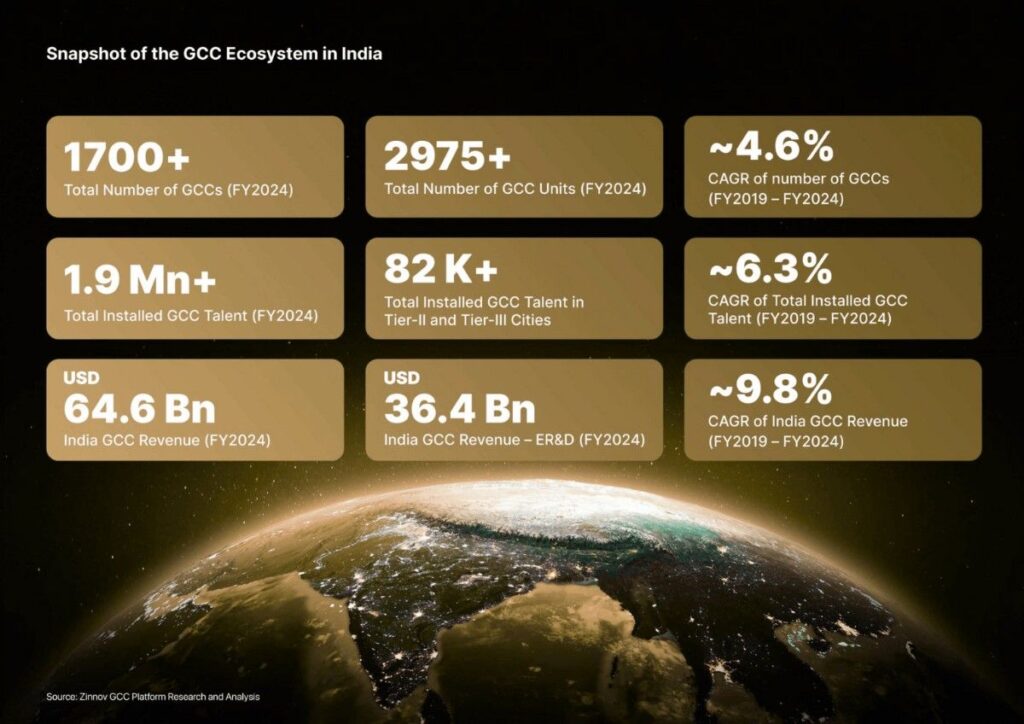
Infographic showing a snapshot of the GCC ecosystem in India, including total number of GCCs, installed talent, unit distribution, revenue figures, and CAGR growth rates from FY2019 to FY2024.
Snapshot of India’s GCC ecosystem, highlighting growth in units, talent, and revenue between FY2019–FY2024. Source: Zinnov GCC Platform Research and Analysis.

This data underscores a fundamental shift: capability ecosystems are scaling faster than traditional workforce models can adapt. With over 1.9 million GCC professionals in India and sustained growth across engineering, R&D, digital, and platform roles, organisations increasingly rely on teams that can operate beyond task-based boundaries. The rise of multi-disciplinary delivery centres means talent must possess scalable, transferable, and evolving capabilities that align with cloud, AI, product engineering, and enterprise platforms. For GCC enterprises operating in the Middle East and India, capability based workforce models are no longer a theoretical construct,they are the only sustainable framework to manage complexity, reduce delivery risk, and build long-term organisational resilience.

Why Capability Based Workforce Models Provide the Structure GCC Enterprises Now Need

How capability-led frameworks create alignment between talent, technology, and transformation outcomes

GCC enterprises are beginning to recognise that the real determinant of transformation success is not headcount, job titles, or even experience levels—it is the organisation’s capability architecture. Traditional workforce structures assume that roles remain stable, that skills evolve slowly, and that employees operate within well-defined boundaries. In contrast, the modern GCC operating environment demands adaptive behaviours, cross-functional fluency, and the ability to navigate continuous shifts in AI adoption, cloud maturity, data governance, cybersecurity risk, and digital service design. Capability based workforce models respond to this by anchoring talent strategy around the skills, behaviours, and cognitive patterns required to deliver value in complex environments. Instead of assuming roles define capability, they focus on what individuals must be able to contribute—problem solving, system thinking, collaboration, product sense, data literacy, and the capacity to learn emerging technologies quickly. This gives organisations a far more accurate picture of their readiness to execute and a clearer understanding of where capability gaps reside.

These models also provide the structural coherence needed to support large-scale transformation programmes. By defining work in terms of capabilities rather than tasks, GCC organisations can align their talent ecosystems with evolving strategic priorities. Teams can be assembled not based on titles but on the specific capabilities needed at each stage of transformation—architecture review, cloud migration, data modelling, AI integration, user experience design, cybersecurity hardening, and operational scaling. This creates fluid, interdisciplinary teams capable of responding to complexity without constant restructuring. It also enables organisations to reskill more effectively, because capability frameworks make learning pathways explicit and measurable. Employees understand what capabilities they must develop, leaders understand how capability gaps affect delivery, and HR understands how to align recruitment with the skills of the future. For GCC enterprises, adopting capability based workforce models is not simply a workforce optimisation decision—it is a fundamental shift in how organisations build resilience, attract scarce specialist talent, and maintain competitiveness in an increasingly complex regional landscape.

Building Capability Systems for Teams Rather Than Roles

Why GCC organisations must shift from role-based structures to integrated capability systems that support transformation at scale

As GCC organisations advance deeper into digital and AI-driven transformation, they increasingly recognise that capability gaps do not exist at the individual level alone they exist at the team level. Traditional role-based structures assume that if each employee performs their assigned tasks, collective performance will follow. But modern transformation environments do not behave linearly. They require teams capable of synchronising architecture, data, engineering, product, security, and operations into unified delivery patterns. This is where capability based workforce models shift from being a talent strategy to becoming an organisational design philosophy. Instead of asking whether a role is filled, organisations ask whether the team possesses the right mix of capabilities to support cloud stability, data reliability, AI productisation, customer experience, or cybersecurity resilience. This approach creates more adaptive teams, reduces bottlenecks, and allows organisations to handle dynamic programme requirements without repeatedly redesigning job structures or outsourcing specialised work.

Developing capability systems also forces leaders to rethink how talent is assessed, deployed, and developed. Rather than measuring employees on tasks or legacy competency frameworks, organisations evaluate them on their ability to contribute to capability clusters: problem-solving in ambiguous environments, architectural reasoning, cross-functional collaboration, data-informed decision-making, and the integration of new technologies into existing workflows. This shift allows the workforce to evolve with the organisation rather than lag behind it. It also builds a more resilient talent base, because capabilities grow cumulatively and travel across domains far more effectively than role-specific knowledge. As GCC enterprises continue to scale transformation initiatives, the organisations that succeed will be those that structure their teams around capabilities, not roles—creating a workforce architecture that is inherently more flexible, more future-ready, and aligned with the demands of modern digital delivery.

How Yallo Helps Enterprises Transition to Capability Based Workforce Models and Fix the Talent Supply Chain

Why GCC organisations need specialist, architect-led talent structures to build sustainable capability depth

The shift toward capability based workforce models marks a turning point for GCC organisations that can no longer depend on static hiring practices or legacy job architectures. But making this shift requires more than intent, it demands precise talent evaluation, deep domain insight, and the ability to assemble specialist teams at speed. This is where Yallo provides structural advantage. Our approach begins with architect-led assessment, ensuring talent is evaluated not on titles or tasks, but on capability signals: problem solving depth, architectural reasoning, delivery behaviour, technical judgment, and the ability to operate across modern cloud, data, AI, platform, ERP, and cybersecurity environments. Because we work at the intersection of technology strategy and talent execution, we help enterprises identify the real capability gaps that slow transformation and deploy the exact specialists required to stabilise and accelerate programmes. Whether a transformation requires AI product engineers, data platform specialists, SAP architects, cloud security experts, or DevOps/SRE practitioners, Yallo delivers talent that is curated for capability, not credentials.

This capability first model is the foundation of a resilient Talent Supply Chain, enabling organisations to scale skills at the speed their programmes demand. With ME India blended teams, contract and project based structures, and 72 hour talent delivery, Yallo offers enterprises the agility and depth that traditional hiring cycles cannot sustain. In many cases, YALLO can fix the Talent Supply Chain, ensuring enterprises have predictable access to high calibre, transformation-ready talent without the delays of traditional recruitment or the inconsistencies of vendor-led models. Our Insights highlight the patterns we see across GCC digital programmes where capability gaps emerge, how organisations can pre-empt them, and which roles create the greatest impact. Our Case Studies show these principles in action, demonstrating how capability-led teams stabilised cloud migrations, accelerated AI product delivery, strengthened ERP rollouts, and reduced long-term vendor dependency. For GCC organisations operating in high velocity, high complexity environments, capability based workforce models are no longer optional, and Yallo is designed to make this transition achievable, scalable, and strategically aligned.

Recent Post

How We Serve

TS/EA as a Service

Empowering Business Transformation with Expert Technology Strategy

Talent in a Box

Scaling Innovation with World-Class Talent

Managed IT COE

Delivering Seamless IT Operations at Scale

Leave a Comment

Your email address will not be published. Required fields are marked *

Scroll to Top