The Architecture Debt No One Tracks Until It Stops Delivery

Why architectural compromises accumulate quietly and surface only when execution momentum breaks down

February 09, 2026 5 mins Read Insight

How architecture debt forms long before it is recognised

Why early delivery trade-offs feel harmless but shape long-term execution limits

Architecture debt rarely appears as a deliberate choice. It forms quietly, embedded in a series of pragmatic decisions made to keep delivery moving. Early in programmes, these trade-offs often feel sensible. Timelines are tight, dependencies are still forming, and teams prioritise visible progress over structural purity. In that context, architectural compromises are framed as temporary, reversible, or low risk.

The problem is not that compromises are made, but that they are rarely acknowledged as debt. Unlike technical debt, which can be logged, prioritised, and refactored, architecture debt tends to remain implicit. Decisions are absorbed into the design without clear ownership or a plan to revisit them. Over time, these choices harden into constraints.

Common sources of early architecture debt include:

  • Platform decisions made to meet immediate deadlines rather than long-term scalability

  • Integration shortcuts taken to avoid dependency alignment across teams

  • Exception-heavy designs justified by local context but never re-evaluated

  • Vendor-specific optimisations that narrow future architectural options

Each decision, taken in isolation, appears reasonable. Collectively, they begin to shape what the system can and cannot do. Architecture debt is created not by negligence, but by the absence of deliberate tracking and accountability at the moment decisions are made.

Why architecture debt remains invisible to leadership

How reporting, governance, and metrics fail to capture structural fragility

One of the most dangerous aspects of architecture debt is that it does not surface through standard management signals. Delivery dashboards continue to show progress. Milestones are met. Risks appear mitigated. From a leadership perspective, the programme looks healthy, even as structural fragility increases beneath the surface.

This invisibility is largely systemic. Most organisations are well equipped to track delivery activity, but poorly equipped to track architectural health. Governance forums focus on approvals rather than cumulative impact. Risk registers capture known issues, not emerging constraints. Architecture reviews assess individual designs, not how compromises interact over time.

As a result, architecture debt is often excluded from executive conversations because it is difficult to quantify. It does not map neatly to cost, schedule, or headcount metrics. Instead, it shows up indirectly through second-order effects that are easy to misinterpret.

Typical signals are overlooked or misattributed:

  • Increasing effort required to make small changes

  • Growing reliance on manual coordination between systems or teams

  • Slower integration cycles despite stable delivery capacity

  • Rising operational complexity without corresponding functional gains

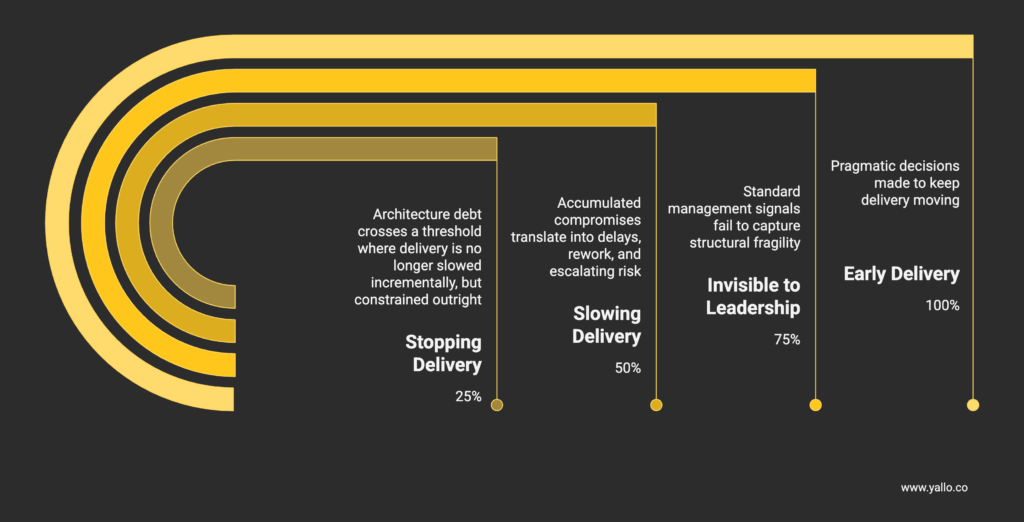
Progressive stages of architecture debt showing how early pragmatic delivery decisions accumulate into invisible structural risk, slowing delivery and eventually stopping execution.
How architecture debt evolves quietly—from early pragmatic decisions to delivery-blocking structural constraints.

This visual illustrates how architecture debt rarely appears as a sudden failure. In the early stages, pragmatic decisions are made to keep delivery moving, often with little visible downside. As these compromises accumulate, delivery begins to slow through rework, integration friction, and escalating risk. Because traditional reporting focuses on milestones and timelines rather than structural integrity, this fragility often remains invisible to leadership. By the time architecture debt crosses a critical threshold, delivery is no longer just delayed—it becomes constrained outright, requiring significant intervention to restore momentum.
When architecture debt begins to slow and then stop delivery

How accumulated compromises translate into delays, rework, and escalating risk

Architecture debt becomes visible only when it starts to interfere with execution. At this stage, delivery teams experience friction that is difficult to diagnose because no single decision appears responsible. Systems still function, but change becomes harder, slower, and riskier. What once felt like flexibility now manifests as constraint. The impact typically surfaces during moments of stress: a major integration, a scale event, a regulatory change, or a shift in business direction. Architecture that evolved through incremental compromise struggles to absorb new demands. Teams respond by adding workarounds, manual controls, or parallel solutions, further increasing complexity.

Several delivery patterns tend to emerge as architecture debt reaches a critical point:

  • Release cycles slow as dependencies multiply and testing effort increases

  • Integration failures become more frequent and harder to isolate

  • Small changes require disproportionate coordination across teams

  • Operational risk rises as systems behave unpredictably under load

At this point, delivery does not stop suddenly. It degrades. Confidence in timelines erodes, contingency buffers expand, and decision-making becomes more cautious. Architecture is often revisited reactively, but remediation now requires significant effort, investment, and disruption. What could have been addressed incrementally must be tackled as a stabilisation exercise. This is why architecture debt is so costly. It delays delivery long before it visibly blocks it, and by the time it is acknowledged, the cost of correction is already high.

Why architecture debt is ultimately an ownership problem

Architecture debt persists not because organisations are unaware of good design practices, but because no one is explicitly accountable for tracking and retiring it. Delivery teams own outcomes, architects influence decisions, and leadership governs progress, yet responsibility for cumulative architectural impact often sits nowhere. Without clear ownership, architecture debt falls between roles. Architects may flag concerns but lack mandate to enforce remediation. Delivery teams prioritise immediate objectives over long-term structure. Governance forums approve exceptions without responsibility for downstream consequences. The system incentivises progress, not structural discipline.Disciplined organisations address this by treating architecture debt as a delivery risk, not a theoretical concern. They make it visible, assign ownership, and integrate it into execution planning rather than deferring it indefinitely. Architecture becomes an ongoing responsibility rather than a one-time design activity.

Across complex enterprise delivery environments, Yallo consistently observes that programmes with explicit ownership for architectural outcomes are better positioned to sustain execution over time. Patterns seen across our case studies and ongoing insights show that architecture debt is manageable when it is acknowledged early, governed deliberately, and addressed as part of delivery rather than after it. When ownership is clear, architecture protects execution. When it is not, delivery eventually pays the price.

Recent Post

How We Serve

TS/EA as a Service

Empowering Business Transformation with Expert Technology Strategy

Talent in a Box

Scaling Innovation with World-Class Talent

Managed IT COE

Delivering Seamless IT Operations at Scale

Leave a Comment

Your email address will not be published. Required fields are marked *

Scroll to Top