When Architecture Authority Is Lost and Delivery Pays the Price
Why the erosion of architecture authority quietly increases delivery risk, complexity, and execution failure in large enterprises
How Architecture Authority Was Gradually Reduced to an Advisory Function
Why architecture authority weakened as enterprises prioritised speed, decentralisation, and autonomy over decision ownership
In many enterprises, architecture still exists as a formal function, complete with frameworks, standards, and review forums. On paper, the organisation appears well governed. In practice, however, architectural authority has steadily eroded. Architects are increasingly positioned as advisors rather than decision-makers, consulted after key choices have already been made or asked to validate designs under time pressure rather than shape them upfront. This shift is rarely intentional, but it has profound consequences for delivery.
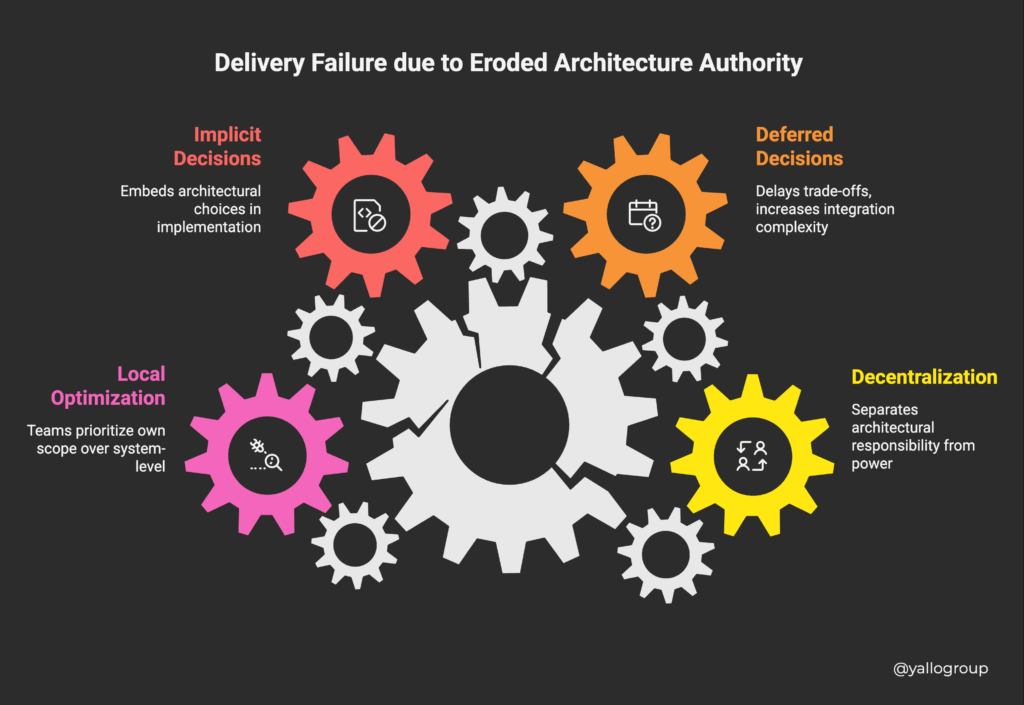
The erosion of authority often begins with good intentions. In the pursuit of speed and autonomy, organisations decentralise decision-making and push responsibility closer to teams. Over time, however, this decentralisation separates architectural responsibility from architectural power. Architects remain accountable for coherence and long-term integrity, but lack the mandate to enforce trade-offs when delivery pressure mounts. Architecture becomes something that happens around delivery instead of within it.
As a result, architectural decisions are deferred, negotiated, or escalated into committees. The organisation gains process but loses judgement. Control is maintained through standards and documentation rather than through experienced practitioners making timely decisions. This is the point at which architecture stops preventing risk and starts reacting to it.
Why Delivery Continues to Move Even as Architecture Authority Weakens
How programmes appear healthy while architectural control erodes beneath the surface
One of the most dangerous aspects of declining architecture authority is that delivery does not immediately slow down. In fact, many programmes appear to accelerate in the early stages. Teams are empowered to make decisions locally, dependencies are resolved pragmatically, and visible progress is reported. From a distance, this looks like agility. In reality, it is often the early stage of architectural fragmentation.
When architecture authority weakens, teams default to optimising for their own scope and timelines. Decisions are made quickly, but without sufficient system-level consideration. This local optimisation masks deeper issues because the negative consequences of architectural misalignment are rarely immediate. They emerge later, when systems must integrate, scale, or operate under stress.
Several patterns tend to repeat in this phase:
Architectural decisions are made implicitly rather than explicitly, often embedded in implementation choices
Design trade-offs are deferred in favour of speed, with the assumption they can be resolved later
Integration complexity grows quietly as teams solve similar problems in different ways
Governance reporting focuses on milestones rather than structural health
As delivery progresses, the organisation begins to rely more heavily on coordination to maintain coherence. Forums, alignment meetings, and review checkpoints multiply. This creates the appearance of control, but it is a reactive form of control that responds to symptoms rather than causes. Architecture, instead of guiding delivery, is pulled into a cycle of validation and exception handling.
By the time concerns surface at leadership level, the programme has already committed to design paths that are difficult to unwind. Delivery did not fail because teams moved too fast, but because they moved without a clear, authoritative architectural spine to absorb complexity as it emerged.
How the Loss of Architecture Authority Converts Directly into Delivery Risk
Why delivery teams compensate for weak architecture authority through escalation, rework, and governance overhead
As architectural authority continues to erode, delivery teams are forced into compensatory behaviours. Engineers build defensive solutions to protect themselves from downstream uncertainty. Programme managers escalate decisions that should have been resolved earlier. Leaders intervene more frequently to arbitrate trade-offs they were never meant to own. Risk management shifts from design to damage control.
This phase is where the cost of weak architecture authority becomes tangible. Delivery slows, not because teams are incapable, but because too much effort is spent navigating ambiguity. Architectural decisions are revisited repeatedly as their downstream implications become clearer. Each revisit increases cost, delay, and frustration.
Common delivery impacts include:
Rework caused by late discovery of architectural misalignment
Increased dependency management as systems struggle to integrate
Escalation chains replacing clear decision ownership
Governance overhead increasing without a corresponding reduction in risk
Over time, this dynamic changes behaviour across the organisation. Teams become cautious, prioritising defensibility over optimisation. Innovation slows as architectural uncertainty increases the perceived cost of change. Leaders experience a loss of confidence in delivery forecasts because progress depends on resolving issues that should never have surfaced so late.
Crucially, accountability becomes blurred. When architecture is advisory, no one truly owns system-level outcomes. Failures are attributed to execution issues, vendor performance, or shifting requirements, while the structural cause remains unaddressed. Delivery pays the price for an authority gap it did not create and cannot fix on its own.
Why Restoring Architecture Authority Is an Execution Requirement, Not a Governance Exercise
Restoring architectural authority is often misunderstood as centralising control or slowing delivery. In reality, it is the opposite. Strong architectural authority reduces the need for heavy governance by enabling better decisions earlier. It places experienced judgement close to execution, where trade-offs can be resolved in real time rather than escalated after damage is done.
This requires rethinking how architecture is positioned. Architects must be embedded within delivery, not adjacent to it. Decision rights must be explicit, not implied. Authority must be matched with accountability for outcomes, not limited to compliance with standards. Most importantly, architecture must be treated as a core delivery capability, not a review function.
When architecture regains authority, delivery becomes more predictable, not less. Teams move faster because they are not constantly negotiating foundational decisions. Risk is addressed through design rather than process. Confidence returns because complexity is being governed deliberately rather than absorbed reactively.
When architecture loses authority, delivery inevitably pays the price. When authority is restored, delivery regains its footing. The difference is not more process, but better judgement exercised at the right moment by people empowered to make it count.
This is where organisations such as Yallo focus their work. Yallo operates at the intersection of architecture authority, delivery risk, and workforce design, helping enterprises rebuild execution capability where it has eroded quietly over time. Through architect-vetted teams and capability-led models, Yallo works with organisations to ensure architectural judgement is present where complexity is highest and delivery pressure is real. The objective is not heavier governance, but better decisions made earlier, reducing risk before it becomes visible and costly.
When architecture authority is restored in this way, delivery no longer has to compensate for structural gaps. It can focus on execution rather than recovery. The difference is not process or tooling, but the deliberate placement of authority, experience, and accountability where they matter most.
Newsletter
Get the latest updates and insights delivered to your inbox.
Thank you!
You have successfully joined our subscriber list.