The New AI Talent Archetypes Emerging
in the Middle East

Discover The New AI Talent Archetypes Emerging in the Middle East, exploring the most in-demand roles, skills, and opportunities shaping the region’s AI-powered future.

January 07, 2026 7 mins Read Insight

Why The New AI Talent Archetypes Emerging in the Middle East Matter Now

AI Adoption in the Middle East Has Shifted From Experimentation to National Strategy

Artificial intelligence is no longer a peripheral or experimental tool in the Middle East—it is a core enabler of national economic transformation and digital governance. Countries like the United Arab Emirates, Saudi Arabia, and Qatar are integrating AI into the heart of their long-term development visions. These initiatives go beyond private-sector productivity; they aim to redefine public service delivery, data infrastructure, and even national identity through AI-powered systems. AI is now viewed as a sovereign capability—essential for competitiveness, innovation, and future-proofing public administration and industry.

Emerging Talent Roles Reflect a Regional Vision That Combines Innovation, Ethics, and Public Value

As AI becomes embedded in everything from smart cities to border control, the Middle East requires a new breed of professionals. These are not just technical specialists—they are architects of trust, innovation, and policy alignment. Emerging AI talent archetypes are uniquely shaped by the region’s multilingual societies, cultural heritage, and strategic objectives. This hybrid workforce is being trained to not only deploy advanced algorithms but also uphold ethical frameworks, support national values, and translate global technologies into locally impactful solutions.

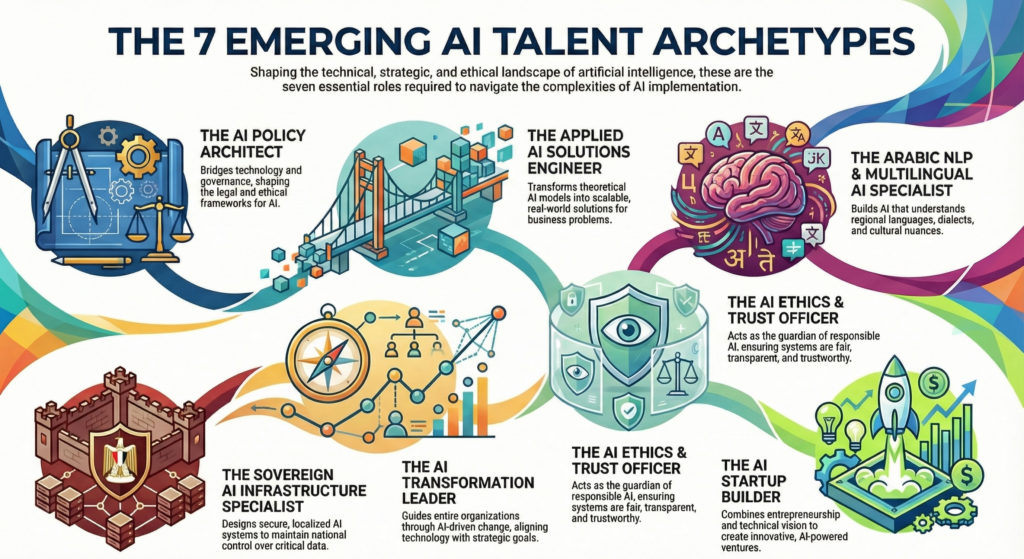
The 7 Emerging AI Talent Archetypes

Emerging AI platforms, giga projects, and national initiatives create unique conditions for next generation skill formation.

1. The AI Policy Architect

The AI Policy Architect plays a crucial role in bridging cutting-edge AI capabilities with governance frameworks that align with legal, ethical, and national objectives. Instead of building models, they ensure AI technologies are responsibly integrated into public systems like digital identity, taxation, and national defense by establishing clear policies around accountability, data protection, and societal impact.

  • Role Overview: Translates AI capabilities into legal and governance frameworks.
  • Why It’s Emerging: Growing AI use in public services requires regulation and ethical alignment.
  • Core Skills & Impact: AI governance, public policy, ethics, stakeholder engagement, shaping national strategies.

2. The Applied AI Solutions Engineer

Applied AI Solutions Engineers turn AI theory into practice by building scalable systems tailored to real-world industries like healthcare, energy, and logistics. These professionals prioritize system architecture, machine learning deployment, and performance, enabling governments and businesses in the Middle East to implement AI solutions with measurable results and operational efficiency.

  • Role Overview: Builds practical, scalable AI systems for real-world impact.
  • Why It Matters: The region focuses on execution and ROI-driven AI deployment.
  • Core Skills & Impact: MLOps, cloud integration, industry data modeling, delivering measurable improvements.

3. The Arabic NLP & Multilingual AI Specialist

Arabic NLP & Multilingual AI Specialists design intelligent systems that understand regional dialects, grammar, and cultural nuances. As most global models are English-centric, this role ensures that AI solutions like chatbots, assistants, and translation tools can engage users in native languages with linguistic accuracy and cultural respect.

  • Role Overview: Develops AI tools for Arabic and multilingual use cases.
  • Why It’s Unique: Arabic language complexity demands localized, inclusive AI systems.
  • Core Skills & Impact: NLP, Arabic linguistics, semantic modeling, bias mitigation, improving accessibility.

4. The AI Ethics & Trust Officer

AI Ethics & Trust Officers ensure that AI systems operate with transparency, fairness, and accountability, especially in sensitive sectors like healthcare, finance, and public services. Their frameworks help build and maintain citizen trust in government-backed AI programs by aligning technologies with ethical principles and regional regulations.

  • Role Overview: Oversees the ethical design and deployment of AI systems.
  • Why It’s Critical: AI use in public domains requires trust, compliance, and transparency.
  • Core Skills & Impact: Explainable AI (XAI), ethical auditing, compliance, risk assessment, public trust protection.

5. The AI Transformation Leader

AI Transformation Leaders are responsible for steering organizations through end-to-end AI adoption. They combine leadership and change management to align AI strategy with organizational goals, ensuring technical initiatives are embraced by people and processes for lasting digital transformation.

  • Role Overview: Guides enterprise-wide AI transformation efforts.
  • Why It’s Growing: Success with AI requires leadership, not just technical tools.
  • Core Skills & Impact: Change management, cross-functional leadership, strategic roadmaps, aligning people and tech

6. The Sovereign AI Infrastructure Specialist

Sovereign AI Infrastructure Specialists develop and manage secure AI computing environments within national borders. With a focus on scalability, data sovereignty, and security, they support the Middle East’s priority of maintaining control over sensitive data while enabling AI at national scale.

  • Role Overview: Builds and secures local AI computing environments.
  • Why It’s Emerging: National security and data sovereignty are key regional concerns.
  • Core Skills & Impact: Secure cloud systems, AI hardware, cybersecurity, data governance, resilient infrastructure.

7. The AI Startup Builder

AI Startup Builders fuse technical knowledge with entrepreneurial drive to build and scale AI-first businesses. With regional ecosystems flourishing, they identify unmet market needs, develop AI products, raise capital, and lead cross-functional teams to transform innovation into commercially viable solutions.

  • Role Overview: Creates and scales AI-driven startups.
  • Why It’s Emerging: Regional ecosystems are expanding with strong funding and infrastructure.
  • Core Skills & Impact: Product development, fundraising, agile development, cross-disciplinary collaboration, market readiness.
Who Builds the Future of AI? The Roles That Matter Most

AI Adoption Is Accelerating Faster in the Middle East Than Globally

AI adoption in the Middle East is accelerating faster than workforce skills can evolve. This growing gap is reshaping roles, expectations, and the very structure of work.

As the Middle East accelerates workplace adoption of emerging technologies, the region continues to lead in AI integration, with about 75 % of employees in the Middle East reporting they’ve used AI tools at work over the past year, outpacing the global average and moving AI from experimentation into everyday practice. This adoption spans sectors such as government, finance, healthcare, and energy and reflects strong institutional backing and digital strategy implementation across the GCC.

The structural transformation of the workforce is deepening worldwide as well. Global research from the World Economic Forum projects that technological change—including AI—will create 170 million new jobs and displace 92 million by 2030, underscoring the urgency for continuous skills development and workforce adaptability.

Together, these trends highlight that the pace of transformation has accelerated—and that upskilling and workforce readiness are vital if workers and organizations are to benefit fully from the promise of AI and other emerging technologies across the Middle East through 2026.

How Organizations Can Prepare for These New Archetypes

To navigate the rapid emergence of new AI talent archetypes, organizations must take a comprehensive approach to workforce development. This includes prioritizing continuous upskilling through digital learning and internal academies, building academic partnerships to strengthen the talent pipeline, establishing clear governance and ethical frameworks, and encouraging collaboration across technical, policy, and business domains. These actions are critical to ensure AI systems are implemented responsibly and aligned with organizational goals.

Yallo supports enterprises through this transition by helping reinforce internal teams with specialist talent vetted for AI, cloud, and data domains. Our focus is on enabling structured capability development while aligning talent with the operational, security, and delivery demands of AI at scale—ensuring organizations are not only future-ready but resilient.

Recent Post

How We Serve

TS/EA as a Service

Empowering Business Transformation with Expert Technology Strategy

Talent in a Box

Scaling Innovation with World-Class Talent

Managed IT COE

Delivering Seamless IT Operations at Scale

Leave a Comment

Your email address will not be published. Required fields are marked *

Scroll to Top