The Accountability Gap: Why AI Cannot Replace the Chief Architect
Why AI cannot replace senior architects in Saudi Arabia and the GCC, and why accountability now matters more than automation.
February 11, 2026
5 mins Read
Insight
When an AI misinterprets a command and executes a recursive delete on a two-terabyte production drive, it can generate an apology instantly. What it cannot do is accept responsibility.
That limitation explains why, in 2026, the technology industry is confronting an uncomfortable truth: artificial intelligence did not replace software engineers. It replaced the illusion that software engineering was ever an easily automated discipline. For senior engineers and architects in the GCC particularly in Saudi Arabia, this realization marks a turning point. What many feared would be a threat to their relevance is instead exposing something the industry cannot function without: accountable human judgment.
The End of the Automation Narrative
For years, AI was positioned as a replacement layer. The narrative around AI replacing software engineers suggested that code generation would eliminate junior work, streamline delivery, and flatten teams. What enterprises are now experiencing, however, is very different.
AI generates output, but it does not own outcomes. It produces syntactically correct code, yet it does not understand why a system exists, how it will evolve, or what failure would cost. The result has been a surge in hidden complexity. Senior engineers increasingly report slower delivery, not because they lack skill, but because they are forced to unwind fragile logic, duplicated patterns, and architectural inconsistencies introduced by AI tools. Speed without understanding has proven to be a false economy.
Why Accountability Is Non-Negotiable in KSA and the GCC
This problem is magnified in Saudi Arabia and across the GCC, where software systems are rarely isolated or experimental. National platforms, regulated financial systems, energy infrastructure, and giga-projects demand architectural clarity and long-term resilience.
When a system fails in these environments, there are regulatory consequences, financial exposure, and reputational impact. Decisions must be justified. Trade-offs must be defended. Someone must stand behind the architecture.
AI cannot do that.
A chief architect can.
This is why organizations in KSA are quietly reversing course. The initial enthusiasm for “AI-first delivery” is giving way to a renewed emphasis on senior architectural ownership.
Newsletter
Get the latest updates and insights delivered to your inbox.
Thank you!
You have successfully joined our subscriber list.
The Real Cost of “Free” AI Code
Many organizations are now recognizing that AI-generated code is not free at all. It often arrives without domain context, violates architectural boundaries, and introduces security and compliance risks that surface months later. In regulated or mission-critical environments, these weaknesses are not tolerable.
What initially looked like acceleration has become deferred cost. Technical debt accumulates invisibly until senior engineers are pulled in to stabilize systems that were never designed to scale safely. The market is relearning an old lesson: architecture is not about writing more code. It is about making fewer irreversible mistakes.
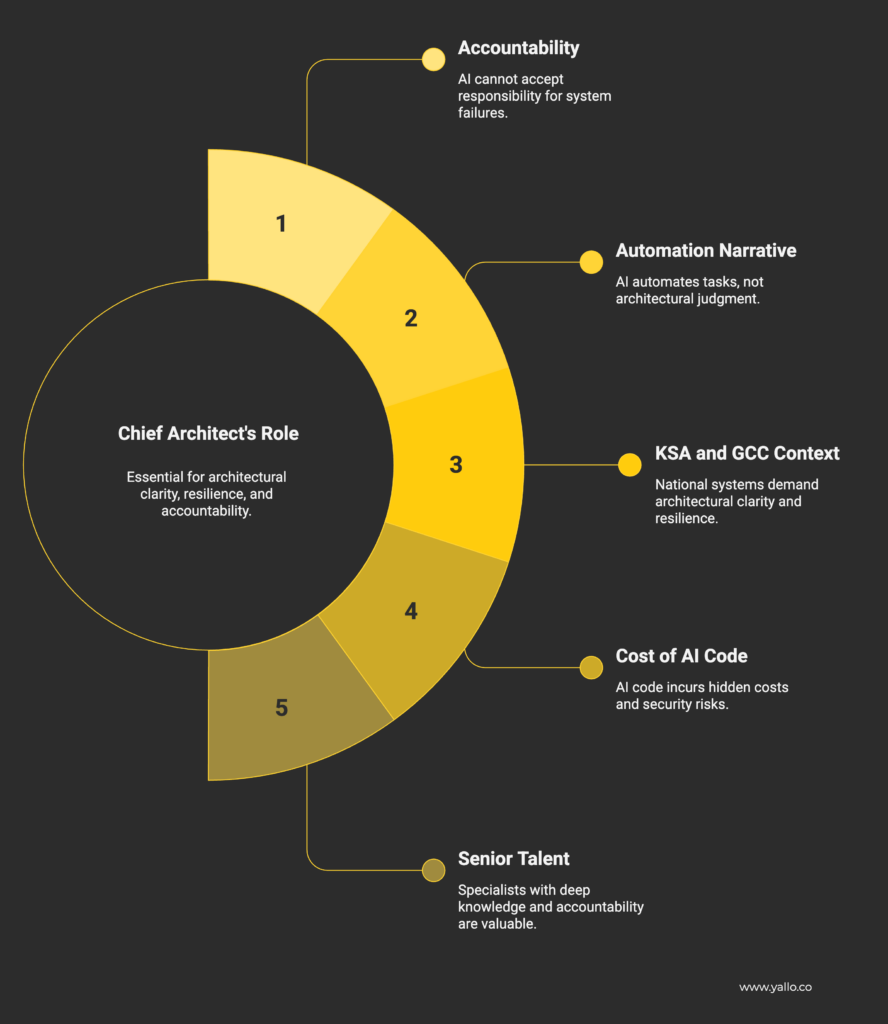
Why chief architects remain irreplaceable: accountability, architectural judgment, and enterprise resilience cannot be automated.
This visual illustrates the widening accountability gap between AI-generated output and human architectural ownership. While AI can automate tasks and accelerate code production, it cannot assume responsibility for system failures, regulatory consequences, or long-term design trade-offs. In enterprise environments, particularly across KSA and the GCC, where national platforms and regulated industries demand resilience, architectural clarity is not optional. The diagram reinforces a central point: automation may improve speed, but only senior architects provide judgment, accountability, and the strategic foresight required to build systems that endure.
What This Means for Senior Talent in Saudi Arabia
For experienced professionals, this shift is reshaping career dynamics. Generalists are increasingly vulnerable to automation, while specialists with deep system knowledge are becoming more valuable. Expertise in enterprise platforms, cloud architecture, cybersecurity, and large-scale integration is being repriced upward. More importantly, accountability itself has become a differentiator. Engineers who can take ownership of design decisions, navigate ambiguity, and guarantee delivery are standing out in a market crowded with AI claims and shallow automation narratives.
This is also why contracting is becoming mainstream across the GCC. Enterprises want flexibility, but they no longer want experiments. They are engaging senior talent for outcomes, not headcount, particularly on large programs in KSA where delivery credibility matters more than long-term payroll commitments.
Why AI Will Never Replace the Chief Architect
Architecture requires judgment across time, context, and consequence. It involves understanding not just how a system works today, but how it will fail tomorrow and evolve over years. These are not promptable skills. AI lacks memory of system history, intuition for organizational dynamics, and responsibility for failure. When something goes wrong, it cannot explain itself to a board, a regulator, or a ministry.
That gap is permanent.
AI will remain a powerful tool. But it will never be the accountable owner of complex systems.
How YALLO Works With Senior Talent
At YALLO, we deliberately work with experienced architects and senior engineers who are tired of being reduced to “prompt supervisors.” Our screening is architect-led because we care about how you think, not how quickly you generate code.
We connect senior professionals in KSA and the wider GCC with organizations that have moved beyond AI hype and are reinvesting in accountable delivery. These are environments where experience is respected, judgment matters, and architecture is treated as a first-class concern.
The industry has reached a point of correction. Output without ownership has proven unsustainable, and the market is adjusting accordingly. For senior engineers and architects in Saudi Arabia and across the GCC, this is not a moment of decline. It is a return to relevance. The future belongs to those who can stand behind systems, explain their decisions, and accept responsibility when things go wrong.