AI Product Ecosystem Skills and the New Capabilities Enterprises Must Develop
A strategic exploration of AI product ecosystem skills and how they are reshaping talent expectations across modern technology organisations.
The Evolution of AI as a Product and the Capabilities Behind Its Ecosystem
Why the shift from standalone algorithms to integrated AI products demands a new layer of talent sophistication
The rapid evolution of AI from isolated models to fully integrated digital products has reshaped how organisations think about capability, execution, and long-term adoption. What once lived inside research teams or experimental innovation labs has now become a core layer of enterprise value—embedded in workflows, customer interfaces, supply-chain processes, analytics environments, and decision-support systems. This shift represents the formal emergence of the AI product ecosystem, a structured collection of platforms, data pipelines, governance layers, model lifecycles, observability frameworks, domain logic, and user-experience patterns. As organisations adopt AI at enterprise scale, the complexity sits not in building models themselves, but in designing, scaling, and maintaining AI products that behave reliably in production environments.
This transition has introduced a capability challenge that many organisations underestimated. According to a recent global survey, only around 26 percent of companies have developed the necessary set of capabilities to move beyond proofs-of-concept and generate tangible value from AI investments. These “capability-ready” organisations tend to be those that combine strong data infrastructure, agile product delivery pipelines, and clear talent strategies, highlighting that AI success depends as much on human and organisational readiness as on technology.
AI products operate across distributed architectures, cloud platforms, governed data environments, MLOps pipelines, risk and compliance layers, and evolving user behaviours. As a result, the skills required to deliver AI products differ fundamentally from those required to build standalone models or proof-of-concepts. Teams need talent that understands problem framing, data governance, model deployment, lifecycle performance monitoring, operational risk and compliance, and continuous improvement. They need to build cross-domain fluency spanning product management, data engineering, AI ethics, security, user experience, and change management. Those who possess these AI product ecosystem skills will be essential to organisations seeking not only to deploy AI, but to embed it sustainably across business operations. (PwC)
Why AI Product Ecosystem Skills Are Redefining Talent Models Across Technology Teams
How new AI operating patterns are reshaping workforce expectations, role boundaries, and capability depth
The rise of AI-enabled products has created a new class of organisational skills that traditional The rise of AI-enabled products has created a new class of organisational skills that traditional technology teams were never designed to carry. Much of this shift comes from the fact that AI products do not behave like conventional software. Their behaviour changes with new data, new contexts, and new user patterns, requiring teams to operate them as evolving systems rather than static releases.
According to Gartner, by 2026, 40 percent of enterprise applications will feature task-specific AI agents, up from less than 5 percent currently (Gartner). This trend transforms enterprise applications from mere tools into intelligent, adaptive systems, and introduces complex execution, compliance, and lifecycle demands. As a result, organizations need a new breed of talent with hybrid skills: engineers who understand AI-native architectures, product managers versed in data governance, security professionals experienced in AI-driven risk, and domain experts who can guide model outputs with business context. These are not optional extras: they are critical components for building stable AI products in enterprise environments.
Recent global research reinforces that technical readiness is no longer the key bottleneck, the real barrier is talent and capability. McKinsey’s latest survey shows that although almost all companies now invest in AI, only 1 percent believe they have attained “AI maturity”, meaning that AI is fully integrated into workflows and driving business impact at scale. Moreover, a 2025 global technology-talent study by McKinsey highlights that 46 percent of technology leaders now cite skill gaps as the primary obstacle in adopting frontier technologies such as AI, data platforms, and advanced analytics (McKinsey).
This aligns with observations from Deloitte in earlier years that firms have long struggled to build pipelines of AI-specialist talent. For enterprises in the Middle East, many of which are scaling cloud, data, and AI investments simultaneously, the implication is clear: success in the AI product ecosystem depends not just on access to technology or capital, but on strategic workforce architecture. The demand is shifting from “tool-centric engineers” to “ecosystem-capable teams” that bring together data, design, governance, security, and domain insight under one orchestrated delivery model.
As enterprises advance deeper into AI-enabled ecosystems, the timeline for how AI will reshape application behaviour is becoming clearer. Gartner’s agentic AI roadmap illustrates how quickly enterprise systems are moving from simple AI assistance toward complex, collaborative, multi-agent architectures. This evolution is highly relevant for organisations building AI products today, because it shows that the skills required to develop and maintain these systems will expand significantly over the next five years. Understanding this trajectory is essential for planning capability development and preparing teams for the increasing sophistication of AI-driven workflows.
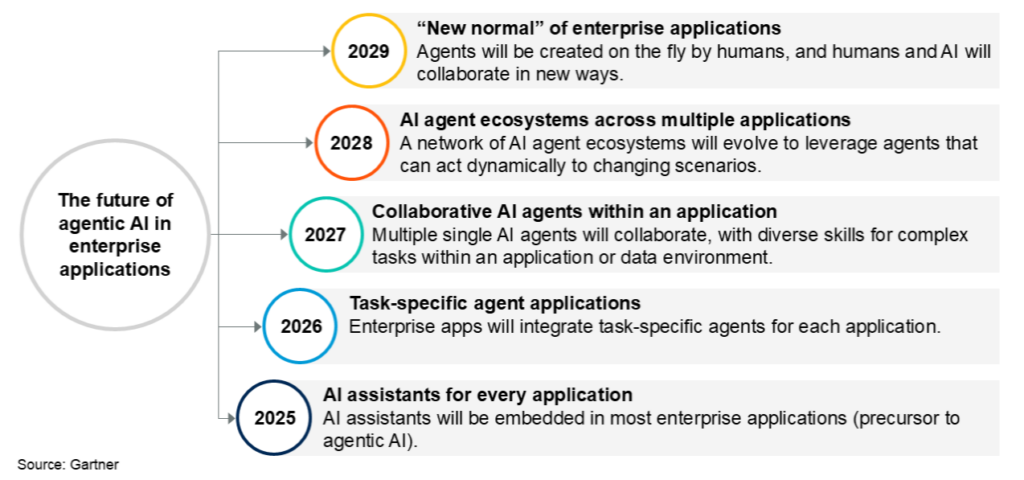
This roadmap reinforces why AI product ecosystem skills must evolve beyond today’s capabilities. As applications begin integrating task-specific agents, collaborating agent networks, and dynamically generated AI behaviours, talent models will need to accommodate new competencies in agent design, orchestration, monitoring, governance, and AI-driven decision flows.
The concentration of shortages in application development and business application users aligns with what we see across Middle East retail, BFSI, and healthcare clients, where the demand for engineers, product specialists, and domain-linked analysts consistently outweighs supply. As enterprises across the Middle East and India advance through cloud, AI, data, and platform modernisation, their readiness to adapt to new skill demands varies significantly. This readiness gap directly influences the pace at which organisations can execute transformation programmes, build blended ME–India teams, and stabilise complex technology estates. The following EY analysis offers a structured view of organisational agility in responding to tech-skills shifts and highlights why enterprise tech skills 2025 are now central to competitive advantage.
The Hybrid Skill Clusters Emerging Across Data, Engineering, and Product Disciplines
Why AI-driven organisations now require cross-functional talent capable of operating across entire AI product ecosystems
The shift toward AI-enabled products has created a new category of hybrid talent that cannot be defined by traditional job descriptions. Organisations are discovering that AI initiatives cannot be staffed through isolated data science teams or single-domain engineering roles. Instead, they require cross-functional groups that bring product judgment, data fluency, engineering depth, and governance awareness together into a unified delivery capability. Research across the industry shows that companies extracting the highest value from AI tend to deploy multidisciplinary AI product teams rather than siloed specialist groups. These teams include product managers who understand experimentation, data engineers who ensure lineage and quality, ML engineers who build and deploy reliable models, platform engineers who maintain the infrastructure around them, and domain experts who guide the decision logic. This collaborative structure is becoming a defining requirement of AI maturity, and it highlights why AI product ecosystem skills must span far beyond model building alone.
The complexity of modern AI systems is also reshaping expectations of technical roles. AI products introduce new dependencies—continuous data flows, lifecycle monitoring, ethical constraints, performance drift, model retraining cycles, and evolving user behaviour—that require deep operational awareness. Studies indicate that many AI failures occur not during algorithm development but during deployment and maintenance, where gaps in engineering readiness, governance, or reliability practices become visible. This has accelerated demand for new competency clusters such as MLOps, ModelOps, data reliability engineering, AI observability, and human-in-the-loop oversight. These disciplines exist at the intersection of multiple fields and require practitioners who can navigate both system architecture and business context. As organisations across the GCC expand their AI footprints, the most valuable talent will be those who possess these integrated AI product ecosystem skills—capabilities that allow AI products to function predictably, safely, and at scale within enterprise environments.
Reinforcing AI Product Delivery Through Specialist Talent and Yallo’s Capability-Led Approach
As organisations accelerate their AI ambitions, many discover that internal capability development is necessary but not sufficient. Scaling AI from experimentation to enterprise-grade products demands specialist roles that are difficult to hire, difficult to evaluate, and even harder to assemble into cohesive teams. AI products introduce dependencies that sit across cloud engineering, data architecture, MLOps, risk governance, security, user experience, and domain-specific insight. Most organisations do not have the talent depth required to support these interlocking components, which is why execution gaps appear even when strategies are well defined. Yallo supports enterprises at this point of complexity by supplying specialist, architect-vetted contract and project-based talent across cloud, data, AI, DevOps, cybersecurity, platform engineering, and ERP modernisation. Instead of narrowly filling vacancies, we reinforce the delivery layer that allows AI ecosystems to behave consistently in real-world enterprise environments. This helps organisations build and sustain the AI product ecosystem skills required for long-term operational success.
Beyond specialist roles, organisations increasingly need a capability partner who can interpret skill gaps, reduce delivery risk, and align talent structures to transformation realities across the Middle East and India. This is where Yallo’s operating model becomes strategically valuable. With architect led screening, deep domain evaluation, and ME, India blended teams, we help organisations build resilient capability structures rather than ad-hoc technical staffing. In many cases, YALLO can fix the Talent Supply Chain by ensuring enterprises have predictable access to high-calibre, transformation-ready talent within 72 hours, talent that can stabilise programmes, accelerate delivery, and reduce SI dependency. Our Insights share the patterns we see across cloud, data, AI, and digital transformation programmes, while our Case Studies demonstrate how targeted specialist deployment strengthens capability, recovers timelines, and drives measurable delivery outcomes. Together, they illustrate a simple truth: organisations that match strategy with the right talent architecture are the ones that successfully scale AI products, not just test them.
Newsletter
Get the latest updates and insights delivered to your inbox.
Thank you!
You have successfully joined our subscriber list.