What AI Agents Mean for Job Architecture in Saudi Enterprises
How autonomous systems are reshaping roles, responsibilities, and workforce design across Saudi organisations
Why AI Agents Are Breaking Traditional Job Architecture in Saudi Enterprises
Saudi Arabia is accelerating into an AI-first economic cycle. With national investments in autonomous systems, agentic AI platforms, and AI-enabled government services, enterprises in the Kingdom are beginning to operate in environments where intelligent agents not humans carry out increasing portions of analysis, orchestration, and execution. This shift is not incremental; it fundamentally redefines how work gets done and what roles organizations need to sustain performance.
Traditional job architecture in Saudi enterprises was built around human-centric tasks manual analysis, operational oversight, decision escalation, and predictable workflows. AI agents dismantle that foundation. They perform tasks autonomously, collaborate with each other, trigger actions across systems, and adapt based on real-time data. As a result, many job descriptions no longer align with how work is actually executed. Instead of replacing roles, AI agents redistribute responsibilities, creating new categories of supervision, governance, and cross-domain capability needs.
This shift is especially significant in high-impact sectors such as public services, healthcare, fintech, national security, and mega-project operations. These industries require reliability, speed, and precision—attributes that agentic AI can enhance but only when paired with the right talent architecture. Saudi enterprises are now realizing that the challenge is not adopting the agent systems themselves; it is redesigning the workforce around them to ensure stability, accountability, and safe scaling.
How AI Agents Are Changing Responsibility and Accountability Models
When systems act autonomously, ownership must be redesigned, not reassigned
As Saudi enterprises begin to integrate AI agents into operational and decision-making environments, the foundations of responsibility and accountability inside organisations are undergoing a significant shift. Traditional job architecture was built on the assumption that humans initiate actions, analyse outcomes, escalate decisions, and maintain control over the systems they operate. AI agents dissolve these assumptions. They act autonomously, initiate workflows without human prompting, evaluate data in real time, and often complete tasks end to end. This creates a workforce environment where responsibility can no longer be tied purely to task ownership, but must be redesigned around system supervision, behaviour monitoring, and outcome governance.
This shift is particularly important in Saudi industries where AI is being deployed at scale, including national platforms, finance, public services, infrastructure management, and regulated sectors such as healthcare and energy. Leaders in these environments increasingly recognise that accountability cannot remain attached to static job descriptions if autonomous systems are driving execution. Instead, enterprises require new layers of oversight that ensure AI agents operate within approved boundaries, follow policy constraints, and escalate anomalies before they disrupt operations.
To support this shift, responsibility within teams is evolving in several critical ways. These changes do not replace human involvement; instead, they redefine how human involvement must occur in AI-enabled environments:
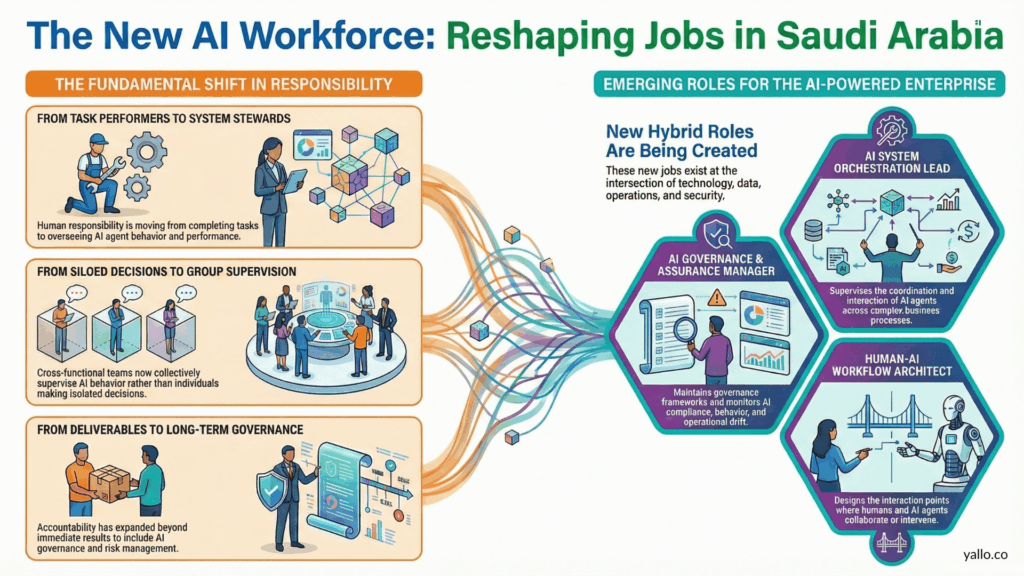
- Responsibility is moving upward from task performers to system stewards who oversee how agents behave, not just what tasks they complete.
- Decision ownership is shifting from individuals within isolated functional silos to cross-functional groups who collectively supervise system behaviour, interpret outcomes, and intervene when necessary.
- Accountability is expanding beyond immediate deliverables to include AI governance, risk management, and evaluation of system outputs over time, which requires deeper understanding of data patterns, model drift, and operational performance.
These changes highlight a central reality for Saudi enterprises. The adoption of AI agents requires a transformation in how work is structured and how teams are organised. The goal is not to eliminate roles, but to design roles that reflect the nature of autonomous systems and the responsibility frameworks they demand.
The New Enterprise Roles Emerging Around AI Agents
Saudi organisations are creating capability-based roles instead of fixed job titles
The rise of AI agents inside Saudi enterprises is giving shape to a new category of roles that did not exist in traditional job architecture. These roles emerge from the need to supervise agentic behaviour, ensure alignment with regulatory expectations, and maintain system reliability across increasingly complex operating environments. They do not fit neatly into existing job families such as software engineering, data science, cybersecurity, or operations. Instead, they live at the intersection of these capabilities and require a form of hybrid proficiency that reflects the nature of autonomous systems.
As these responsibilities expand, organisations are formalising new job families that can support the full lifecycle of AI agent deployment. These roles are not reactive additions to existing teams but structural components of an enterprise architecture designed for AI-enabled systems. They reflect the shift from task-based work to outcome-based oversight, where professionals must understand how multiple autonomous components interact, where risks may materialise, and how interventions must be designed to protect system integrity.
To make this shift more visible, the following table summarises the emerging categories of roles that Saudi enterprises are beginning to institutionalise as AI agents become part of daily operations:
| Emerging Role Category | Core Responsibility | Enterprise Need Addressed |
|---|---|---|
| AI System Orchestration Lead | Supervises the coordination, interaction, and flow of tasks executed by AI agents within complex systems | Ensures agents operate coherently across business processes and do not create fragmentation or hidden dependencies |
| AI Governance and Assurance Manager | Maintains governance frameworks, monitors compliance, evaluates model behaviour, and identifies operational drift | Addresses regulatory expectations and safeguards system integrity in high-stakes environments |
| Human AI Workflow Architect | Designs workflows where humans and AI agents interact, collaborate, or intervene based on predefined rules | Ensures that human oversight is embedded into processes without slowing down performance |
| Model Lifecycle and Reliability Specialist | Oversees model deployment, retraining, performance assessment, and version control | Ensures models remain reliable as data, context, and business conditions evolve |
| Enterprise Data Steward for AI | Manages data quality, lineage, and accessibility for AI agent-driven tasks | Ensures agents have access to accurate, compliant, and timely data inputs |
| AI Augmented Engineering Lead | Builds technical systems that integrate agents into software or operational processes and supervises agent-generated outputs | Ensures AI-driven components align with architecture, performance, and security standards |
These roles differ from traditional enterprise functions in several meaningful ways. They demand a broader base of technical and operational understanding, the ability to interpret system behaviour rather than static outputs, and a continuous engagement with governance principles that influence how AI agents should operate. They also require professionals to collaborate across domains that were previously separate, such as architecture, security, data, and operations.
The emergence of these roles demonstrates that AI adoption in Saudi Arabia is not simply a matter of automating tasks. It is a fundamental restructuring of job architecture, accountability frameworks, and capability expectations. The enterprises that recognise and operationalise these roles early will be better positioned to adopt AI safely, scale it sustainably, and maintain control over increasingly autonomous systems.
Building AI Agent Ready Teams in Saudi Arabia Without Increasing Delivery Risk
The organisations that succeed with AI agents in Saudi Arabia will be those that invest in workforce models built around capability, oversight, and system-level understanding. AI agents do not reduce the need for human expertise. Instead, they elevate the need for professionals who can supervise autonomous components, interpret dynamic behaviour, and align system outputs with strategic objectives.
Designing AI agent ready teams begins with establishing role clarity around supervision, governance, and technical integration. It requires organisations to identify which parts of the workflow must remain human-controlled, where intervention is needed, and how responsibility is distributed across architecture, operations, data, and security. It also requires building capacity for continuous learning, since AI agents evolve as data patterns, regulatory expectations, and business demands change.
Yallo supports Saudi enterprises in navigating this transition by providing specialist, architect-vetted talent aligned with the capabilities required to operate agentic systems at scale. Our focus is on supplying professionals who understand the interplay between AI behaviour, enterprise architecture, security constraints, and delivery risk. We help organisations reinforce internal teams with AI, cloud, data, cybersecurity, model lifecycle, and governance specialists who can stabilise programmes, accelerate progress, and reduce dependency on vendors. Through our Insights, we analyse emerging role patterns, capability gaps, and workforce risks across the region. Through our Case Studies, we demonstrate how capability-led deployment improves delivery outcomes and strengthens organisational ownership of AI systems over time.
Newsletter
Get the latest updates and insights delivered to your inbox.
Thank you!
You have successfully joined our subscriber list.