AI-Powered Shopping Set to Surge as U.S. Online Holiday Sales Exceed $253 Billion
November 11, 2025
8 mins Read
News
A Record-Breaking Season for U.S. E-Commerce
The 2025 U.S. holiday shopping season is shaping up to be one of the most data-driven in history. According to Adobe’s Digital Insights Holiday Forecast, total online spending is projected to reach $253.4 billion, marking a 5.3 percent year over-year increase despite broader economic pressures and cautious consumer sentiment. This estimate comes from Adobe Analytics, which monitors over 1 trillion retail site visits and analyzes 100 million SKUs across 18 product categories. With its analytics platform used by the majority of the top 100 U.S. online retailers, Adobe’s data offers one of the most accurate lenses into consumer behavior heading into the year’s most competitive shopping window.
The findings confirm that while inflation and interest rates are reshaping spending priorities, American shoppers remain highly active online. Cyber Monday is expected to again dominate as the biggest shopping day of the year, with $14.2 billion in projected sales (up 6.3 percent year over year), followed by Black Friday at $11.7 billion (up 8.3 percent). Thanksgiving Day will also see early momentum, with $6.4 billion in expected spend, showing that the holiday shopping cycle is expanding beyond its traditional peaks. Behind these numbers lies a growing sophistication in how people shop. Consumers are increasingly using digital tools to make smarter, faster decisions. From mobile apps and price-tracking extensions to AI assistants that generate product ideas or gift lists, the modern holiday experience has become deeply personalized, and highly intelligent.
The Shift in Shopper Behavior and the Rise of AI-Assisted Commerce
The most striking headline in Adobe’s report is the projected 520 percent increase in AI-assisted shopping traffic compared to last year. Generative AI tools, including conversational search, recommendation engines, and personalized deal finders, are transforming how people browse and buy. Adobe’s survey of 5,000 U.S. consumers revealed that 53 percent plan to use AI for pre-purchase research, while 40 percent expect to seek AI-based recommendations, 36 percent will use AI for deal-finding, and 30 percent for gift inspiration.
This shift represents a fundamental change in consumer psychology. Instead of passively scrolling through pages of products, shoppers are turning to AI assistants to filter, refine, and suggest, effectively outsourcing part of the decision process. Retailers are already responding by integrating generative AI features into their websites and mobile platforms. These tools analyze context, behavior, and preferences to deliver suggestions that feel conversational rather than mechanical. The growth of AI shopping is also changing marketing dynamics. Retailers can now capture intent earlier in the discovery phase and build campaigns around predictive interest rather than demographic assumptions. Adobe expects the heaviest AI traffic to occur in the 10 days leading up to Thanksgiving, signaling a new type of “micro-moment marketing” where brands compete for algorithmic visibility as much as human attention. Beyond convenience, the rise of AI-enabled shopping suggests deeper trust in intelligent systems. Consumers are increasingly comfortable letting algorithms assist them in financial and emotional decisions, from selecting gifts for loved ones to choosing payment plans. This normalization of AI-mediated decision-making will have lasting effects well beyond the holiday season. Retail spending this year is not evenly distributed across categories. Adobe’s data shows that consumer priorities are diversifying beyond electronics and apparel. Lifestyle and wellness categories — including groceries, beauty, and personal care — are seeing the fastest growth, reflecting a more balanced approach to holiday gifting. This shift suggests that consumers are blending practicality with indulgence, seeking experiences and products that improve everyday life rather than simply adding volume to their carts.
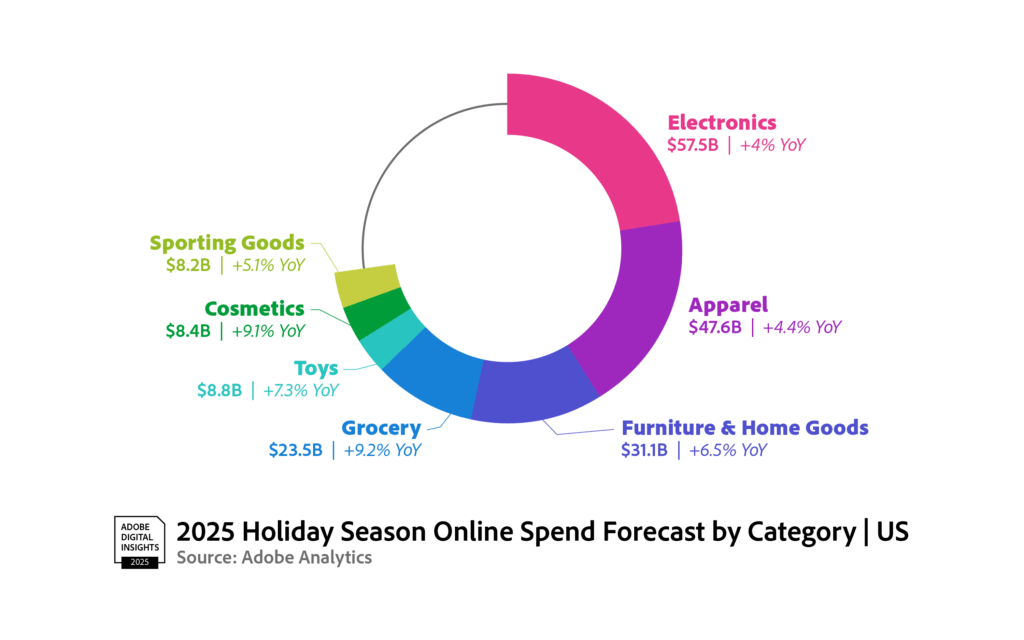
2025 Holiday Season Online Spend Forecast by Category in the United States. Electronics and apparel continue to lead, but groceries and cosmetics show the fastest growth in online demand. Source: Adobe Digital Insights, Holiday Shopping Forecast 2025
This category distribution confirms that digital retail is no longer dominated by a few sectors. Instead, every category has become data-driven and opportunity-rich. Retailers that understand these nuanced spending patterns can adjust inventory, tailor discounts, and optimize promotions in real time. As Adobe’s data illustrates, the future of retail growth depends not on category dominance but on category intelligence, the ability to identify where demand is emerging and how quickly it is shifting.
Mobile, Payments, and Social Commerce Reshape the Shopping Experience
If 2024 marked the mobile tipping point, 2025 is the year of mobile dominance. Adobe forecasts that 56.1 percent of online sales this holiday season will come from smartphones, up from 54.5 percent in 2024 and 51.1 percent in 2023. The widening of smartphone screens and the seamless integration of digital wallets have made it easier for consumers to browse and purchase from anywhere. Retailers that optimize their mobile experiences, through faster checkout, tailored notifications, and AI-powered search, will capture the lion’s share of this growth. At the same time, flexible payment methods are changing how shoppers manage budgets during the holidays. Buy Now, Pay Later (BNPL) services are expected to account for $20.2 billion in online spend, an 11 percent year-over-year increase. On Cyber Monday alone, BNPL transactions are projected to reach $1.04 billion, setting a new record. The appeal of these services lies in their ability to balance convenience with affordability, allowing consumers to stretch spending without the friction of traditional credit.
Social commerce is also emerging as a powerful new channel. Adobe reports a 51 percent increase in online revenue from social platforms compared with 2024. Shoppable content, influencer campaigns, and integrated checkout options on apps like Instagram, TikTok, and Pinterest are turning casual browsing into impulsive conversion. This signals that the line between entertainment and commerce is disappearing, every scroll can now lead directly to a sale. The convergence of AI, mobile, and social media points toward a future where retail is ubiquitous and intuitive. Consumers no longer go shopping; they are always shopping. The rise of AI-assisted commerce is not a temporary trend but a structural shift. Consumers are rapidly integrating AI tools into their shopping habits, and the momentum is accelerating far faster than expected. From conversational recommendations to real-time deal engines, AI now influences every stage of the online journey.
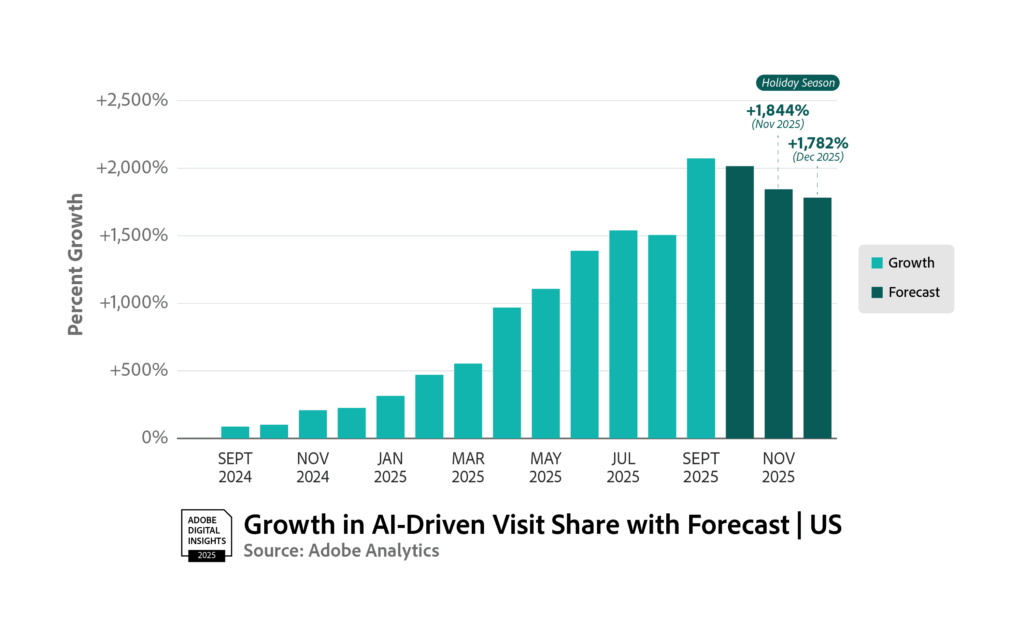
Growth in AI-driven retail visits in the United States, showing a sharp surge approaching the 2025 holiday season and an expected 520 percent increase in traffic year over year. Source: Adobe Digital Insights, Holiday Shopping Forecast 2025
This growth trajectory demonstrates how AI is no longer an experimental feature but a mainstream shopping companion. Retailers who strategically deploy AI to anticipate needs, personalize engagement, and automate support are redefining convenience itself. The data also hints at a deeper behavioral transformation, consumers increasingly trust algorithms to assist them in making meaningful purchasing decisions.
The Economics of Discount Culture and Category Insights
Discounts remain one of the most powerful levers driving holiday sales, with Adobe predicting average markdowns of around 28 percent off list prices. Electronics, toys, and apparel are expected to offer some of the deepest deals. The appetite for promotions reflects a consumer mindset that is still price-sensitive after years of inflation. But it also highlights how retailers are using dynamic pricing algorithms to adjust discounts in real time based on inventory levels and demand spikes.
In terms of category breakdown, electronics will continue to lead with an estimated $57.5 billion in sales, followed by apparel at $47.6 billion and furniture at $31.1 billion. These sectors are seeing steady mid single digit growth as shoppers prioritize home upgrades and wearable tech. Interestingly, the fastest-growing categories this year are expected to be cosmetics and personal care (up 9.1%) and groceries (up 9.2%), driven by lifestyle convergence and gifting trends that blend wellness with convenience. However, analysts note that while overall sales are climbing, growth rates are stabilizing compared with the explosive gains of 2021-2023. The focus is shifting from expansion to optimization. Retailers are being challenged to balance heavy discounting with profitability, making technology-driven efficiency, in logistics, marketing, and personalization, more essential than ever.
What the Numbers Reveal About the Future of Retail
Adobe’s latest report paints a picture of a retail world that is becoming intelligent by default. Every click, search, and purchase is now part of a vast feedback system where data constantly informs design, pricing, and personalization. This is not just e-commerce growth, it is the evolution of how intelligence drives business. The 2025 holiday season marks a defining moment where AI, mobile, and behavioral analytics converge to make shopping not only faster but also deeply contextual and predictive. Retailers are realizing that technology alone is no longer a differentiator. What matters now is how intelligently it is applied. The businesses that are thriving are those that have embedded analytics and AI directly into decision making, from inventory planning to real-time marketing and customer service. They are not reacting to data; they are anticipating it. This is what separates technology adoption from transformation. At Yallo Group, we see this transition firsthand across industries. Retail is moving toward what we call intelligent commerce, where strategy, technology, and human experience operate in complete alignment. In our Case Studies, we explore how leading organizations are using AI, automation, and experience design to create retail systems that think and adapt dynamically. These examples show that digital maturity is not achieved through tools alone but through structural clarity and cultural readiness.
Our Insights highlight the same pattern, the most successful retailers of 2025 are those that combine data precision with emotional intelligence. They treat personalization as more than marketing; they see it as an ethical commitment to relevance. They use analytics not just to sell more, but to serve better. These are the hallmarks of intelligent retail, where value creation is measured by trust, experience, and adaptability. The takeaway from Adobe’s numbers is clear. The future of retail will not be owned by those who spend the most, but by those who learn the fastest. Intelligence, integration, and purpose are becoming the new competitive currencies. As the holiday season sets new records, retailers that think strategically about technology, and partner with firms that help them align business design with AI-driven transformation, will be the ones that define the next decade of commerce.