Building Retail Tech Teams in India: Bengaluru vs Hyderabad vs Pune

A strategic comparison of Bengaluru, Hyderabad, and Pune for global technology expansion

February 23, 2026 5 mins Read Insight

The Rise of Retail Tech Teams in India

Why global brands are building engineering capability before market entry

Retail tech teams are no longer an afterthought in international expansion. For global brands entering new markets, technology capability is increasingly built ahead of physical retail scale. In India, multinational retailers have established engineering hubs to support global commerce platforms, enterprise systems, cloud infrastructure, and customer experience architecture well before store networks are fully operational.

India has moved beyond cost optimisation to become a strategic delivery centre for complex retail platforms. Retail tech teams in India now own product roadmaps, manage Salesforce ecosystems, support omnichannel integration, and contribute to enterprise architecture decisions across regions. Hiring, therefore, is focused less on individual developers and more on building cross functional squads capable of sustaining platform scale.

Bengaluru has emerged as the leading location for this model. Its concentration of global capability centres, enterprise architects, Salesforce specialists, and platform engineers enables sophisticated retail technology delivery. Several global athletic and lifestyle brands have selected Bengaluru as their primary India base for global retail technology operations, reflecting confidence in the depth and maturity of its ecosystem.
The drivers behind the growth of retail tech teams in India are both structural and strategic:

  • Access to large and diverse engineering talent pools
  •  Mature Salesforce and enterprise platform ecosystems
  •  Deep cloud and platform engineering capability
  • Time zone alignment with global headquarters
  • A cost to capability balance that supports long term scaling

What differentiates the current wave of expansion is intent. These retail tech teams are not designed as support functions. They are being positioned as core contributors to global digital strategy. That positioning increases the importance of where they are built and how deeply they are structured from the outset.

Comparing Retail Tech Teams Across Bengaluru, Hyderabad, and Pune

Talent depth, ecosystem maturity, and cost realities

For global leaders assessing where to build retail tech teams in India, the choice between Bengaluru, Hyderabad, and Pune requires more than a salary comparison. Each city offers a different mix of talent depth, ecosystem maturity, cost structure, and delivery risk. The decision ultimately depends on the level of capability required rather than headline cost advantages.

Bengaluru remains the most mature and competitive environment. It has the highest concentration of global capability centres and enterprise architecture leadership, alongside a strong Salesforce and platform engineering ecosystem. Exposure to large scale cloud native environments and complex retail systems is more common here than in other cities.

Hyderabad offers a balanced alternative. It has grown steadily as a centre for enterprise technology and product development, supported by continued global investment. The Salesforce and cloud talent pool is expanding, costs are typically lower than Bengaluru, and attrition can be more manageable in certain segments.

Pune provides a stable cost base and a solid enterprise engineering foundation, particularly in ERP and legacy systems. However, the pool of senior Salesforce architects and advanced platform engineers remains smaller. For retail tech teams requiring deep integration ownership and high availability architecture, capability depth may need to be supplemented through blended sourcing strategies.

A simplified comparison illustrates the differences:

FactorBengaluruHyderabadPune
Talent Pool SizeLargest and most diverseLarge and expandingModerate
Senior Architect AvailabilityStrongGrowingLimited
Salesforce Ecosystem MaturityHighDevelopingEmerging
Platform Engineering DepthMatureGrowingModerate
Cost ProfileHighestMid rangeLower
Attrition RiskHighModerateLower to moderate

For leaders building retail tech teams in India, the decision is therefore not purely geographic. It is strategic. Bengaluru offers immediate ecosystem maturity but with competitive pressures. Hyderabad provides balance with strong growth momentum. Pune can deliver cost stability but may require longer term investment in capability development.

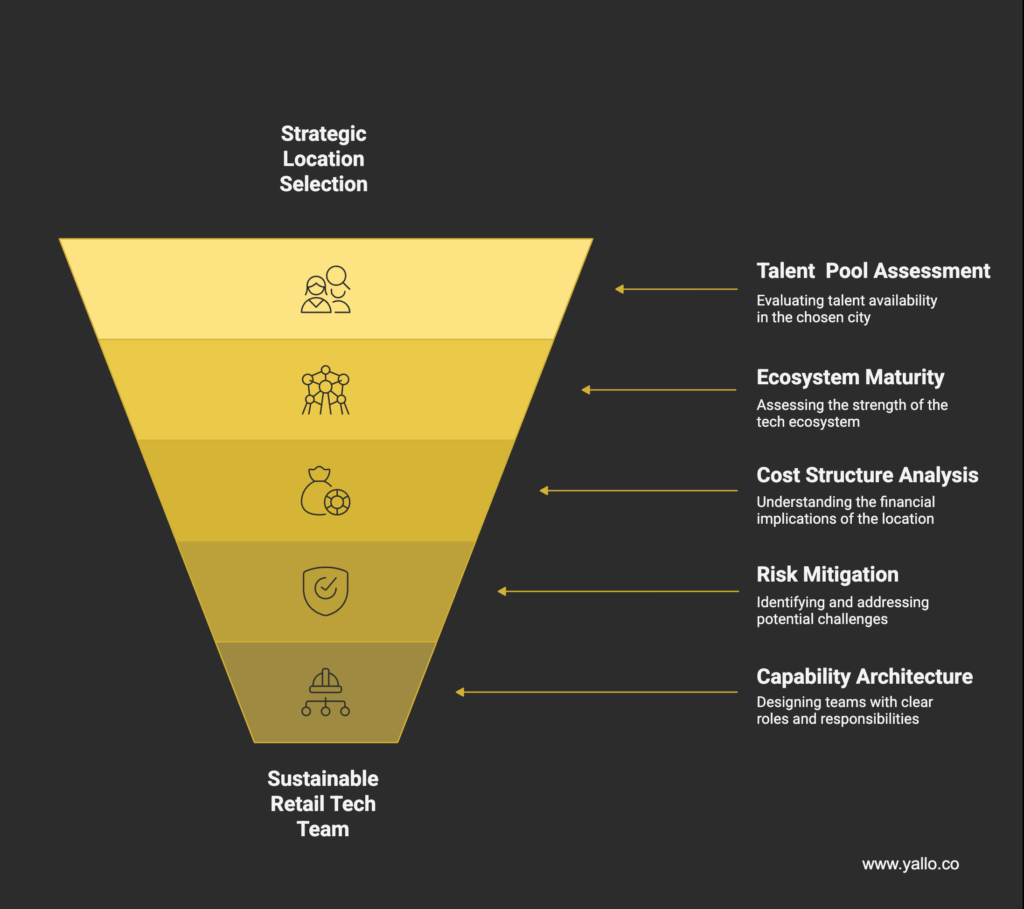
Strategic framework for building retail tech teams in India showing funnel model from location selection to sustainable retail tech team through talent pool assessment, ecosystem maturity, cost structure analysis, risk mitigation, and capability architecture
Strategic Location Selection Framework for Building Sustainable Retail Tech Teams in India

The decision to build retail tech teams in India should follow a structured progression from location evaluation to capability architecture, rather than focusing on cost or talent volume alone. When location strategy, ecosystem strength, cost structure, and capability design are evaluated sequentially, retail tech teams are more likely to scale sustainably rather than reactively.

The Hidden Risks When Scaling Retail Tech Teams in India

Why headcount growth does not guarantee delivery maturity

Once the location is selected, many organisations assume the hardest part of building retail tech teams is complete. In reality, the more difficult phase often begins after the first hiring wave. Rapid scaling across Bengaluru, Hyderabad, or Pune can create visible momentum, yet underlying execution capability may still be fragile. Retail environments demand tight integration between Salesforce, commerce platforms, ERP systems, data layers, and supply chain tools, supported by strong platform engineering discipline. When retail tech teams grow without adequate architectural depth, strain appears in integration, governance, and decision making rather than in coding capacity.

Recurring pressure points typically include:

  •  Unclear integration ownership between Salesforce and core enterprise systems
  •  Weak architectural governance across distributed product squads
  •  Overreliance on mid level engineers without senior oversight
  •  Fragmented delivery models involving multiple vendors
  •  Attrition at the point where domain knowledge becomes critical

The core issue is the gap between hiring volume and execution maturity. Teams may expand in size while remaining thin in architectural leadership and platform reliability, creating delivery delays that directly affect expansion timelines.

Designing a Specialist Tech Hiring Framework for Long-Term Stewardship

Selecting a city is only the starting point in building retail tech teams in India. The more decisive factor is how those teams are structured. Sustainable expansion depends on aligning workforce planning with platform ambition. When that alignment exists, location differences become manageable rather than risky.

Strong organisations prioritise capability sequencing over rapid hiring waves. Architectural leadership is secured early, integration ownership is clearly defined, and Salesforce roles are balanced across development, architecture, and governance. Platform engineering is designed to own reliability and cloud maturity from the outset rather than correcting gaps later.

In practical terms, sustainable design often includes:

  •  Early appointment of senior architects with cross platform accountability
  • Clear separation between product ownership and platform reliability ownershi
  •  Structured onboarding to reduce dependency on informal knowledge
  •  Blended sourcing to offset city specific talent constraints
  •  Workforce planning tied directly to platform roadmap milestones

Hybrid models are increasingly part of this equation. Combining onsite teams in Bengaluru or Hyderabad with nearshore or remote specialists can reduce concentration risk and stabilise critical capabilities such as Salesforce architecture or site reliability engineering

Across retail and enterprise programmes in the Middle East, the UK, and India, Yallo has observed that resilient retail tech teams are intentionally architected from the beginning. When hiring is architect led and directly aligned to delivery roadmaps, execution risk reduces. Location matters, but capability design ultimately determines whether expansion translates into sustained platform performance.

Recent Post

How We Serve

TS/EA as a Service

Empowering Business Transformation with Expert Technology Strategy

Talent in a Box

Scaling Innovation with World-Class Talent

Managed IT COE

Delivering Seamless IT Operations at Scale

Leave a Comment

Your email address will not be published. Required fields are marked *

Scroll to Top