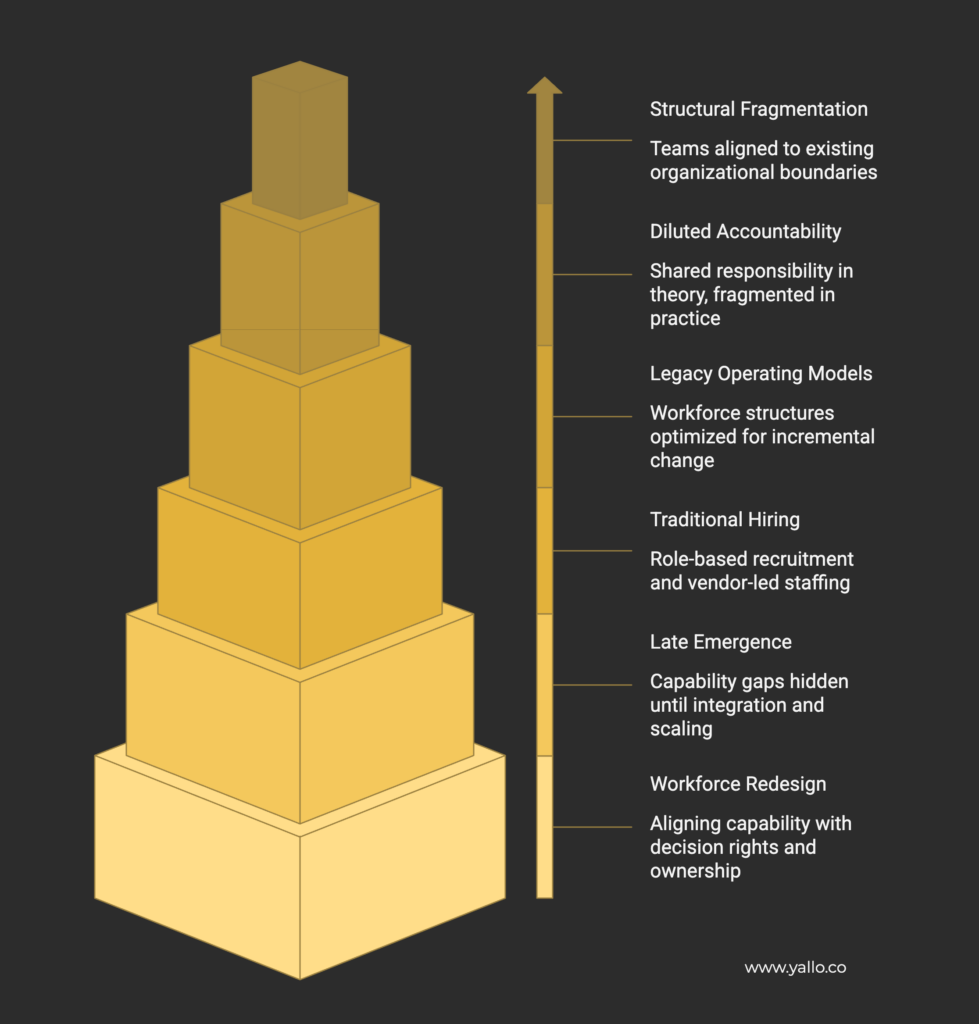
This visual illustrates how the digital banking talent bottleneck is not driven by a single failure, but by the accumulation of structural decisions over time. Teams are aligned to legacy organisational boundaries, accountability is shared in theory but fragmented in practice, and hiring continues to reinforce role-based models rather than outcome ownership. These layers mask capability gaps until programmes reach integration and scaling phases, at which point remediation becomes expensive and disruptive. Removing the bottleneck requires redesigning the workforce so that capability, authority, and ownership are deliberately aligned around delivery outcomes rather than inherited structures.
Several patterns consistently appear as this bottleneck forms:
Experienced individuals operating without clear outcome ownership
Delivery teams optimising locally rather than for system-wide coherence
Decision latency increasing as governance expands
Capability gaps emerging at the intersections between technology, risk, and operations
Over time, the organisation appears busy but struggles to move decisively. Progress is measured through activity rather than outcomes, masking the accumulation of delivery risk.