The Architecture Talent Shortage No One Is Talking About
Why the architecture talent shortage is eroding architectural authority and quietly increasing delivery risk across modern enterprises
January 06, 2026
5 mins Read
Insight
Why the architecture talent shortage is structural rather than numerical
How enterprises continue to staff architecture roles while quietly losing the authority, depth, and judgement required to govern complex systems at scale
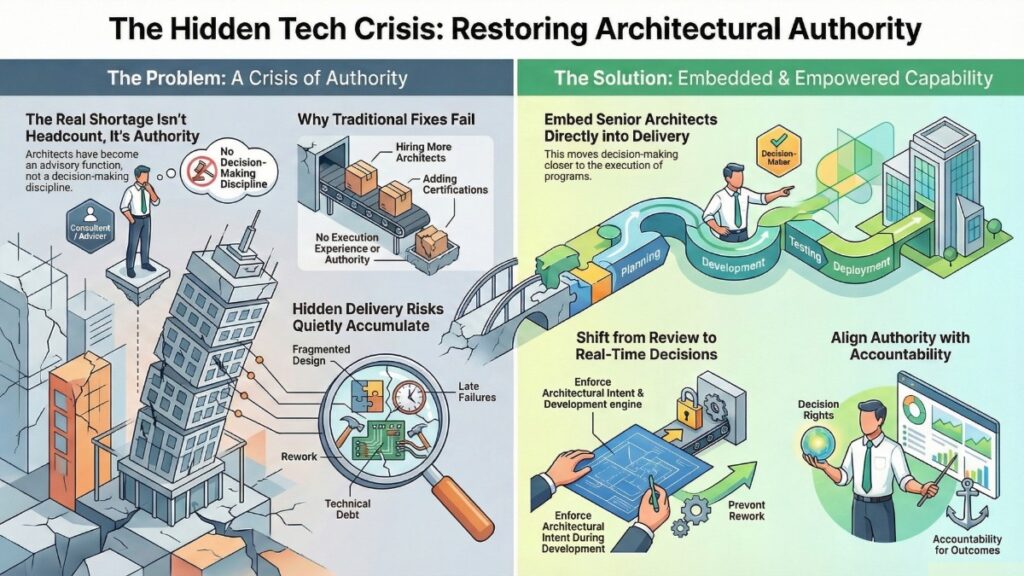
Most enterprises do not believe they have an architecture talent shortage because, on paper, the roles exist. Organisation charts show enterprise architects, solution architects, cloud architects, and domain specialists distributed across programmes and platforms. Yet despite this apparent coverage, delivery environments increasingly suffer from fragmented design decisions, excessive rework, brittle integrations, and governance processes that grow heavier as confidence declines. This disconnect exists because the architecture talent shortage is not about the absence of people with architectural titles, but about the erosion of architectural authority and capability where it actually matters.
As architecture functions have expanded, their influence has often diminished. Architects are frequently positioned as reviewers or advisors rather than decision owners, expected to align designs to standards without the mandate to resolve trade-offs under delivery pressure. This creates a gap between responsibility and authority, where architectural intent exists but is not enforced consistently.
Several patterns tend to surface in organisations experiencing this structural shortage:
Architects are involved late in delivery cycles, limiting their ability to influence outcomes
Design decisions are escalated into committees, diluting accountability
Architectural standards replace architectural judgement as a proxy for control
Delivery teams bypass architecture to maintain momentum under pressure
Over time, architecture becomes procedural rather than strategic. The organisation still “has architects,” but architecture no longer functions as a governing discipline capable of shaping complex systems. The true shortage is therefore not numerical, but the absence of senior architectural capability embedded close enough to delivery to make consequential decisions when they matter most.
How modern enterprise complexity has outpaced traditional architecture roles and career paths
Why the convergence of cloud, data, security, and platforms has expanded architectural responsibility faster than organisations have evolved their talent models
Enterprise architecture was originally designed for environments where systems evolved slowly, technology domains were loosely coupled, and decisions could be optimised within silos. That model no longer reflects reality. Today’s enterprises operate across cloud platforms, data ecosystems, security controls, and product-centric delivery models that are deeply interdependent. Architectural decisions now have immediate and often irreversible consequences across cost, risk, performance, and compliance.
Despite this, architecture roles and career paths have remained largely static. Architects are still developed as domain specialists, rewarded for depth within a single layer rather than fluency across the system. As complexity increases, these roles are stretched beyond their original design, expected to arbitrate trade-offs they were never trained or empowered to manage.
This misalignment manifests in several recurring ways:
Architects lack visibility into downstream cost and operational impact
Cross-domain decisions default to negotiation rather than informed judgement
Risk is managed through conservative design rather than intentional trade-offs
Architectural ownership fragments as complexity increases
Role-based teams fragment accountability and slow execution, while capability-based teams integrate authority and skills to reduce delivery risk and sustain momentum in Saudi enterprises.
The result is an environment where architectural responsibility grows without a corresponding increase in capability or authority. Architects are expected to manage complexity, but the organisation has not invested in evolving the role itself. The shortage that emerges is not of architectural knowledge, but of practitioners capable of exercising architectural judgement across domains under real delivery constraints.
Why underpowered architecture functions create hidden delivery risk long before programmes show visible signs of failure
How gaps in senior architectural capability quietly manifest as rework, integration fragility, and escalating governance overhead
When architectural capability is underpowered, delivery rarely fails in obvious or immediate ways. Programmes often appear to make progress, milestones are met, and issues are managed through escalation and workaround. However, beneath this surface momentum, design coherence begins to erode. Decisions are made tactically rather than systemically, integration complexity increases, and technical debt accumulates in places that are difficult to reverse. By the time failure becomes visible, the architectural choices that caused it are deeply embedded.
This is particularly dangerous in large, multi-stream programmes where architectural decisions propagate across teams and vendors. Without senior architects who have both the authority and experience to shape system-level trade-offs, delivery teams optimise locally, often in conflict with one another. Governance responds by adding more checkpoints and controls, which creates the appearance of risk management while actually slowing feedback and masking root causes.
Several early warning signs tend to emerge in organisations experiencing this form of hidden risk:
Architectural decisions are revisited repeatedly as delivery progresses
Integration issues surface late, often during testing or scale-up
Governance overhead increases without a corresponding reduction in incidents
Delivery teams rely on exceptions rather than stable design patterns
Over time, these conditions erode confidence at both the delivery and leadership levels. Programmes become harder to steer, estimates lose credibility, and risk tolerance narrows. The architecture function is often blamed for being bureaucratic, when in reality it has been deprived of the authority and capability required to prevent these issues from arising in the first place.
Why traditional hiring and certification driven approaches are failing to address the real architecture talent shortage
In response to architectural challenges, many organisations default to hiring more architects or investing in certifications, assuming that additional credentials will translate into stronger architectural control. In practice, these approaches rarely address the underlying problem. Certifications validate familiarity with tools and frameworks, but they do not develop the judgement required to navigate trade-offs under real delivery pressure. Similarly, hiring into narrowly defined architecture roles often reinforces silos rather than resolving them.
Traditional hiring models tend to prioritise domain expertise over execution experience. Architects are evaluated on their ability to describe patterns and standards, not on their track record of making difficult decisions in complex, high-risk environments. As a result, organisations accumulate architectural knowledge without building architectural authority. The gap between what architects know and what they are empowered to decide continues to widen.
This failure mode is reinforced by several structural habits:
Hiring criteria focus on certifications rather than delivery outcomes
Architects are positioned as advisors rather than accountable decision-makers
Ownership of architecture is split across domains with no system-level authority
Architectural effectiveness is measured by compliance, not by delivery quality
Until organisations move beyond these patterns, the architecture talent shortage will persist regardless of hiring volume. The issue is not access to architectural knowledge, but the absence of models that develop, empower, and retain architects who can govern complex systems in practice. Without addressing this structural gap, enterprises will continue to experience delivery risk that no amount of additional tooling or certification can resolve.
Why restoring architectural authority now requires a capability led approach rather than incremental fixes
In these models, architecture is no longer positioned as an oversight function that intervenes periodically, but as a core delivery capability that shapes trade-offs continuously. Senior architects operate close to programmes, not as reviewers, but as accountable decision-makers whose judgement spans cloud, data, security, and integration concerns. This proximity allows architectural intent to be enforced in real time, reducing rework and preventing risk from accumulating invisibly.
Insights and case studies observed by Yallo across large-scale delivery environments reinforce this pattern. Where architect-vetted, execution-experienced capability is embedded into active programmes, organisations see measurable reductions in delivery friction, fewer late-stage design reversals, and improved confidence among both engineering and leadership teams. The improvement does not come from heavier governance, but from better decisions being made earlier by people empowered to make them.
Ultimately, the architecture talent shortage no one is talking about is a shortage of authority, not awareness. Enterprises already understand that architecture matters, but many have allowed the role to drift away from execution in the name of speed or flexibility. Reversing this trend requires deliberate workforce design choices that place architectural capability back where it belongs, at the centre of delivery, with the mandate to govern complexity before it becomes risk.
Newsletter
Get the latest updates and insights delivered to your inbox.