Why Saudi Arabia Is Becoming the New Global Magnet for AI Talent
A data-backed analysis of how Saudi Arabia’s investments, infrastructure, national strategy, and global talent policies are positioning the Kingdom as the world’s next hub for AI innovation and advanced technical capability.
December 15, 2025
5 mins Read
Insight
The Economic Forces Turning Saudi Arabia Into a Global Destination for AI Specialists
Understanding the scale, speed, and strategic intent behind the Kingdom’s AI-driven economic transformation.
Saudi Arabia is emerging as one of the world’s most attractive destinations for AI professionals due to the scale, urgency, and long-term nature of its economic transformation. Vision 2030 positions artificial intelligence as a national priority, and this has triggered a level of investment, infrastructure development, and regulatory support that is uncommon globally. Mega-projects such as NEOM, Red Sea Global, and Qiddiya rely on AI-driven planning, simulation, automation, and digital twins, creating an environment where AI specialists can work on problems that do not exist anywhere else at comparable scale.
The Kingdom’s strategic advantage is the combination of ambitious national goals, deep capital reserves, and a willingness to build AI capability into every major sector from smart cities and logistics to energy, healthcare, and financial services. This creates a workforce environment where demand for Saudi AI talent consistently outpaces supply. Global engineers, product specialists, researchers, and applied scientists are drawn to a market where they can accelerate their careers, lead high-impact teams, and work on next-generation infrastructure. Saudi is not only competing for AI talent it is reshaping the global map of where AI professionals choose to build long-term careers.
How Massive Investment in AI Infrastructure and Cloud Capacity Fuels Saudi’s Talent Attraction
How Massive Investment in AI Infrastructure and Cloud Capacity Fuels Saudi’s Talent Attraction
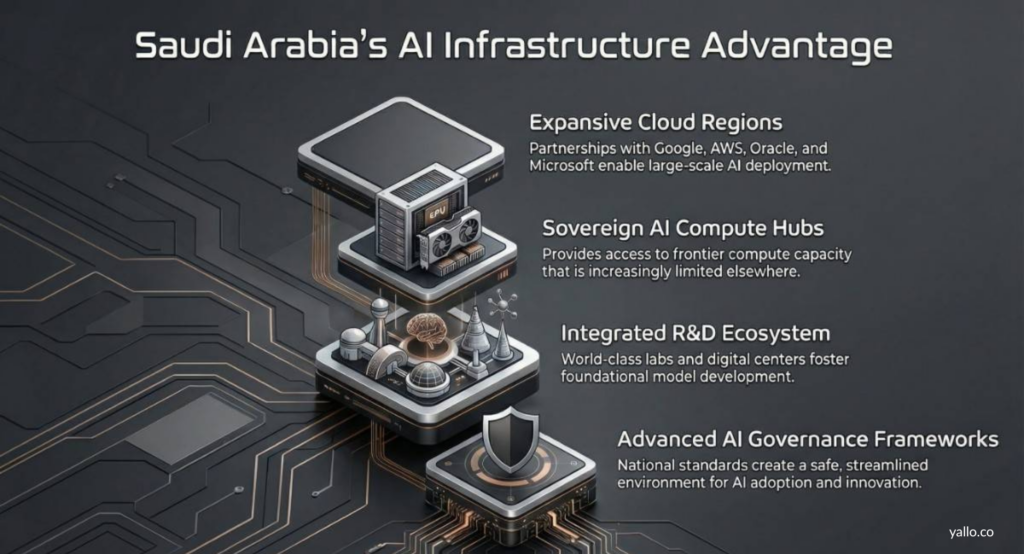
Saudi Arabia has built one of the most aggressive AI infrastructure strategies globally. The Kingdom is investing simultaneously in cloud regions, national AI compute, sovereign data platforms, model training environments, and R&D facilities. This ecosystem is redefining where AI talent chooses to work, because specialists are attracted to environments where they can build and deploy at scale.
Access to frontier compute: Many global engineers leave markets with compute scarcity to join KSA’s rapidly expanding facilities.
Role elevation: Talent can step into leadership and architecture positions more quickly than in saturated US/EU markets.
Greenfield engineering: Engineers prefer ecosystems where they are not constrained by legacy systems.
Saudi’s AI ecosystem is therefore not just competitive — it is structurally appealing for global talent seeking impact, scale, and influence.
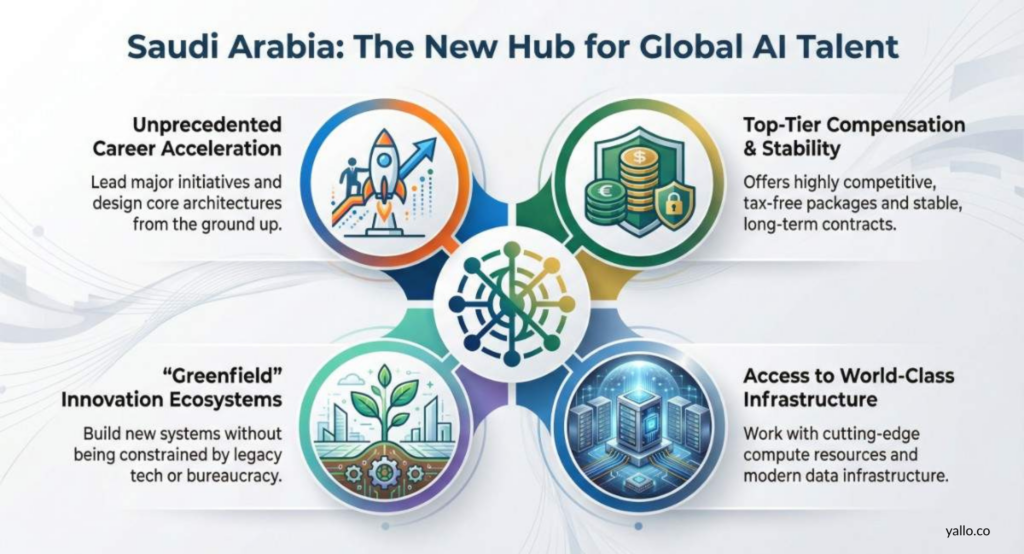
Saudi Arabia continues to consolidate its position as a global AI talent destination by offering career acceleration, high compensation, innovation-focused greenfield projects, and advanced technical infrastructure.
These factors highlight why global AI professionals increasingly view Saudi Arabia as a long-term career destination rather than a short-term assignment. The Kingdom’s model fundamentally differs from Silicon Valley, Europe, and Singapore because it allows talent to build core architectures, influence national-scale platforms, and lead frontier innovation without legacy constraints. This unique combination reshapes global mobility trends and positions Saudi Arabia as a primary hub for advanced AI capability.
Why Global AI Engineers, Researchers, and Product Teams Are Relocating to Saudi Arabia
Compensation, career opportunity, mega-projects, and leadership roles creating unprecedented pull factors.
Saudi Arabia has become one of the most attractive destinations for global AI professionals because it offers something that mature markets rarely can: scale, autonomy, and accelerated career progression. AI specialists who join the Kingdom’s public-sector programs, mega-projects, or digital-first enterprises gain access to environments where they can design core architectures rather than maintain legacy systems. Senior engineers, AI architects, MLOps leaders, and applied researchers often find themselves leading initiatives that shape entire sectors — from autonomous mobility to smart city operations to national digital platforms.
Compensation is also a major draw. Saudi Arabia offers highly competitive, tax-free packages that rival or exceed those in the US and Europe. But beyond salary, global talent is attracted by the promise of working in greenfield environments, where AI is not constrained by technical debt or slow-moving bureaucracy. A data scientist joining KAUST, Aramco Digital, or NEOM’s tech division can work with cutting-edge compute resources, modern data infrastructure, and leadership that is actively encouraging rapid experimentation. This creates a uniquely empowering environment for Saudi AI talent — whether local or international — who want to work at the frontier of applied AI, multi-agent systems, robotics, or digital twins at city scale.
Culturally, Saudi Arabia is also becoming more accommodating for international talent. With global hiring programs, streamlined relocation initiatives, and English-first engineering environments, the Kingdom has significantly reduced friction for senior AI professionals looking to move. Combined with long-term contracts, stable growth, and world-class research institutions, this ecosystem positions Saudi Arabia as one of the world’s fastest-growing magnets for AI capability.
Saudi Arabia’s AI infrastructure advantage is powered by expansive cloud regions, sovereign compute hubs, integrated R&D ecosystems, and robust national governance frameworks that accelerate enterprise adoption.
This shift shows that AI agents do not eliminate roles; they redistribute responsibility across systems, raising the capability threshold for engineering and product teams. Instead of focusing on execution alone, teams now require fluency in supervision, orchestration, and strategic oversight marking a profound evolution in the architecture of technical work.
What the Rise of Saudi AI Talent Means for Future Workforce Architecture Across the GCC
Saudi Arabia’s AI momentum is not isolated, it sets a precedent for workforce transformation across the entire GCC. As AI agents, foundation models, and autonomous systems become integrated into national infrastructure, the demand for multi-disciplinary talent will rise across engineering, product, cybersecurity, data strategy, and AI governance. The future workforce architecture will require capabilities that go beyond traditional job roles: system thinking, model lifecycle management, AI risk literacy, and human AI collaboration.
GCC enterprises will need to redesign how teams are structured. Instead of hiring by title, organisations must hire by capability clusters, AI orchestration, data reliability, agent supervision, and AI-powered workflow design. Traditional role boundaries will blur as AI systems take on more decision-making responsibility. Product teams will need engineers who understand AI constraints; engineering teams will need product thinkers who understand user behaviour; and operations teams will need specialists who can monitor agent performance and intervene intelligently. This shift toward capability-first workforce design is already visible in Saudi Arabia and will quickly influence neighbouring markets such as the UAE, Qatar, and Oman.
Organisations that fail to adapt risk facing chronic skill shortages, delayed digital programs, and dependency on external vendors. Those that embrace this new workforce architecture will build sustainable internal capability and gain a decisive competitive advantage. As the region grows into a global AI corridor, the need for structured talent systems built around continuous learning, specialist deployment, and cross-functional capability will define which enterprises lead and which fall behind.
How Organisations Can Build the AI Capability Needed to Compete in Saudi Arabia’s Emerging Talent Landscape
As Saudi Arabia grows into a global hub for AI capability, enterprises across the region will need more than recruitment strategies to stay competitive. AI-driven environments demand talent that can operate across architecture, engineering, data, and governance layers simultaneously. They require teams that understand how AI agents behave, how multi-agent workflows scale, how model risks are managed, and how autonomous systems are integrated into real-world operations. This shift cannot be addressed through traditional hiring alone. It requires organisations to build capability systems that combine specialist talent, advanced screening, continuous skill development, and strategic workforce design.
Yallo supports this transition by helping enterprises build AI-ready teams with precision and speed. Our model is centred on architect-led evaluation, ensuring that specialists in AI, cloud, data engineering, cybersecurity, platform operations, ERP, and DevOps are assessed based on real capability—not keyword-driven CV matching. This approach gives organisations immediate access to the technical depth required for high-stakes AI programmes, while also reinforcing long-term capability across engineering and product functions. Through Insights, we track emerging AI skill patterns, capability gaps, and workforce risks shaping the GCC landscape. Our Case Studies demonstrate how targeted deployment of specialist talent accelerates delivery, strengthens architectural quality, reduces programme risk, and enables organisations to execute confidently within AI-intensive environments.
As Saudi Arabia accelerates its national AI agenda, capability, not headcount, will determine which organisations lead and which fall behind. By integrating specialist talent with structured capability design, Yallo enables enterprises to operate at the level of maturity required for the next generation of AI adoption. The organisations that invest early in capability-building will be the ones positioned to take advantage of Saudi Arabia’s rise as a global AI talent magnet.
Newsletter
Get the latest updates and insights delivered to your inbox.